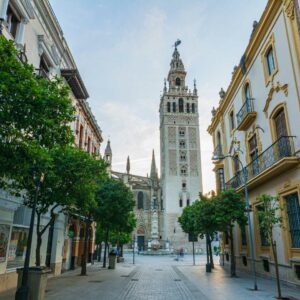
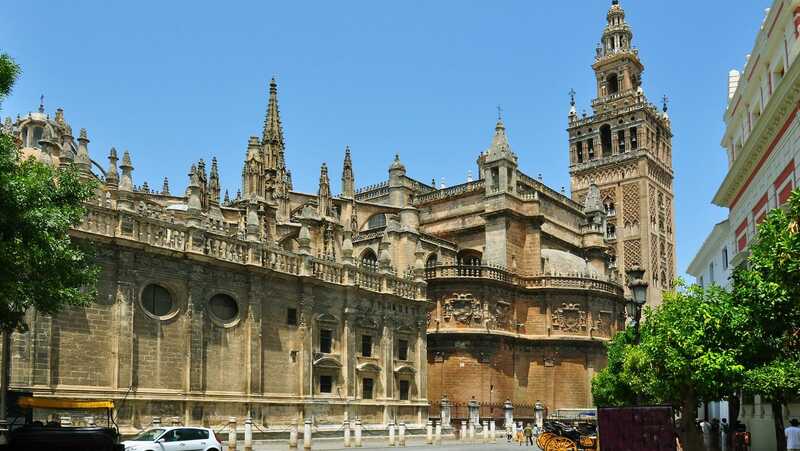
The Giralda is the tower that can be seen from almost anywhere in Seville and is the city’s most recognisable landmark, but it is worth clarifying exactly what it is: it is not a standalone monument, but rather the bell tower of Seville Cathedral. Its lower section was the minaret of the old 12th-century Almohad mosque, and following the Christian conquest, a bell tower was added in the 16th century. Hence its distinctive silhouette, half Islamic and half Renaissance.
As it forms part of the cathedral complex, you can visit it with the same ticket as for the Cathedral and access it from inside. If you’d like to visit it without having to worry about transport or bookings from the Costa del Sol, you can do so with a a day trip to Seville including admission to the Cathedral and the Giralda one day.
If you wish, you can enjoy an incredible walk with a guided tour of Seville.
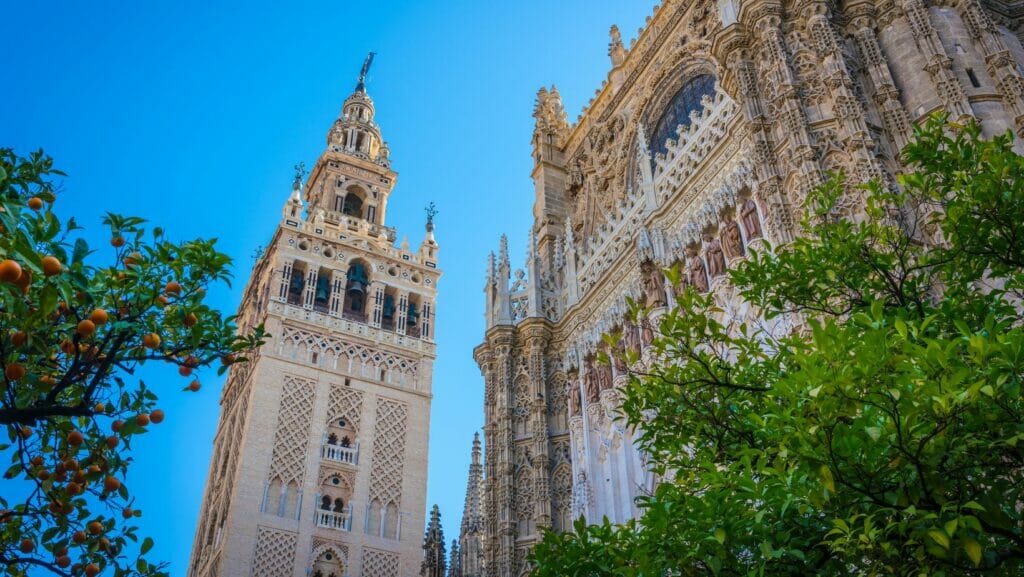
The Giralda was built as a minaret for the Great Almohad Mosque in Seville, when the city was the administrative capital of al-Andalus. The mosque was begun in 1172 Caliph Abu Yaqub Yusuf, and he was his son Abu Yusuf Ya'qub who ordered the minaret to be built in 1184.
The brick structure that makes up most of the tower dates from that period and is decorated with sebka cloths, the diamond-shaped patterns characteristic of Almohad architecture. It is a sister building to the Kutubiya, Marrakesh and of the Hassan Tower in Rabat, built by the same builders.
Following the Christian conquest of the city in 1248, the mosque was consecrated as a cathedral and the tower was retained for use as a bell tower. In the XVIth century, the architect Hernán Ruiz II, also known as ‘the Younger’, added the bell tower and the spire that we see today, incorporating Renaissance elements into the Almohad base and crowning it with the Giraldillo.
This is easy to see from the street: the lower section, built of brick and with a solid appearance, corresponds to the original minaret; above a certain height, the material and the rhythm of the openings change, indicating the Christian addition. The tower reaches a height of nearly one hundred metres high and its bell tower features 24 bells. In its day, it was one of the tallest minarets in the Islamic world.
Of the original mosque complex, only the Giralda itself and the Orange Tree Courtyard. The interior of the tower reflects the austerity of the Almohad style: there is hardly any ornamentation, just the bare volume of the brickwork.
At the very top is the Giraldillo, a bronze sculpture that acts as a weather vane and gives the Giralda its name. It depicts the Triumph of Faith and it holds a banner that flutters in the wind, hence its name. It was installed in the 16th century as the finial of the bell tower and is over three metres tall.
The figure that now tops the tower is a replica: the original Giraldillo has been restored and is kept in storage. Despite its size and weight, it is designed to move easily and indicate the direction of the wind, making it one of the largest surviving monumental weather vanes.
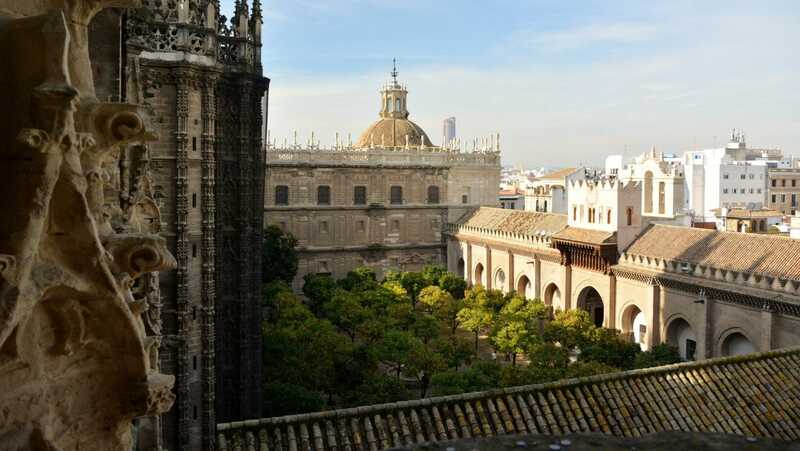
The most distinctive thing about going up the Giralda is that It isn’t done via stairs, but via 35 ramps. According to tradition, they were designed in this way so that one could ride a horse right to the top of the minaret, and they are the same ones used today. This makes the climb considerably easier than one might expect for a tower of this height; only the final section, once inside the bell chamber, consists of a few steps.
The bell tower offers the best panoramic view of the historic centre: the cathedral’s roofs at your feet, the Royal Alcazar and its gardens, the Torre del Oro, the Guadalquivir and the neighbourhood of Triana on the other side, with the Plaza de España looking southwards.
The viewing platform is small and visitor numbers are limited, so at busy times you may have to queue to take a look from either side. Go up first thing in the morning or late in the afternoon It usually makes for a more peaceful experience and provides better light for photos.
The Giralda is open to visitors inside the cathedral grounds and shares the same opening hours, entrance and access as the cathedral, so there is no separate ticket to go up the tower. The climb starts from inside the cathedral, once you’re inside.
There are strips of free admission Capacity is limited and advance booking is required, but opening times, prices and operating days vary depending on the season, so it is best to check the latest information on the the cathedral’s official website before your visit. During peak season, it’s a good idea to buy your ticket in advance, as the tower has limited capacity and queues can get long.
A practical tip: access to the climb closes a little before the Cathedral does, so that the tower can be cleared at the end of the day. If you’re short on time or would rather not have to sort out bookings yourself, an organised tour takes care of both your ticket and access in one go.
A common question is whether the Giralda and the Cathedral are one and the same. Not exactly: the Cathedral is the cathedral, the largest Gothic cathedral in the world, and the Giralda is its bell tower. Together they form a single monumental complex, which has been declared Designated a UNESCO World Heritage Site in 1987 next to the Real Alcázar and the Archivo de Indias, and can be visited as part of the same tour.
Inside the temple, there are other features that are well worth seeing: the Orange Tree Courtyard, the High Altarpiece —the world’s largest Gothic altarpiece—, the Choir, the chapels, with the Royal Chapel on the front page, and the front covers, including the Puerta del Príncipe and the Gate of Forgiveness.
And a must-see: the the tomb of Christopher Columbus, in the nave next to the Puerta del Príncipe, with the coffin held aloft by four heralds representing the kingdoms of Castile, León, Aragon and Navarre. In the Royal Chapel, meanwhile, lie the remains of Fernando III, Alfonso X y Beatrice of Swabia.
The combined visit takes between an hour and a half and two hours, including the interior and the climb up the tower. You can find more information in our guide to Seville Cathedral, and if you’re going to spend the day in the city, the obvious thing to do is to combine it with the Royal Alcazar, which is opposite.
The Giralda is in the heart of the historic centre, so it fits in well with the other sights in the city centre:
To plan your whole day, you can consult our guide to must-see places in Seville or that of What to see in Seville in a day.
If you’re coming from Málaga or the Costa del Sol and want to make the most of the day, here are the available day trips, which include transport, a tour guide and, depending on the option chosen, admission to the Cathedral and the Giralda or the Real Alcázar:
The Giralda is famous because it was the minaret of the ancient 12th-century Almohad mosque and, following the Christian conquest, became the bell tower of Seville Cathedral. This blend of Islamic and Renaissance architecture, together with its height of almost one hundred metres and its silhouette, has made it the symbol of the city.
Inside the Giralda there are no rooms or museum, but rather a series of 35 ramps leading up to the bell chamber. They were built in this way so that people could ride up on horseback during the Almohad period, and today they provide access to the belfry and the upper viewing platform. The interior is very austere, in keeping with the principles of the Almohad movement.
At the top stands the Giraldillo, a bronze sculpture that acts as a weather vane and gives the tower its name. It represents the Triumph of Faith, measures over three metres in height, holds a banner that turns in the wind, and crowns the bell chamber added in the 16th century. The piece on display today is a replica: the original is kept safe following its restoration.
Yes. The ascent is via 35 ramps rather than stairs, which makes it quite manageable, and access is included in the admission ticket to Seville Cathedral, from inside which the climb begins. It’s advisable to book in advance during peak season due to limited capacity, and bear in mind that access to the tower closes earlier than the cathedral itself.
Christopher Columbus’s tomb is in the nave of the Cathedral, next to the Puerta del Príncipe, with the coffin held aloft by four heralds representing the kingdoms of Castile, León, Aragon and Navarre. It is not in the Royal Chapel, where the remains of Ferdinand III, Alfonso X and Beatrice of Swabia rest.