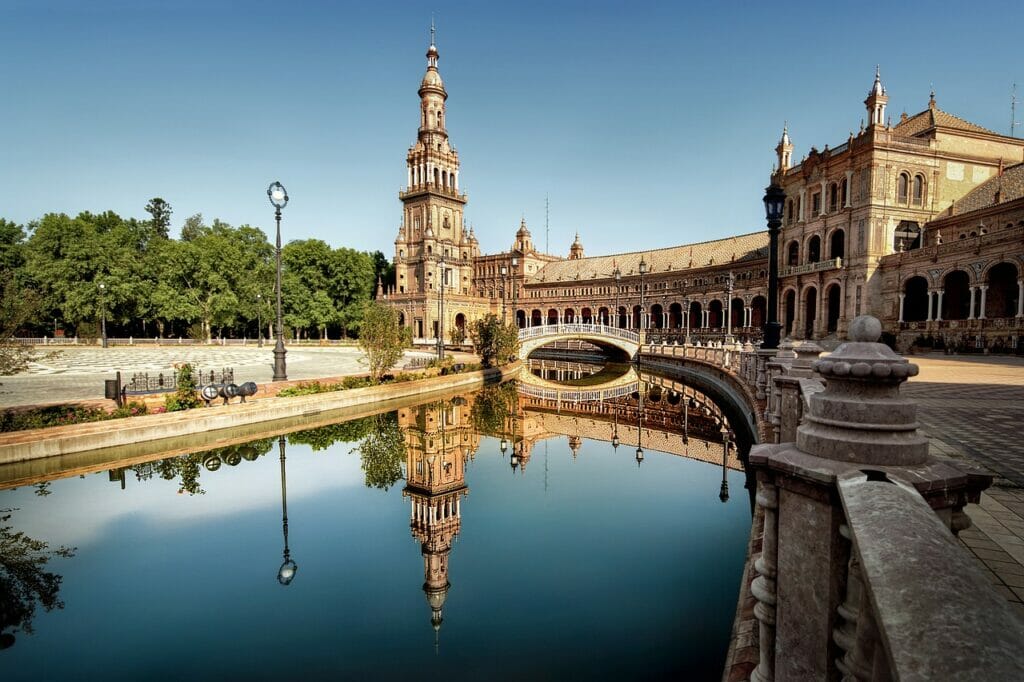
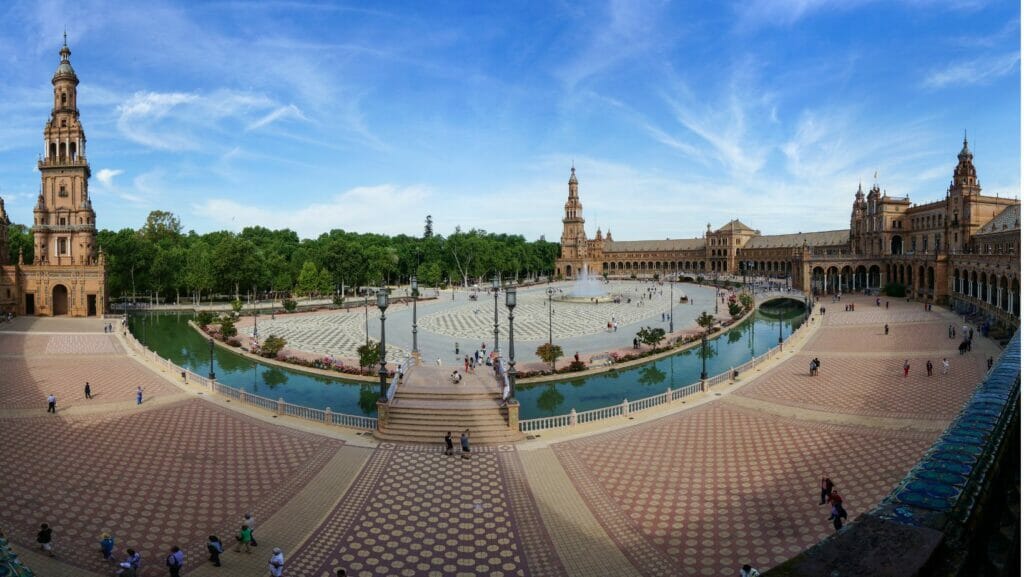
If you’re wondering what to see at the Plaza de España in Seville, the answer lies in a single monumental complex: a large semi-circular building surrounded by a navigable canal, four tiled bridges and a series of benches dedicated to the provinces of Spain. It is situated within the Maria Luisa Park, a short distance from the historic centre, and was built for the 1929 Ibero-American Exhibition.
It is one of the most photographed spots in Seville and, as it is open to the public free of charge, it fits in well with any itinerary. In this guide, we look at its history, what to do during your visit, the interesting facts that have made it famous in films, and practical information on opening hours and how to get there.
If you’d like to visit the Plaza de España, book a day trip to Seville from Málaga
Plaza de España was conceived as the centrepiece of the 1929 Ibero-American Exhibition, through which Seville sought to strengthen its ties with Latin America and modernise the entire southern part of the city. Work began in 1914 and continued for more than a decade, eventually becoming the most expensive structure at the entire Exhibition.
The project was commissioned to the architect Aníbal González, the leading figure of Andalusian regionalism, who fused Mudejar architecture with Renaissance, Gothic and Baroque influences, all reinterpreted using Sevillian materials and craftsmanship: exposed brick, ceramics, marble and wrought iron. González personally oversaw the artisanal details, from the design of the tiles to the forging of the balustrades, during a period of revival in Sevillian ceramics that can still be seen in many corners of the city.
The complex covers an area of approximately 50,000 square metres and its semi-circular layout, opening out onto the park, was interpreted as a warm greeting from Spain to its former overseas territories. In the foreground runs a canal spanned by four bridges representing the ancient kingdoms of the peninsula, and in the centre stands a large fountain that is often associated with the Guadalquivir, the river that flows through the city.
Following the Exhibition, the building was converted into the headquarters of administrative and military bodies, a function it still serves today. This explains why it has been preserved in good condition and why its interior is not open to visitors as a museum: the main attraction lies in exploring the square, the porticoes and the open space surrounding it.
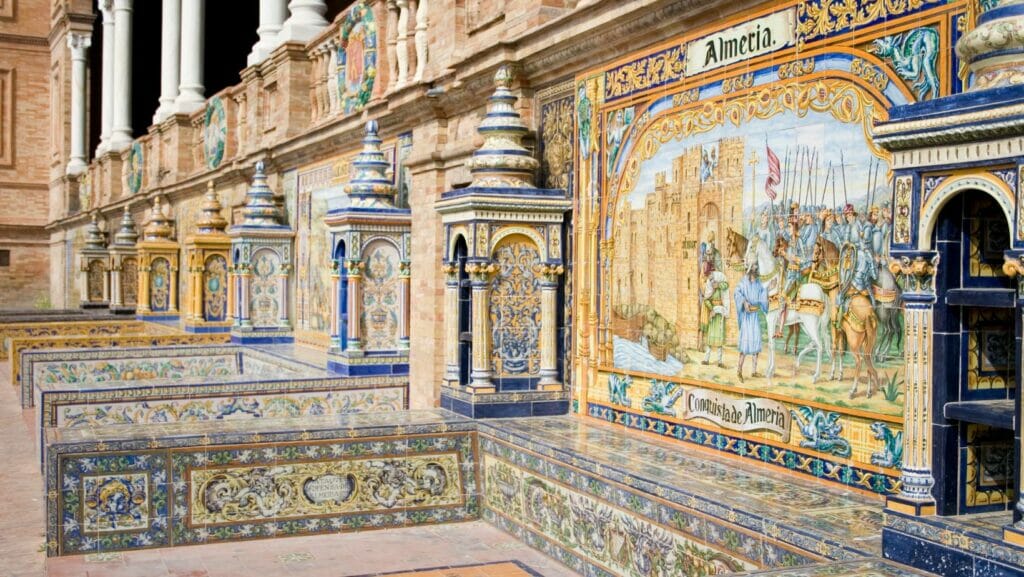
The visit consists, above all, of strolling around and taking in the details. The building is flanked by two towers at either end, north and south, and between them runs a colonnaded gallery topped by a balustrade, which you can walk along to view the square from above. These are the things you shouldn’t miss:
It’s a good idea to set aside some time for a leisurely walk and choose the right time of day: the light of late afternoon It is the one that best brings out the colours of the brickwork and the tiles. During the hot months, the shade provided by the arcades and the park’s proximity make it a pleasant place to stop at any time of day.
Don’t miss out on the chance to discover the main attractions of Seville’s Plaza de España on a fantastic day trip from Málaga.
This is the most surprising detail. Spain has fifty provinces, but in the square there are only 48 banks. There are two reasons.
The first is Seville: it doesn’t have its own stand because it’s the host city, and in a way the whole square is a tribute to it. The second are the Canary Islands: when the complex was designed, the archipelago was a single province, and its division into Las Palmas and Santa Cruz de Tenerife came later, in 1927, when the building work was already well advanced. That is why it is depicted as a single entity.
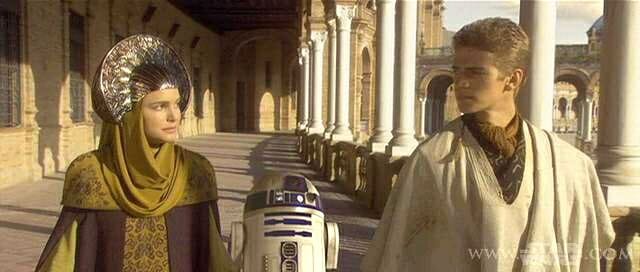
The square’s monumental setting has captured the attention of the film industry for decades. The appearance best known to today’s audience is that of Star Wars: Episode II — Attack of the Clones, where the building served as the backdrop for the scenes in Theed, the capital of the planet Naboo. Many visitors recognise the place precisely because of those images.
Long before that, the classic Lawrence of Arabia It had already been used, transformed into the British headquarters in Cairo. This ability to portray very different locations with hardly any sets explains why national and international production companies have returned to it on several occasions.
The building’s orientation was designed to provide shelter from the afternoon sun. The complex was built using hundreds of thousands of bricks and ceramic tiles manufactured locally. And the symmetry is no accident: the two towers, the side pavilions and the rhythmic succession of arches are designed to draw the eye towards the centre of the square.
If you wish, you can enjoy an incredible walk with a guided tour of Seville.
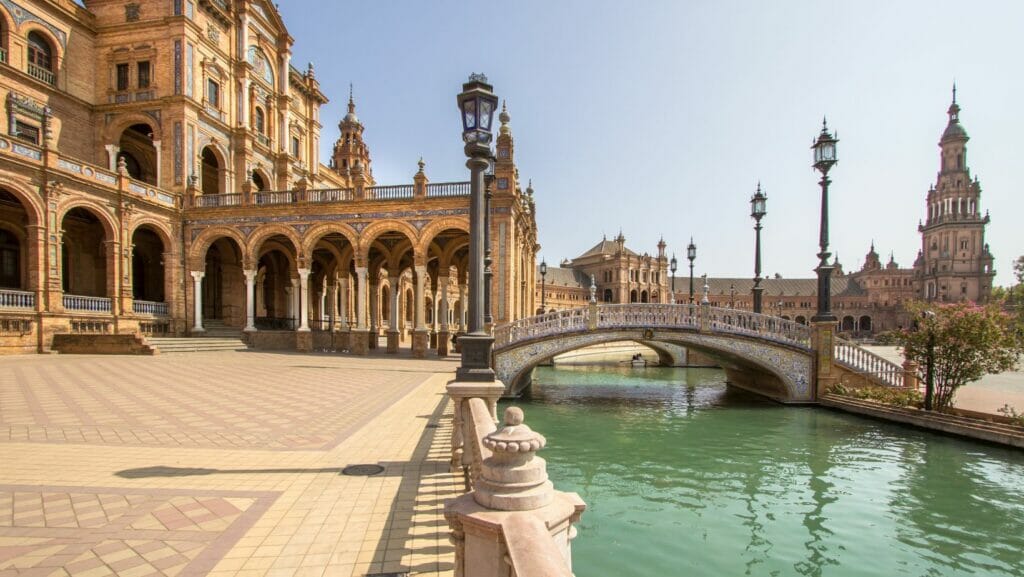
Plaza de España is a outdoor public space part of María Luisa Park, so There are no set opening or closing times, and entry is free. It doesn’t operate like a monument with a ticket office: you can wander around it, cross the bridges and see the benches at any time of day without needing a ticket or booking.
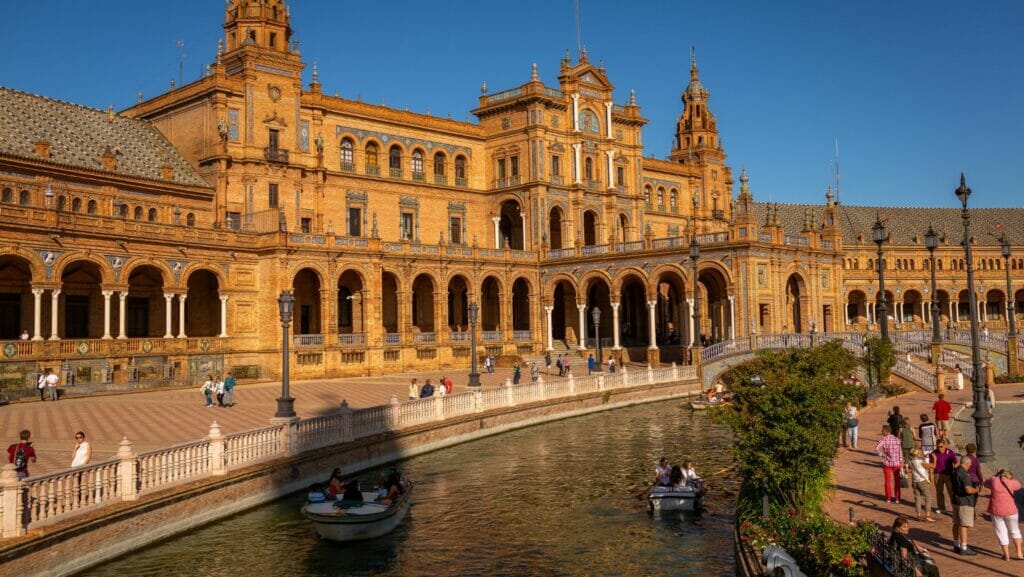
The only thing that has its own timetable and price is the boat hire. They are usually available all year round in the mornings and afternoons, approximately from 10.00 to 20.00, and the price varies depending on the duration of the trip and the number of passengers, generally ranging from 6 to 25 euros.
The service is subject to availability and may be suspended due to weather conditions, so if you’re planning to take a boat, it’s a good idea to check the latest timetables and prices before you go.
The square is next to María Luisa Park, at the southern end of Seville city centre, which means it is within easy walking distance of the main monuments.
Given its location, it fits naturally at the end of a tour of the historic centre: you walk down from the Cathedral towards the park and round off the day in the square, making the most of the best light of the afternoon. Those visiting on a day trip from the Costa del Sol tend to save it for this time of day, when the atmosphere is more peaceful.
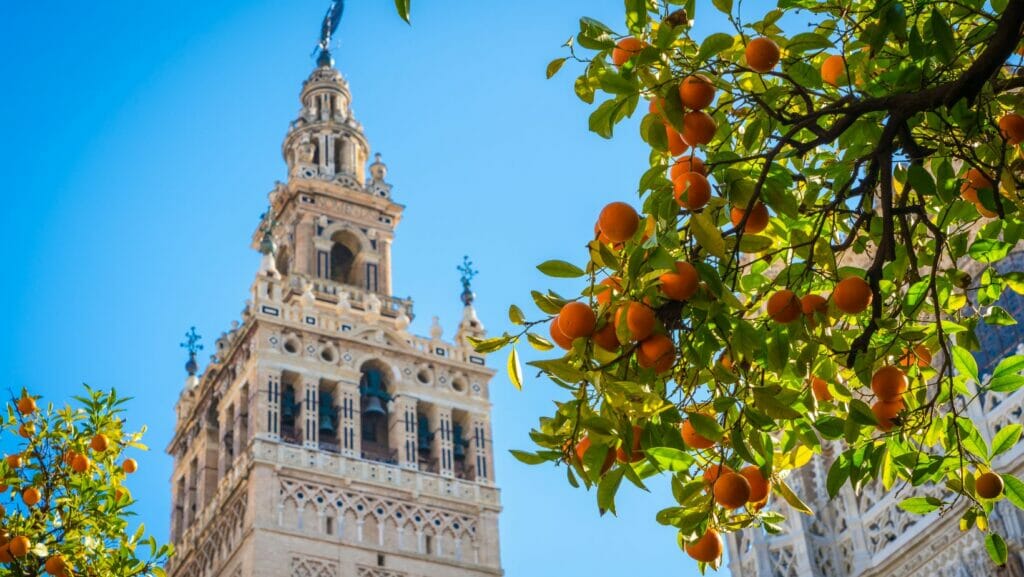
The great thing about the square is that it’s surrounded by sights that can be visited one after the other with ease:
To plan your entire itinerary, please see our guide to must-see places in Seville.
In the Plaza de España, you can see its large, semi-circular building in the regionalist style, the canal – some five hundred metres long – which you can travel along by boat, and the four bridges that span it. The most recognisable feature is the row of tiled benches dedicated to each Spanish province, arranged in alphabetical order. The two towers at either end, the central fountain and the ceramic paving complete the ensemble.
There are 48 banks, although Spain has 50 provinces. Seville does not have its own bank as it is the host city for the Ibero-American Exposition, and the Canary Islands are shown as a single province because their division into Las Palmas and Santa Cruz de Tenerife took place in 1927, by which time the map had already been finalised.
No, entry is free and there are no set opening or closing times, as it is an open-air public space within María Luisa Park. You only pay for specific services, such as hiring the boats that travel along the canal. Strolling through the square, crossing its bridges and viewing the provincial benches is free of charge.
Plaza de España is next to María Luisa Park, about a 15- to 20-minute walk from the Cathedral and the historic centre. By public transport, the nearest underground station is Prado de San Sebastián, on line 1, where the Metrocentro tram also stops, and several Tussam bus routes stop in the vicinity of the park.
The best-known examples are *Star Wars: Episode II – Attack of the Clones*, in which the square represents Theed, the capital of the planet Naboo, and *Lawrence of Arabia*, which used it as a backdrop for Cairo. Its monumental setting has made it a regular filming location for national and international productions.