Go up

What to see in Seville: 15 must-sees

Table of contents

Seville Within its compact historic centre, it is home to the world’s largest Gothic cathedral, Europe’s oldest royal palace still in use, and neighbourhoods that can be explored on foot in a matter of minutes.

These are The 15 must-haves, including opening times, prices and a one-day itinerary if you’re coming from the Costa del Sol.

First of all: two tours are closed on Mondays

Plan your day bearing this in mind:

  • The Archivo de Indias is closed on Mondays, and it’s open the rest of the week only until 4.30 pm.
  • The Museum of Fine Arts is closed on Mondays y It’s only open in the mornings, until 2.30 pm.

Both are free, or almost free, so missing them because of the timing is a shame that can be avoided.

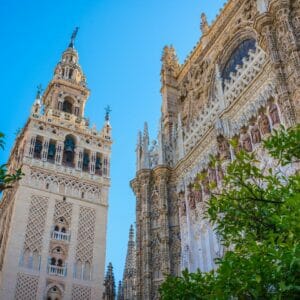
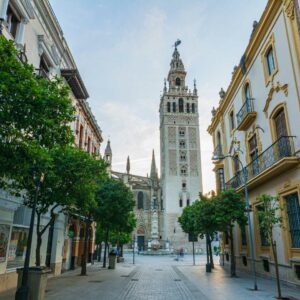
Seville Cathedral and the Giralda, seen from the street
The Cathedral and the Giralda: the starting point for any visit.

1. The Cathedral and the Giralda

The the world’s largest Gothic cathedral, built between the 15th and 16th centuries on the site of the former mosque. Inside are the the tomb of Christopher Columbus, the high altarpiece — the largest in Christendom — and the Royal Chapel.

The Giralda is accessed via the same entrance, and it has a detail that surprises everyone: You go up via ramps, not stairs, because they were designed to allow people to climb up to the top when it was the Almohad minaret. There are 34 steps, and the view from the top is the best in the city centre.

Buy your ticket online: the queue at the ticket office is one of the worst in Andalusia. More at Seville Cathedral y the Giralda.

2. The Royal Alcázar

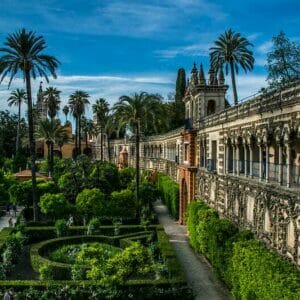
Courtyard of the Real Alcázar in Seville with Mudejar arches

A hundred metres from the cathedral, the the oldest royal palace still in use in Europe: the royal family still stays here. A blend of Mudéjar, Gothic and Renaissance styles, with the Courtyard of the Maidens with a central feature and vast gardens.

Book a date and time in advance, because tickets sell out every day. Work out an hour and a half or two hours with the gardens.

If it rings a bell, it’s because Dorne was filmed here in Game of Thrones. You talk about it in Game of Thrones in Seville, and a detailed look at the Royal Alcázar.

3. The Plaza de España

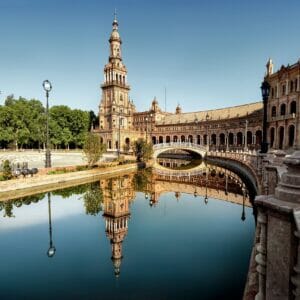
Plaza de España in Seville, with its canal and tiled bridges

Built for the 1929 Ibero-American Exhibition, is the most photographed spot in the city and Admission is free.

Search tile benches: there’s one in every Spanish province, listed in alphabetical order, and people take a photo at the one in their own province. You can explore the channel in a rowing boat for just a few euros.

Go in the late afternoon, when the light hits the brick wall directly. Enlarged in the Plaza de España.

4. The Santa Cruz neighbourhood

The old Jewish quarter and the best part of Seville for a stroll: narrow alleyways barely wide enough for two people to pass, whitewashed courtyards and tiny squares between the cathedral and the Alcázar gardens.

There’s nothing specific to visit: the plan is to get lost, stop at the Doña Elvira Square or in that of Santa Cruz and go for tapas. You’ve got a script in The 10 must-sees in Santa Cruz.

5. The Mushrooms of Seville

The Metropol Parasol, which nobody actually calls that, is the world’s largest wooden structure and the contemporary counterpart to Seville’s historic city centre. With 110,000 reviews, is one of the city’s most popular attractions.

The trick that almost nobody knows: with With a single ticket, you can go up twice, so go up during the day and come back at night, when the light display comes on. It’s well worth seeing it with both light displays.

Open every day from 9.30 am to 11.45 pm, the walkway takes about 20 minutes to walk along, and at the end there is an audiovisual presentation lasting about 15 minutes. In the basement is the Antiquarium, where Roman remains have been found on the building site. It is advisable to book in advance.

6. The Torre del Oro

Torre del Oro by the River Guadalquivir in Seville

Watchtower of the 13th century, part of the Almohad defences at the harbour. Inside is the Naval Museum, small but well-appointed, and from the terrace you can see the river and Triana opposite.

Admission is free, with a voluntary donation, and includes Wi-Fi audio guide on your mobile. It takes a good half an hour to watch.

And as for the name: it doesn’t come from the gold of the Americas, but from the the golden sheen of its original tiles reflected in the river. More at the Torre del Oro.

7. The Archivo de Indias

Between the cathedral and the Alcázar, on the the old Merchants’ Exchange, a Renaissance building in the style of Juan de Herrera. It was designed by Charles III in 1785 to bring together all the documentation relating to the Americas in one place.

The figures are impressive: save ten linear kilometres of bookshelves, and amongst its collection is one of the two original copies of the Treaty of Tordesillas.

Free admission, but closed on Mondays: Open Tuesday to Saturday from 9.30 am to 4.30 pm and on Sundays from 10.00 am to 1.30 pm. Together with the cathedral and the Alcázar, it forms part of the World Heritage Site, which was designated in 1987.

8. The Museum of Fine Arts

The most underrated attraction in Seville. It occupies the former Convent of La Merced and is regarded as Spain’s second-largest art gallery after the Prado, with an extraordinary collection from Seville’s Golden Age: more than a dozen Murillos, as well as Zurbarán, Valdés Leal and a Velázquez.

And it’s almost free: free entry for European Union citizens y 1,50 € for the rest. They only accept cash, so just leave it loose.

Bear in mind the timetable: closed on Mondays and on the other days It’s only open in the mornings, until 2.30 pm. It’s not really suitable as an afternoon plan.

9. The House of Pilate

The city’s most notable private palace, where the Mudejar and the Italian Renaissance blend seamlessly. Its main courtyard, with its tiles and classical sculptures, is what stays in the memory.

It’s a bit off the beaten track, so she is usually calm. It still belongs to the House of Medinaceli and The upper floor can only be viewed with a guide.

10. María Luisa Park

Tree-lined roundabout in María Luisa Park, Seville

The city centre’s green lung, and the place to slow down. These were the the private gardens of the Palace of San Telmo until the Infanta María Luisa Fernanda of Bourbon He donated them to the town.

It features roundabouts dedicated to Bécquer and the Álvarez Quintero brothers, ponds and plenty of shade, which is very welcome in summer. It borders on the Plaza de España and the Plaza de América, where the Archaeological Museum and the Museum of Folk Arts and Customs are located.

11. The Basilica of La Macarena

Custody of the Our Lady of Hope, Macarena, Seville’s most deeply-rooted devotion and the focus of in the early hours of Good Friday, when the whole city takes to the streets.

The temple dates from the mid- 20th century, and its museum houses the brotherhood’s artefacts and canopy. It lies outside the usual sightseeing route, next to a preserved section of the Almohad wall, which is one of the best left.

12. The Royal Cavalry Order

One of Spain’s oldest bullrings, with its white façade and sand-covered arena on the banks of the Guadalquivir. Even if you’re not interested in bullfighting, the guided tour of the bullring, the stands and the museum clearly illustrates its significance in the city.

It’s just a couple of minutes’ walk from the Torre del Oro, so you can visit both in quick succession. Nearby there is the Arenal neighbourhood.

13. Sierpes Street and the city centre

The long-established, pedestrianised high street between the San Francisco Square and La Campana. Traditional shops, sweet shops and parasols hanging outside in summer.

Explore it with Tétouan and Cuna to see the city centre that the people of Seville frequent. And for tapas, the best tapas in Seville.

14. Triana

Betis Street in Triana, overlooking the Guadalquivir

Crossing the Isabel II Bridge There is the pottery and flamenco district, which feels like a world apart from the rest of the city and makes no secret of it.

What to do: to walk along the Betis Street, with the best view of the town centre from the opposite bank; enter the Triana Market, built on the ruins of the St George’s Castle, which was once the headquarters of the Inquisition and is now a free visitor centre; and visit the pottery workshops.

It’s also the best place to eat and listen to flamenco. The bridge is in the Triana Bridge and the river at the Guadalquivir.

15. Itálica, nine kilometres away

At Santiponce, the first city founded by Rome in Hispania and the birthplace of Trajan and Hadrian. It preserves one of the largest amphitheatres in the Empire, with a capacity of 25,000 people, as well as streets, thermal baths and mosaics.

Its amphitheatre was the Well of the Dragons in *Game of Thrones*. It’s a fifteen-minute drive or bus ride from the city centre, and it’s worth a visit mid-morning.

Seville in a day

If you’re coming from the Costa del Sol and only have a day to spare, this route is ideal:

  • Tomorrow: The Cathedral and the Giralda first thing in the morning, the Real Alcázar during the first allocated time slot, and then a wander through Santa Cruz.
  • Midday: Head down to the river, visit the Torre del Oro and the Maestranza, and enjoy some tapas in the Arenal or over in Triana.
  • Afternoon: Plaza de España and María Luisa Park in the right light.
  • Night: Head up to Las Setas to watch the sunset and the play of light.

The only essential thing is to book the Cathedral and the Alcázar in advance. Otherwise, you’ll spend the whole morning queuing.

If you have two days, adds Itálica, visit the Casa de Pilatos and the Museum of Fine Arts, and make the most of your time to see the squares of Seville y Murillo’s gardens.

How to get there from Malaga

We are a local tour operator based in Málaga with over 50 years’ experience organising trips around Andalusia. Seville is about two hours on the A-92, and there’s also high-speed transport.

If you’d rather not drive or have to worry about finding a parking space, a day trip takes care of the transport and leaves you with free time in the city centre:

More about the city at the Seville guide.

Frequently asked questions

What are the must-see attractions in Seville?

The Cathedral and the Giralda, the Real Alcázar, the Plaza de España, the Santa Cruz neighbourhood and Las Setas. These five sites cover the historic, palatial, tiled, street-level and contemporary sides of Seville, and they are all close to one another. For the first two, it’s best to book your tickets online in advance.

What can you visit for free in Seville?

More than meets the eye. The Plaza de España is free to visit, as is the Archivo de Indias, whilst the Torre del Oro operates on a voluntary donation basis. The Museum of Fine Arts is free for European Union citizens and costs €1.50 for everyone else, payable in cash only. The Castillo de San Jorge, beneath the Triana Market, is also free to enter.

What’s closed on Mondays in Seville?

On Mondays, the Archivo de Indias and the Museum of Fine Arts are closed – two of the city’s most affordable attractions. Furthermore, both have reduced opening hours: the Archivo is open until 4.30 pm and the museum is only open in the morning, until 2.30 pm. The Cathedral, the Real Alcázar and Las Setas are open on Mondays.

How much does it cost to go up the Setas in Seville?

Tickets for the viewing point can be purchased on the official website, and it’s advisable to book in advance. The great thing is that a single ticket allows you to go up twice, so it’s well worth visiting during the day and returning at night, when the light display is switched on. It’s open every day from 9.30 am to 11.45 pm, and the walkway takes about twenty minutes to walk along.

Can you see all of Seville in a day?

Yes, by focusing on the historic centre and booking tickets online for the Cathedral and the Real Alcázar. One day is enough to see those two, Santa Cruz, the Torre del Oro, the Plaza de España and a trip up to Las Setas at sunset. Itálica, the Casa de Pilatos and the museums can be saved for a second visit.

Why do you go up the Giralda via ramps?

This is because they were built to allow people to mount their horses when the tower served as the minaret of the Almohad mosque. There are 34 sections of ramp rather than steps, which makes the climb considerably easier than it looks. Access is included in the Cathedral admission ticket.

If you liked... Share!

Make the most of it! only during the month of November and book our excursions.

UP TO 30% DISCOUNTS

Book now and enjoy the tour whenever you want!

BLACK MONTH offer valid from 1 November at 00:00h until 30 November at 23:59h.

We have a present for you!

Download the ebook "What to see in Malaga in 3 days - the perfect route" for free! and plan your perfect trip to discover Andalusia from Malaga.