EN
EN  ES
ES  FR
FR  DE
DE 
The Real Alcázar of Seville is a place full of history and culture, with an impressive collection of gardens, palaces, chapels and audience rooms. In addition, the Alcázar of Seville has been used by Spanish monarchs as a royal residence from the Middle Ages to the present day.
In this post we will tell you the main attractions You can't miss out on the Alcazar of Seville!

The Alcazar of Seville has 2 palaces that have been built over the centuries. These include the Mudejar Palace o Palace of Pedro I, and the Gothic Palace.
The Mudejar Palace was built in the 14th century by order of Pedro I, in the Andalusian style, and is the most ornate, with rooms full of details with plasterwork and tiles.
It has a magnificent gilded dome on the Ambassadors' Lounge, the Royal Alcove and the incomparable Courtyard of the MaidensThis is a beautiful courtyard surrounded by arches and marble columns, with a marble fountain in the centre surrounded by a pond. Its name comes from the legend that King Pedro I requested the presence of young maidens for his court.

Other rooms not to be missed in the Mudéjar Palace are the Dolls' Courtyard, the Prince's Room and the Charles V Ceiling Hall.
The Gothic Palace was also used as a royal residence and has hosted numerous monarchs and dignitaries over the centuries. It is characterised by its high towers, arcades and windows with pointed arches, and its richly detailed decoration.
The chapel is a highlight of the palace, the Hall of Tapestries and the Hall of VaultsThe latter is decorated with 6 large tapestries depicting the 1535 Conquest of Tunisia. This palace directly overlooks the Royal Alcazar Gardens.
The guided visit to the Alcázar of Seville is one of the great experiences you can have on your holidays in this Andalusian city. There is nothing like being accompanied by a specialised guide to learn all about the history and curiosities of this emblematic monument of Seville.

In additionno need to queue up to buy tickets and save time searching for information. We'll take care of everything so you can make the most of your visit:
Don't miss the opportunity to get to know the Alcázar of Seville in depth from the experts!
Whichever option you choose, however, it is important to book in advanceespecially if you visit in high season. Also, be sure to wear comfortable clothes and appropriate footwear for walking around the gardens and the many courtyards of the Alcazar.
The Ambassadors' Hall is one of the main rooms in the Alcázar, where the kings received ambassadors and dignitaries. It is located on the ground floor of the Mudéjar Palace, one of the oldest parts of the Alcázar.
The room has a carved wooden ceiling and painted with geometric and floral motifs, as well as impressive tile and stucco decorations. The centre of the Ambassadors' Hall has a large marble fountain with an octagonal pond surrounded by seats. On one of the side walls of the room is a large carved stone fireplace decorated with coats of arms and ornamental motifs.

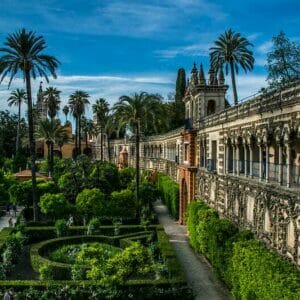
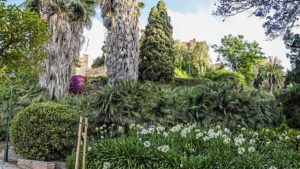
Inside the Real Alcázar of Seville we find an impressive collection of gardens and courtyards in different styles which are one of the main attractionsEach with its own charm and personality. So our recommendation is that you take the time to explore all these beautiful gardens that transmit an incomparable calm.
The Jardín de los Reales Alcázares is the main garden, which features ponds, fountains, beautiful flowers and exotic plants. Among the most popular gardens are also the Pond Gardens, the English Garden, the Garden of Dance and the Murillo Gardens.

Two of the places we recommend you to visit, without a doubt, are the Mercury Pondwhich is presided over by the figure of the god Mercury, and strolling along the Gallery of the Grotesqueswhich extends all the way to the Labyrinth Garden.
The The Audience Hall is located in the Gothic Palace of the Alcázar.It was used as a meeting room for political and judicial affairs, as well as being used as a royal residence.
It is famous for its impressive ceiling made of more than 4000 pieces of woodThe most outstanding features are the coat of arms of Castile and León and the fleur-de-lis of the House of Burgundy. It is considered one of the jewels of Mudejar and Andalusian Gothic art, dating back to the 15th century. It also has an impressive Renaissance fireplace. Today, the hall is a popular tourist attraction and is occasionally used for official events and ceremonies.

The Casa de la Contratación is a key place in the history of Spain. The Catholic Monarchs created the Casa de Contratación de Indias in 1503 to control all the important documentation related to trade, navigation, as well as the reception and shipment of goods.
As well as being the centre of organisation of the discovery of America and the grounds where the great navigators of the 16th century set foot. As a curiosity, in this room Isabella the Catholic received Christopher Columbus after his second voyage.

The Baths of Doña María de Padilla is a set of underground chambers located under the Royal Alcazar, it is said that they were originally built as cisterns to collect rainwater for the palace, but later served as a bath for the queen.
These are just some of the places you should visit inside the Alcázar of Seville. Although there are many more rooms, courtyards and gardens to explore, such as, for example, the Plaster courtyard, the Hall of Justice or the Assistant's House and its courtyards.
Our recommendation to soak up all the history of the palaces, understand the rooms, the gardens and recreate yourself in the era, is undoubtedly to take the guided tour of the Alcázar of Seville.