Go up

The 10 best Andalusian patios in Seville

Table of contents

The Andalusian patios These are indoor spaces open to the sky that organise domestic life around a central point, usually a fountain. They draw on Roman and Arab traditions, combining arches, columns, tiles, vegetation and water to create a cool microclimate that offers respite from the summer heat. More than just a decorative feature, they are an architectural response to the climate and an expression of Andalusian identity.

Seville is one of the finest examples of this architectural style: its palaces, stately homes and historic buildings boast some of the best-preserved courtyards in the whole of Andalusia. On this tour, we bring together ten Sevillian courtyards which are well worth a visit – almost all of them are in the old town, so it’s easy to visit several on foot in a single day. If you’d prefer to organise your trip without having to worry about transport, you can do so with a organised day trip to Seville from Malaga one day.

If you wish, you can enjoy an incredible walk with a guided tour of Seville.

1. The courtyards of the Real Alcázar in Seville

The Patio de las Doncellas in the Real Alcázar of Seville, with its rectangular pond
Patio de las Doncellas, in the Real Alcázar in Seville.

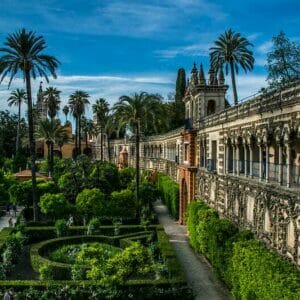
The Royal Alcazar, designated a UNESCO World Heritage Site, comprises several courtyards within a single complex and is the best place to understand how this architectural style evolved between Islamic and Christian influences.

The most recognisable one is the Courtyard of the Maidens, with its rectangular pond surrounded by plasterwork arches and sunken gardens. Next to it, the Dolls' Courtyard shows a much more intimate scale – that of private rooms – and the Gypsum Courtyard It features columns and arches dating from the Almohad period. The site is open to visitors and an admission fee applies; it is advisable to book in advance.

2. The courtyard of the Palacio de las Dueñas

The central courtyard of the Palacio de las Dueñas in Seville, with arches and bougainvillea
The central courtyard of the Palacio de las Dueñas.

This 15th-century palace, associated with the House of Alba, features a central courtyard with semicircular arches resting on marble columns, ceramic tiles and lush vegetation comprising orange trees and bougainvillea. It is situated in the Santa Catalina neighbourhood, to the north of the city centre, and admission is charged.

It also has a literary history that makes it special: Antonio Machado was born here in 1875, when his father worked for the family, and his most frequently quoted line — »My childhood is made up of memories of a courtyard in Seville» — refers precisely to this courtyard. If you’re only going to see one from this list, this one has the added bonus that you can recite the line whilst looking at it.

3. The great courtyard of the Casa de Pilatos

The main courtyard of the Casa de Pilatos in Seville, with a fountain and tiles
The main courtyard of the Casa de Pilatos.

The Casa de Pilatos, situated in the square of the same name, is regarded as the prototype of the Andalusian palace. It was built from 1483 and today it belongs to the House of Medinaceli. It owes its name to the tradition that its layout replicates that of Pontius Pilate’s house in Jerusalem.

Sun main courtyard It is one of the most impressive in the city: Mudejar arches, Gothic balustrades, walls covered in colourful tiles, a Renaissance fountain in the centre and, on the walls, 24 busts of Roman emperors and historical figures brought over from Italy. The palace is organised around this courtyard and the Apeadero Courtyard, surrounded by the Jardín Grande and the Jardín Chico.

You can visit the ground floor or, with a more comprehensive ticket, the upper rooms as well on a guided tour. Interestingly, scenes from Lawrence of Arabia.

4. The Orange Tree Courtyard at the Cathedral

The Patio de los Naranjos at Seville Cathedral, with its fountain and orange trees
The Patio de los Naranjos, the mosque’s former ablutions courtyard.

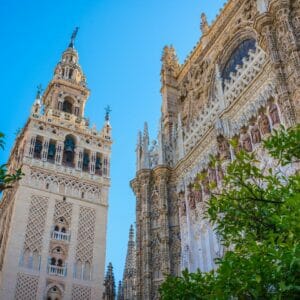
One of the city’s most centrally located courtyards and also one of the oldest. The Patio de los Naranjos in the Cathedral of Santa Maria della Sede retains the layout of the sahn, the ablutions courtyard of the ancient Almohad mosque on which the mosque was built.

Two galleries with pointed arches and the central fountain remain from that period, surrounded by the rows of orange trees that give it its name and fill the grounds with their scent in spring. It can be visited as part of a tour of the Cathedral, next to the Giralda.

5. The courtyard of the Palace of Lebrija

Courtyard of the Palace of Lebrija, with Roman mosaics on the floor
The courtyard of the Palace of Lebrija, with its Roman mosaic floor.

The Palace of the Countess of Lebrija, right in the city centre and near Calle Sierpes, has a distinctive feature that none of the other buildings on this list share: The floor of his courtyard is covered with Roman mosaics from the nearby Italics, brought here by the countess at the start of the 20th century.

With its columns, arches and tiled plinth, the space serves both as an Andalusian courtyard and as a small archaeological collection. It is open to visitors for an admission fee.

6. The courtyard of the Hospital de los Venerables

The Baroque courtyard of the Hospital de los Venerables with its sunken fountain
The courtyard of the Hospital de los Venerables, with the sunken fountain in the centre.

In the heart of the Santa Cruz neighbourhood, this 17th-century building features a square Baroque courtyard with semicircular arches and an unusual design feature: the fountain is sunken in the centre, below ground level, designed in this way to make it easier to water the grounds.

Today it houses a cultural centre and is open to the public, and is just a short walk from the best-known spots in Santa Cruz.

7. The courtyard of the Casa de los Pinelo

Renaissance courtyard of the Casa de los Pinelo in Seville
The Renaissance courtyard of the Casa de los Pinelo.

A little-known gem in the Santa Cruz neighbourhood. The Casa de los Pinelo, on Calle Abades, is a 16th-century mansion built by the Pinelo family, Genovese sailors which had been established in Seville since the 15th century and came to occupy almost an entire block.

Its two-storey Renaissance courtyard combines arches resting on marble columns with tiled decoration. Today, the building is home to the Royal Sevillian Academy of Letters and of the Santa Isabel of Hungary Academy of Fine Arts, which affects access: it is usually open to the public Tuesday and Thursday mornings, so it’s a good idea to check the opening hours before you go.

8. The courtyard of the Casa de Salinas

Inner courtyard of the Casa de Salinas in Seville, with arches and a tiled plinth
The inner courtyard of the Casa de Salinas.

Situated on Calle Mateos Gago, next to the Santa Cruz neighbourhood, this 16th-century palace retains a courtyard with arches resting on columns, galleries, a fountain and a plinth decorated with period tiles. Like the Palacio de Lebrija, it also houses fragments of Roman mosaics from Italica.

As it is a private residence, it can only be visited on pre-arranged guided tours, making it one of the most peaceful stops on the tour.

9. The courtyards of the Museum of Fine Arts

Landscaped courtyard at the Seville Museum of Fine Arts, featuring tiles and orange trees
One of the courtyards at the Seville Museum of Fine Arts.

The Museum of Fine Arts is housed in the former Convent of La Merced Calzada and organises its exhibition spaces around three courtyards landscaped, with tiled floors, orange trees and fountains. A tour of the building takes you from one painting to the next and from one courtyard to the next, so that the building itself forms part of the visit.

It is one of Spain’s most important art museums, with a leading collection of works by Murillo, Zurbarán and Valdés Leal. Admission to the permanent collection is free for citizens of the European Union.

10. The courtyards of the Hospital de la Caridad

Courtyard of the Hospital de la Caridad in Seville, featuring Dutch tiles
One of the twin courtyards at the Hospital de la Caridad.

Situated next to the Arenal, near the river, this 17th-century building retains two twin courtyards decorated with Dutch tiles depicting biblical scenes, alongside fountains featuring allegorical sculptures and orange trees.

The ensemble is associated with the figure of Miguel de Mañara, which the institution promoted in the 17th century. And there’s one more reason to go inside: in its St George’s Church the masterpieces of Juan de Valdés Leal —including In the blink of an eye y The End of the Glory of the World— and several paintings by Murillo. It is open to visitors for a fee.

How to plan the courtyards tour

Almost all of these courtyards are in the old town, so you can visit them one after the other on foot. A logical way to organise your visit is to start with the Real Alcázar and the Patio de los Naranjos at the Cathedral, then head through Santa Cruz to see the Venerables, the Casa de Salinas and the Casa de los Pinelo, and continue northwards to the Casa de Pilatos, the Palacio de Lebrija and Las Dueñas. The Hospital de la Caridad and the Museum of Fine Arts are situated towards the river and can be left until last.

Please bear in mind that opening times vary considerably from one building to another and that some, such as the Casa de los Pinelo or the Casa de Salinas, have restricted access. It is advisable to check opening times and book in advance before setting off. To expand on this itinerary, you can consult our guide to must-see places in Seville and that of What to see in Seville in a day.

Trips to Seville with Visitanddo

Exploring these courtyards is a way of getting to know Seville beyond its major monuments. If you’d like to do so without worrying about transport or timetables, we organise day trips from Málaga and the Costa del Sol. The excursion includes:

  1. Return transport from Fuengirola, Benalmádena, Torremolinos and Málaga.
  2. A Spanish- and English-speaking tour guide to accompany you during the transfers and the excursion.
  3. Tickets for the Real Alcázar in Seville, including a guided tour, depending on the option chosen.
  4. Free time in Seville to explore the city at your own pace.

Frequently asked questions about Seville’s courtyards

Which are the most beautiful Andalusian courtyards in Seville?

Among the most notable are those at the Real Alcázar, the main courtyard of the Casa de Pilatos, the courtyard of the Palacio de Lebrija with its Roman mosaics, and the Patio de los Naranjos at the Cathedral. Added to these are those at the Palacio de las Dueñas, the Hospital de los Venerables, the Casa de los Pinelo, the Casa de Salinas, the Museum of Fine Arts and the Hospital de la Caridad. Almost all of them are in the historic centre, making it possible to visit several on foot in a single day.

What are the defining features of a traditional Andalusian courtyard?

Andalusian patios are open-air courtyards that organise life within the home around a central point, usually a fountain. They draw on Roman and Arab traditions and combine arches, columns, ceramic tiles, vegetation and water to create a cool microclimate that provides relief from the summer heat.

In which courtyard in Seville was Antonio Machado born?

Antonio Machado was born in 1875 at the Palacio de las Dueñas, in the Santa Catalina neighbourhood, where his father worked for the House of Alba. His best-known verse, «My childhood is made up of memories of a courtyard in Seville», refers to the central courtyard of this palace, which can now be visited for an admission fee.

Can you visit the courtyards of the Real Alcázar and the Casa de Pilatos?

Yes, both are open to visitors and require an admission ticket. At the Real Alcázar, it is advisable to book in advance, particularly during the high season. At the Casa de Pilatos, you can explore the ground floor or, with a more comprehensive ticket, also the upper rooms as part of a guided tour.

Are there any courtyards in Seville that you can visit for free?

Yes. Admission to the permanent collection of the Museum of Fine Arts, with its three landscaped courtyards, is free for citizens of the European Union. The Casa de los Pinelo, headquarters of the Royal Academies, is open to the public at specific times, usually on Tuesday and Thursday mornings. The other courtyards on this list require an admission ticket.

If you liked... Share!

Make the most of it! only during the month of November and book our excursions.

UP TO 30% DISCOUNTS

Book now and enjoy the tour whenever you want!

BLACK MONTH offer valid from 1 November at 00:00h until 30 November at 23:59h.

We have a present for you!

Download the ebook "What to see in Malaga in 3 days - the perfect route" for free! and plan your perfect trip to discover Andalusia from Malaga.