The world’s largest Gothic cathedral, built on the site of the Almohad mosque in Seville. Its official name is Cathedral of Santa María de la Sede, and it is also known as Magna Hispalensis. The Giralda was its minaret.
Price, opening hours and the five must-see attractions inside.
From 1 January 2026:
And the most searched-for piece of information: there are Free public viewing on Sundays (excluding public holidays), from 4.30 pm to 6.00 pm, with advance online booking and limited capacity. It sells out quickly, so you’ll need to keep an eye on it.
The ticket includes entry to the Giralda, which is not charged separately.
Please note the closing times: the entrances and the tower close at 6.00 pm.
The cathedral itself estimates 75 minutes. If you take your time climbing the Giralda, it takes an hour and a half.
And a word of warning: the timetables may be subject to change without prior notice due to religious services. It is an active place of worship, so it is advisable to check the official calendar for the specific day.
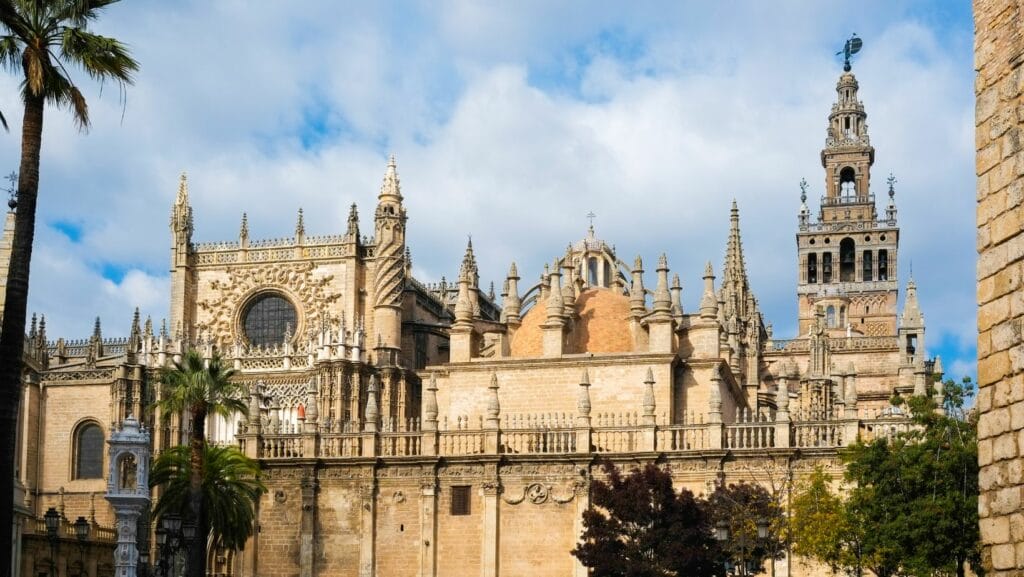
In the late 12th century, the Almohad Caliph Abu Yaqub Yusuf He ordered the construction of the Great Mosque of Seville. The city was conquered on 23 November 1248, and for a century and a half the mosque was used as a Christian church.
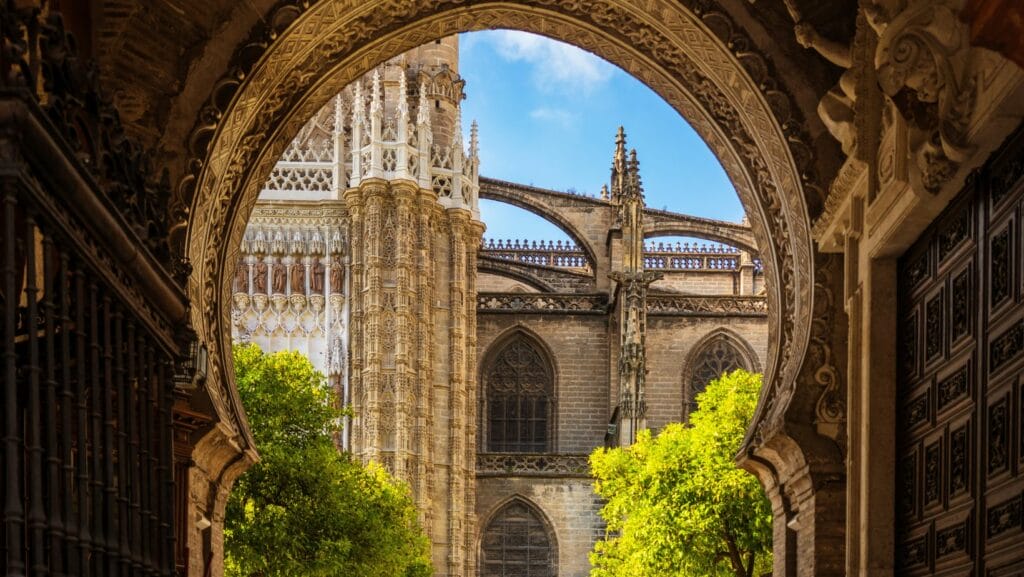
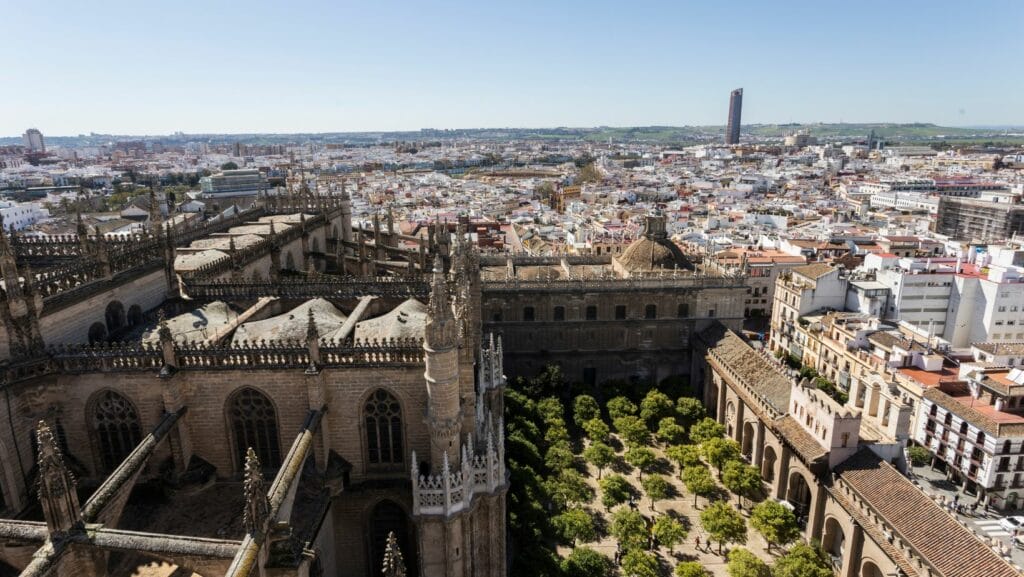
In 1401, the town council decided to build something new, and the following parts of the mosque have been preserved just two elements: the minaret —today the Giralda— and the Patio de los Naranjos.
A detail that explains the layout: the cathedral it does not have the typical Gothic apse, because their Five buildings stand on the exact site of the mosque. It measures 116 metres long by 76 metres wide.
It has been a World Heritage Site since 1987, next to the Royal Alcazar and the Archivo de Indias —all three of them, not just the cathedral—. And in 2010 the complex was declared Site of Outstanding Universal Value.
It is the largest altarpiece in Christendom. Over twenty metres high and featuring dozens of gilded reliefs depicting scenes from the life of Christ and the Virgin Mary.
Work continued for almost a century, between the late 15th and early 16th centuries. It can be seen through the grille of the High Chapel.
Next to the Puerta del Príncipe, in the south arm of the transept. The coffin is held aloft by four figures representing the kingdoms of Castile, León, Aragon and Navarre.
The tomb dates from the 19th century, much later. The remains passed through Seville, Santo Domingo, Havana and back to Seville, and DNA tests confirm that the ones here are his, although Santo Domingo maintains its own claim.
Fernando III is buried here, the king who conquered Seville, and Alfonso X the Wise. It is the royal crypt of the church and is often overlooked.
It was the mosque’s ablution courtyard, and it is one of only two remaining parts of the Islamic building. It still retains the irrigation channels which distributed the water amongst the rows of orange trees, and a central fountain of Visigothic origin.
The Giralda can be accessed from here.
It is regarded as one of the finest collections of paintings in Spain, with more than 500 works from the 16th to the 21st centuries: Murillo, Zurbarán, Goya, Alejo Fernández, Pedro de Campaña and Luis de Vargas.
Two places to look: the Main Sacristy, with its Greek cross plan and the cathedral treasury, and the Chapter House, with an elliptical floor plan and designed by Hernán Ruiz, featuring paintings by Murillo.
And here’s a little-known fact: in the Granada Chapel are preserved Visigothic capitals, the last remaining parts of the temple dating from before the Arab conquest.
The Giralda is not a separate monument: it is the cathedral’s bell tower and admission is included. It was the minaret of the mosque.
And here’s the most surprising detail: you go up via 34 inclined ramps, not by steps. They were made this way so that the muezzin could mount his horse all the way to the top.
That makes it much more accessible Unlike other towers: there are no steps, although the climb is long.
It has inspired replicas around the world, from Kansas City to L’Arboç del Penedès. Full details at the Giralda of Seville.
Avenida de la Constitución, right in the centre, next to the Royal Alcazar and just a stone’s throw from Santa Cruz.
An interesting fact for walkers: the Camino de Santiago, following the Vía de la Plata route, starts at the Cathedral.
We are a local tour operator based in Málaga with over 50 years’ experience organising trips around Andalusia. Seville is best explored in a day:
Check whether the ticket you’re booking includes entry to the Cathedral, because with a €20 entrance fee, the difference is noticeable.
For the rest of the day: what to see in Seville, Seville in a day, its places and the Plaza de España.
Twenty euros online and twenty-one at the ticket office, with a one-euro booking fee per ticket for online purchases, according to the rates in force from January 2026. The reduced-rate ticket costs 7 or 8 euros for those aged 65 and over, students up to the age of 25, people with a disability rating of 33 to 65%, and adults from large families. Entry to the Giralda is included.
On Sundays (excluding public holidays), from 4.30 pm to 6.00 pm, subject to prior online booking and limited capacity. Admission is also free for residents of the Diocese of Seville, children under 13 accompanied by an adult, people with disabilities holding a 65% card, and the unemployed.
They are not separate monuments: the Giralda is the cathedral’s bell tower and admission to it is included in the price of a ticket to the cathedral. It was the minaret of the Almohad mosque and was preserved when the cathedral was built, with the bell chamber added in the 16th century.
No, because of the 34 sloping ramps. They were designed this way so that the muezzin could ride his horse right to the top of the tower. That makes it more accessible than other bell towers, although the climb is a long one.
The cathedral itself estimates 75 minutes, although if you take your time climbing the Giralda, it can take closer to an hour and a half. It is advisable to check the official timetable for the specific day, as opening hours may be subject to change without notice due to religious services.
Its official name is the Cathedral of Santa María de la Sede, and it is also known as the Magna Hispalensis. The full name refers to the Virgin of la Sede, whose image presides over the high altarpiece.
Just two elements: the minaret, which is the present-day Giralda, and the Patio de los Naranjos, the former ablution courtyard with its irrigation channels. The cathedral’s floor plan, lacking the typical Gothic chancel, is precisely because its five naves occupy the site of the mosque.