EN
EN  ES
ES  FR
FR  DE
DE 
What to see in Tetouan Morocco is a question you should ask yourself if you are planning to travel to Morocco from Spain. Although cities such as Tangier, Assilah, Fez o Chefchaouen Often on bucket lists, Tetouan is a destination you can't afford to miss.
Wondering why? If you haven't yet included Tetouan in your itinerary, you don't know what you're missing!
At Visitanddo.com we want to show you the best of this city. That's why we have prepared a list of 10 must-see things to see in Tetouan in one day. You will surely understand why we were captivated by this North African gem.
Known as "The White Dove".is a city located in the north of Morocco. Its origins date back to the Middle Ages, a city with Roman origins in Tamuda. As a result of its proximity to the sea and the navigation of the river Martil, its maritime trade grew.
It is not considered a tourist city, which is surprising given its proximity to Spain and the ties that bind them together. Tetouan is a city to fall in love with and we recommend you add it to your list of things to see in Morocco.
We leave you a interactive map with our must-haves what to visit and what to do in Tetouan:
The Medina of Tetouanalso known as TitawinIt is one of the best-preserved medinas in Morocco and has been declared a UNESCO World Heritage in 1997. Its history dates back to the 8th century, when it served as the main point of contact between Morocco and Andalusia. After the Reconquest, the city was rebuilt by Andalusian refugees expelled from Spain, which is reflected in its Andalusian-influenced art and architecture.
Unlike other Moroccan medinas, Tetouan's medina has remained relatively untouched by outside influences, retaining its authenticity and original structure. Its narrow streets, whitewashed houses and traditional souks offer an authentic experience of Moroccan life. The medina is surrounded by a wall with several access gates, known as babThe new roads, which make it easier to enter and leave the old city.
To visit the medina of Tetouan is to enter a labyrinth of history and culture, where every corner tells a story and every building reflects the city's rich Andalusian heritage. It is a place where past and present coexist harmoniously, offering visitors a unique insight into Moroccan history.
We recommend that you spend a full day in Tetouan with a local guide to learn more about its history and culture:

The Medina of Tetouan is divided into two sectors. On the one hand, connected to the Bab Tut gate leads to the food market area with shops dedicated to spices, fruits, vegetables and meat among others, located in Trankat Street, one of the most important streets of the Medina.
And on the other hand, in the area of Terrafin Street you will find the artisan quarter and you can find numerous objects of all kinds and materials, as well as see with your own eyes how the craftsmen work with leather, weave carpets and even make costume jewellery.
One of the things to do in Tetouan is to put haggling into practice, you can read some tips to succeed in your bargaining when travelling to Morocco from Spain.
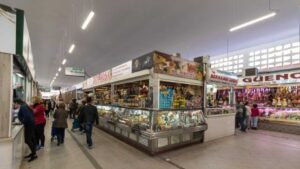
The Tetuán Food Market is a vibrant shopping centre that reflects the daily life of the city. Spread over several levels, the ground floor houses circular stone tables selling mainly fresh fish. On the upper levels, visitors can explore a variety of shops offering everything from groceries to polar blankets and a quirky flower shop with eye-catching bouquets. This market is an ideal place to immerse yourself in the local culture and experience the diversity of products that Tetouan has to offer.
The Tanners' Quarterlocated in the medina of Tetouan, is a historic area where the traditional leather tanning process takes place. This trade, which has endured for centuries, involves the treatment of skins in large tubs on the ground, creating an area of intense smells and hard work. Although once home to numerous artisans, today only a few tanners remain to continue this age-old craft. A visit to this quarter offers an authentic insight into Moroccan craftsmanship and the process of transforming hides into products such as bags, slippers and rugs.
It is important to note that the number of tanners in Tetouan has decreased significantly over the last decades. According to recent reports, the tanning area of the medina, once home to more than a hundred craftsmen, now has only four active tanners. This decline threatens the continuity of this craft tradition, which is an integral part of Tetouan's cultural heritage. A visit to this neighbourhood not only allows us to appreciate the artisanal process, but also to understand the challenges faced by these artisans in preserving their craft.
The Kasbah of Tetouanlocated in the heart of the Moroccan city of Tetouan, is a historic fortress that reflects the rich cultural heritage of the region. Built in the 14th century by the Marinids, the kasbah served as an essential defensive structure and administrative centre. Its architecture combines Andalusian and Moroccan elements, with narrow streets and whitewashed buildings evoking Hispano-Moorish influence.
The Kasbah is an integral part of the medina of Tetouan, declared a UNESCO World Heritage Site in 1997 due to its authenticity and excellent state of preservation. The medina is known for its vibrant souks, where local craftsmen produce traditional products such as textiles, ceramics and jewellery. Strolling through the Kasbah offers visitors an immersive experience into the daily life and traditions of Tetouan.
In addition to its historical and cultural value, the Kasbah of Tetouan has been a source of artistic inspiration. The Spanish painter Mariano Fortuny y Marsal, for example, created works such as "Guard of the Kasbah in Tetouan" around 1873, capturing scenes of life in the kasbah. These artistic depictions have contributed to spreading the image of the kasbah and its unique atmosphere beyond Morocco's borders.
Tetouan is home to several cemeteries that reflect its cultural and historical diversity. The Jewish Cemetery of Tetouan is one of the largest in Morocco, with more than 20,000 tombs, some dating back to the 15th century. This cemetery is notable for its unique anthropomorphic tombstones and its organisation into terraces. Many tombs have no inscriptions, following a local tradition that relied on family memory to identify the graves.
The Spanish Cemetery of Tetuan is composed of two sections: the military cemetery and the civilian cemetery, located opposite each other. The military cemetery houses the graves of Spanish soldiers who died during the period of the Spanish Protectorate in Morocco, while the civilian cemetery is the resting place of many Spanish citizens who resided in the region. Although the security and maintenance of these cemeteries is the responsibility of the Spanish Foreign Ministry, through its consulate in Tetouan, resources for their upkeep are limited.
These cemeteries are not only eternal resting places, but also tangible testimonies to Tetouan's rich and complex history. Visiting these sites offers an in-depth insight into the communities that have influenced the city over the centuries, from the significant Jewish presence to the Spanish influence during the Protectorate. However, it is important to note that, due to lack of resources, some of these cemeteries may not be in the best state of preservation.
Between 1913 and 1956, Tetouan was the capital of the Spanish Protectorate in Morocco until its independence. An important period, both economically and artistically, for the city of Tetouan.
Today, it is a colonial quarter that follows the Medina and is full of historic buildings, shops and cafés.
One of its most emblematic buildings is the Spanish Cinema.where you can go for events related to cinema, music or theatre.
Such is its link with Spain that The television series El tiempo entre costuras was filmed here.based on the novel by María Dueñas, which tells the story that takes place in Tetuán during the time of the Spanish protectorate.

The Place Moulay El Mehdialso known as Primo Squareis an emblematic square located in the heart of Tetouan, Morocco. Located in the centre of the Ensanche, the Spanish part of the city, this square is notable for its circular design and its importance as a convergence point for several main thoroughfares, including Mohammed V Avenue, which leads to the Feddan, where the Royal Palace is located.
In the centre of the square is a fountain with variable water jets, which provides a particularly attractive spectacle during the evening hours. The surrounding architecture reflects the Hispano-Moorish influence, with white buildings and wide avenues evoking Tetouan's Andalusian past. This setting makes it a popular place for both locals and tourists looking to enjoy the city's unique atmosphere.
Moulay El Mehdi Square is not only a nerve centre of the city, but also a venue for a variety of cultural and social events. Its strategic location and lively atmosphere make it an ideal starting point for exploring Tetouan's other attractions, such as the medina, a UNESCO World Heritage Site, and the traditional souks. Visiting this square offers an authentic experience of daily life and Tetouan's rich cultural heritage.

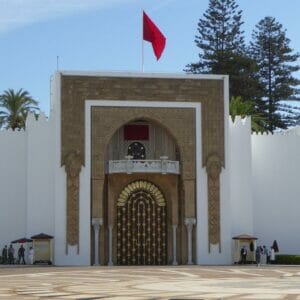
The Royal Palace of Tetuanlocated in the Hassan II SquareThe building is an iconic landmark that reflects the city's rich history and architectural influence. Built around 1740 as the Dar al-Emrat or Governor's Palace, this complex has undergone several transformations over the centuries. During the Spanish Protectorate in Morocco (1913-1956), it was home to the Khalifathe Sultan's personal representative, and to the Spanish High CommissionerIt has consolidated itself as the main centre of political authority in the region.
Following Morocco's independence in 1956, the complex was adapted as a Royal Palace. Under the reign of King Hassan II, significant renovations were carried out, including the remodelling of the square in 1988, when a wall and a monumental gate were erected to isolate the former High Commissioner's building from public view. Today, the palace is not open to the public, but its presence in Hassan II Square adds significant historical and cultural value to Tetouan's urban environment.
The Hassan II Squarealso traditionally known as the Feddanacts as a link between the medina and the widening of Tetouan. Although much of the square is restricted for security reasons, its vastness and the majesty of the Royal Palace make it a central landmark in the city. Visitors can appreciate the exterior architecture of the palace and enjoy the vibrant atmosphere that characterises this historic square, which remains a living testimony to Tetouan's political and cultural evolution.

The El Feddan Park in Tetouan is a public space that has been restored to evoke the time when the city was the capital of the Spanish protectorate. Located along Mohammed V Avenue, between Al Jala Square and Hassan II Square, the park offers a wide boulevard that invites you to stroll and enjoy its surroundings.
This park is a popular spot for locals and visitors alike, offering a relaxing atmosphere in the middle of the city. With a large café, children's play areas and plenty of seating space, it is an ideal meeting point for families and friends. In addition, its proximity to the medina and the Royal Palace makes it a convenient stop for those exploring Tetouan's main attractions.
El Feddan Park is also known for offering breathtaking panoramic views of Tetouan's medina, especially from its elevated areas. Visitors can enjoy a unique perspective of the old city, making it an ideal place for photography and contemplation.

You can't leave Tetouan without trying the following traditional Moroccan cuisine. We recommend the Palace Bouhlal restaurant, a former Riad that has been restored as a restaurant and offers a tasting menu with recipes from Mediterranean and Moroccan cuisine.
The menu features Moroccan dishes such as harira, a Moroccan spoon dish for both summer and winter, lamb kebabs, the traditional couscous dish which is cooked especially on Fridays as it is the Muslim holy day, and delicious Arab sweets accompanied by traditional tea, the national drink par excellence.
On the excursion to Morocco, as well as getting to know Ceuta and Tetouan with a local guide. Also You will taste a Moroccan menu accompanied by traditional folklore.
Yes, visiting Morocco during Ramadan is like travelling in any other month of the year. However, there are a few things to bear in mind:
Because the Islamic calendar follows the lunar cycle, the holy month of Ramadan is shifted by approximately ten days each year. It is estimated that in the year 2024, Ramadan will begin on 11 March and end on 10 April; the dates may change depending on the moon's observations.
We recommend that you take advantage of the Excursion to Morocco from Malaga or from Algeciras to make sure you don't miss any detail of what to visit and what to do in Tetouan and Ceuta in one day with a local guide.
You will fall in love with this Moroccan city in North Africa.
Are you a travel and culture enthusiast? Don't miss the countdown to the Feria de Málaga! Excitement is in the air and in our article on the Malaga and its famous August fair we'll keep you up to date with everything you need to know. Discover the key dates, the unmissable activities and the best tips to make the most of this unique festival. Don't miss this opportunity to experience the magic of Malaga! Click on the link and get ready to immerse yourself in a world of tradition and fun.