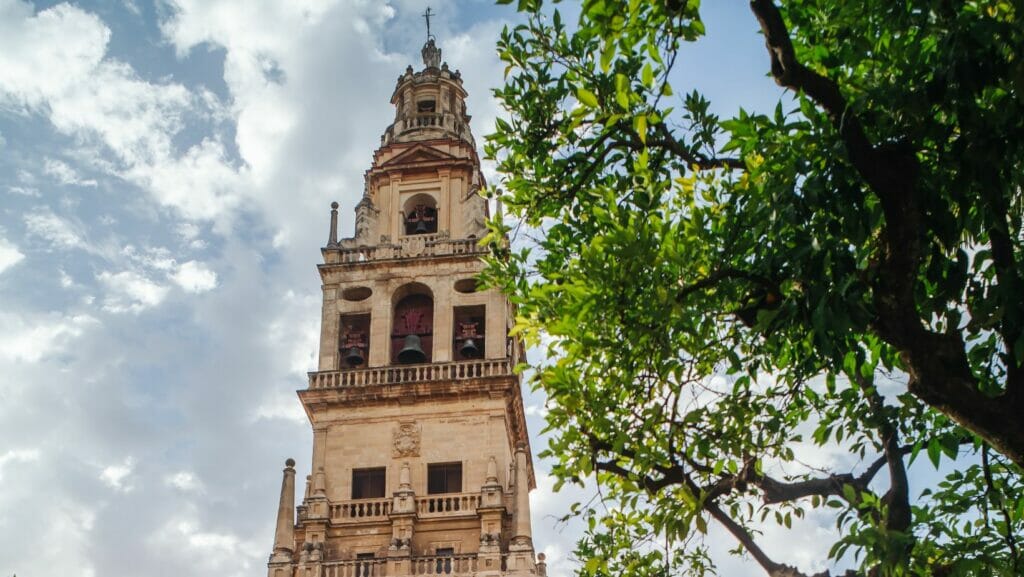
The bell tower of the Mosque of Córdoba is the tallest structure in the complex — and in the city — standing at 54 metres, and it is the first feature you see on entering the Patio de los Naranjos. It is also known as the minaret because, before housing bells, it was the tower from which the call to prayer was made when the building was a mosque. Both names remain in use: “Bell Tower” is the official name, while “minaret” recalls its Islamic origins.
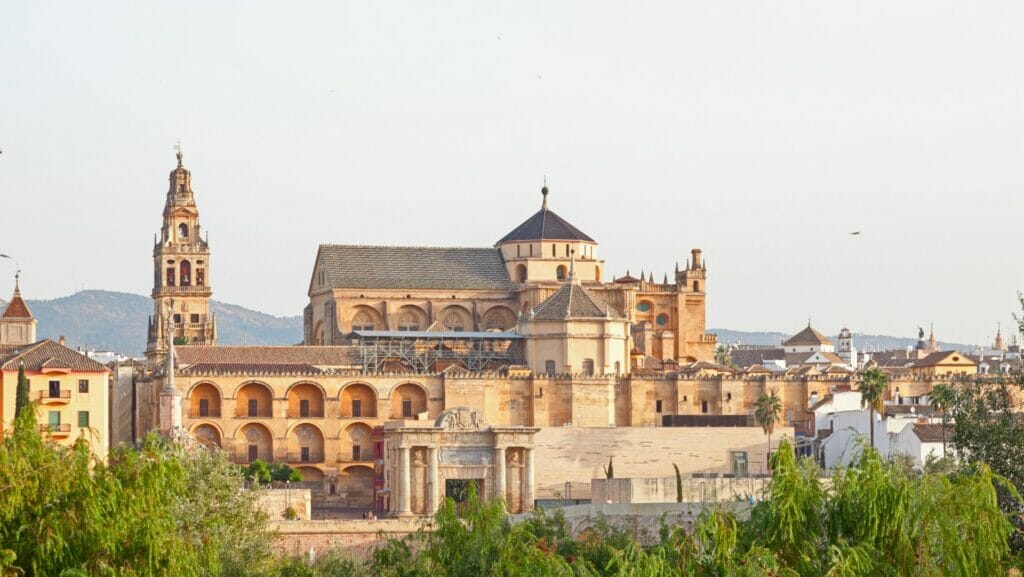
The tower forms part of the Mosque-Cathedral of Córdoba, designated a UNESCO World Heritage Site in 1984, and encapsulates the building’s various historical periods in a single element: it is literally one tower inside another. If you’d like to explore it in depth without having to worry about transport or organisation, you can do so with a organised day trip to Córdoba from Málaga one day.
The tower’s origins lie in the 10th century, when the Caliph Abderramán III He decided to extend the Aljama Mosque and, to this end, to demolish the old minaret and build a new one around the year 951. That Umayyad tower, with a square floor plan and built of ashlar, stood next to the Gate of Forgiveness and served as the model for later Andalusian minarets. From there, the muezzin would call the faithful to prayer five times a day.
Following the Christian conquest of Córdoba in 1236, the mosque was consecrated as a cathedral and the minaret came to serve as a bell tower. The original Islamic structure did not disappear: it was incorporated into a new building erected between the 16th and 17th centuries, so that the tower you see today It contains the remains of the Umayyad minaret inside it, which you can see if you go upstairs. This process of superimposition is the same as that which explains the rest of the building, as you can see when you take a look the parts of the Mosque of Córdoba.
The tower is one of the clearest examples of how a single structure can serve two successive religions. During the Islamic period, it served as a minaret: to announce the time of prayer to the Muslim community. That purpose required height and visibility, which is why it was situated next to the main gate of the complex. Its commanding position also made it a viewpoint about the city and its surroundings.
With the Christianisation of the building, the tower took on the role of a bell tower. The bells replaced the muezzin’s call to mark church services, the hours and events in the city. Interestingly, some of its bells bear inscriptions dating them to the the bishopric of Íñigo Manrique, in the 15th century: they predate even the tower that now houses them.
This dual nature — a minaret on the inside, a bell tower on the outside — makes the tower a symbol of the very character of the Mosque-Cathedral, where Andalusian and Christian elements coexist within the same structure.
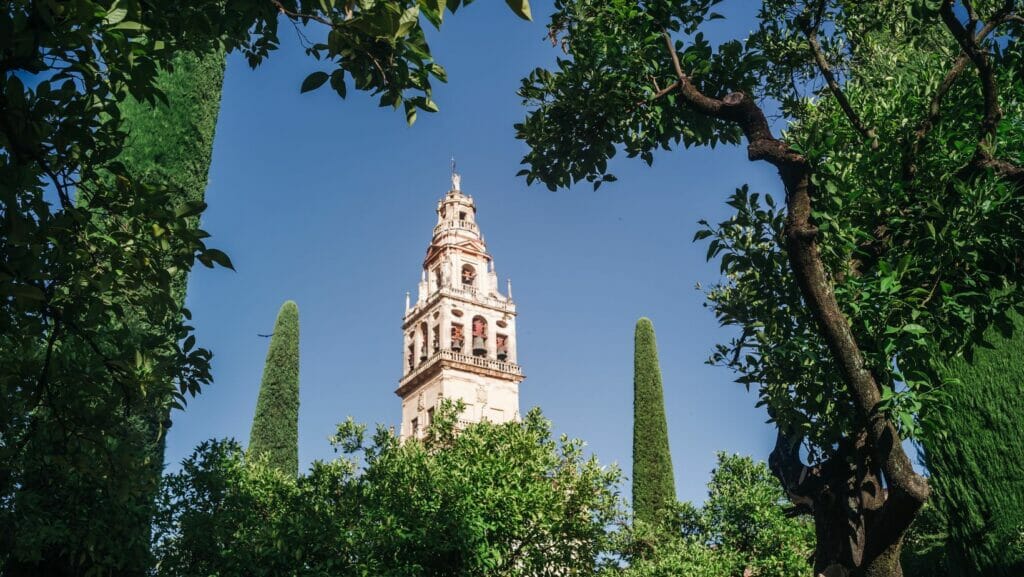
The history of the construction of the current tower begins with a disaster: a earthquake in 1589 The old minaret was left in a precarious condition, and the town council decided not to demolish it but to completely clad it. These were the main works carried out:
During the building works, a temporary bell tower had to be erected so as not to interrupt the call to worship. In the 20th and early 21st centuries, consolidation restoration work was carried out, which made it possible to restore access to the interior and showcase the remains of the minaret preserved beneath the Renaissance structure.
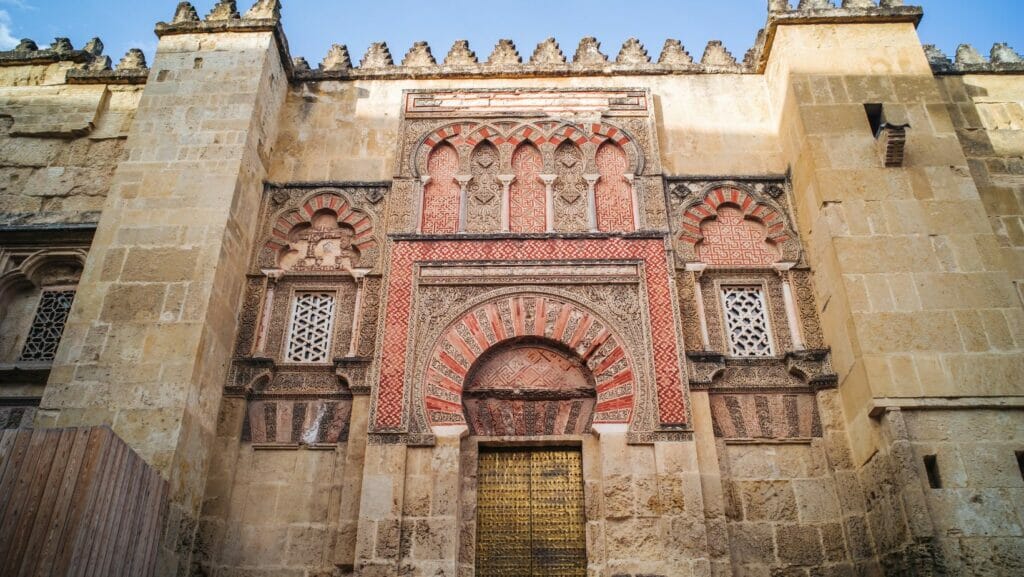
The tower combines several overlapping architectural styles. At its core lies the Alminar Omeya dating from the 10th century, in the Caliphate tradition. Above it, Hernán Ruiz III’s design follows a scheme Mannerist of Italian origin, evolving into Baroque forms in the body of the clock, the lantern and the finial.
The result is a tower organised into steps of decreasing height: the base, the minaret concealed within, the belfry on the first terrace, a second, higher terrace with more bells and, crowning it all, the lantern bearing the figure of Saint Raphael. On the lower levels, one can see blind openings, a trace of that new cladding which covered the Islamic tower.
This accumulation of styles reflects the way in which the entire monument gradually changed; if you’re interested in understanding that evolution as a whole, you can consult the the architecture of the Mosque of Córdoba.
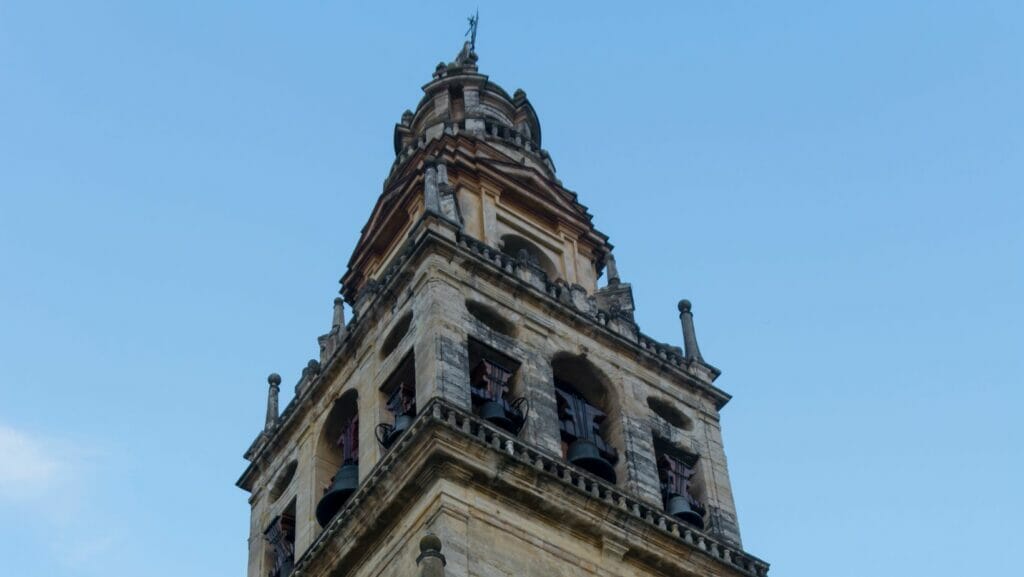
Few towers encapsulate so much significance in such a small space. As a minaret, it was for centuries the centre of religious life in Islamic Córdoba and served as a model for other minarets in al-Andalus, symbolising the presence of Islam in the city and the power of the Caliphate. As a bell tower, it became the landmark of the Christian city, with its bells setting the rhythm of daily life.
The finishing touch featuring the figure of San Rafael adds a further layer of symbolism: the archangel is the guardian and patron saint of Córdoba, and his presence at the very top links the tower to the protection of the city. Viewed from the Patio de los Naranjos or from the streets of the Jewish Quarter, it serves as a landmark and a visible reminder of the two cultures that shaped the building.
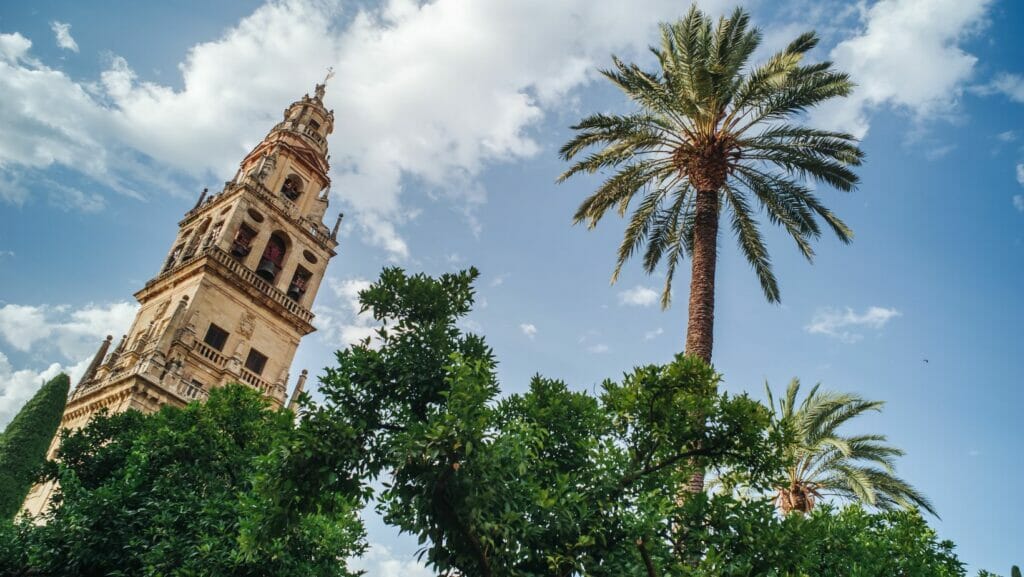
Yes, you can go up. Entry requires a separate ticket, distinct from that for the monument, costing around 3 €. It is organised by departures every half hour and with groups limited to around 20 people, because the space upstairs is limited and there is only one staircase.
The climb saves the day about 203 steps up a spiral staircase to the bell tower, some 40 metres high – the equivalent of a twelve-storey building. The steps are gentle and the climb is manageable. Along the way, you can see the remains of the Umayyad minaret, which is one of the reasons to make the climb, quite apart from the views.
From above, you can see the roof of the old mosque and how the cathedral’s structure rises above it, as well as the Patio de los Naranjos and the historic centre. A handy tip: buy your ticket online, particularly during peak season, and check the official website of the monument for up-to-date opening times, as access may be suspended for maintenance or due to weather conditions. Prices and opening times may vary throughout the year.
If you’re in Málaga or on the Costa del Sol, we recommend the day trip to Córdoba, which includes admission to the Mosque-Cathedral and a guided tour of the Jewish quarter.
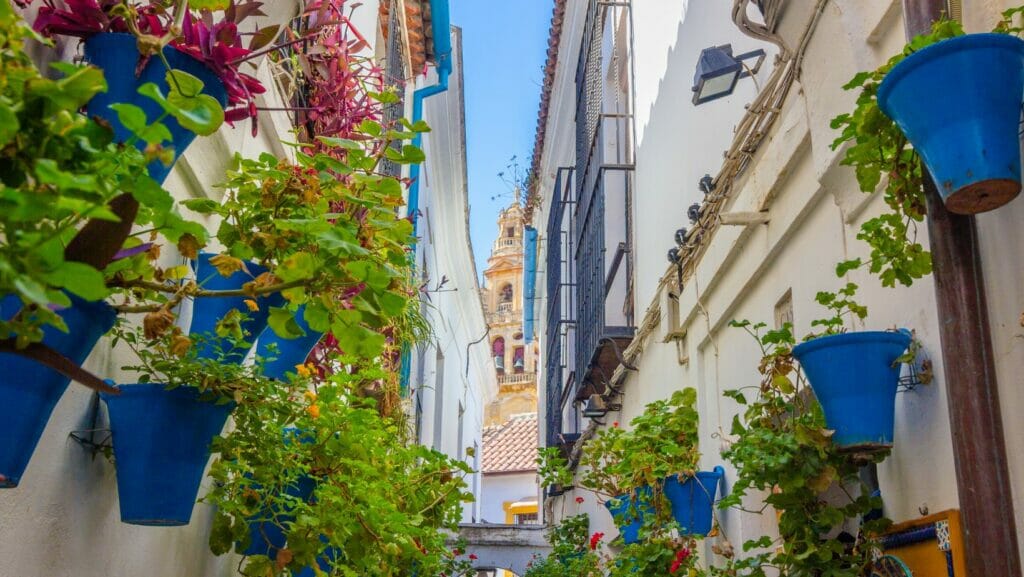
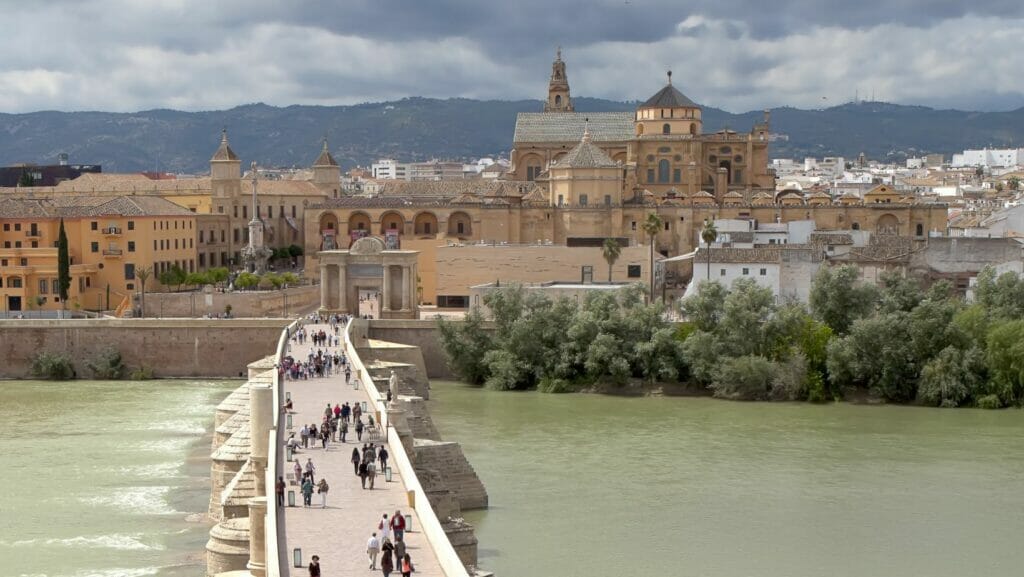
Córdoba is just over an hour and a half from Málaga, making it possible to visit the Mosque-Cathedral and its bell tower in a single day. Much of the city’s heritage is centred around this monument, so it’s easy to combine your visit with a stroll through the Jewish Quarter, across the Roman Bridge and along the banks of the Guadalquivir.
With us, you can choose from three different types of day trip to Córdoba:
All tours include return transport from Málaga and the Costa del Sol, a Spanish- and English-speaking guide to accompany you during the transfers, free time in the city and, depending on the tour option, admission and a guided tour of the Mosque-Cathedral or the Jewish Quarter. Please note that The climb up the tower is not included on the excursions and must be booked separately.
And if you’d like to extend your tour of the city, take a look at the best monuments in Córdoba and the general guide to Cordoba as a destination.
Yes. Access requires a separate ticket, distinct from the one for the monument, costing around €3, and is organised in half-hourly slots with groups limited to around 20 people. The climb involves ascending some 203 steps up a spiral staircase to the belfry, at a height of around 40 metres, from where you can see the Patio de los Naranjos, the monument’s roof and the historic centre. It’s advisable to buy your ticket online, especially during the high season.
Because the Mosque of Córdoba was an Islamic place of worship. The minaret, built by Abd-ar-Rahman III around the year 951, was used to call the faithful to prayer five times a day. Following the Christian conquest of the city in 1236, the building was consecrated as a cathedral and the minaret was converted into a bell tower, until, towards the end of the 16th century, it was encased in a Mannerist structure, which still encloses it within.
The bell tower stands some 54 metres tall, making it the tallest building in Córdoba and one of the most prominent landmarks in the historic centre. The visitor staircase rises to a height of around 40 metres – the equivalent of a twelve-storey building – and at its summit stands a statue of Saint Raphael, the archangel and patron saint of the city.
The climb up the bell tower involves climbing some 203 steps up a spiral staircase to the belfry. The steps are gentle and the climb is manageable; along the way, you can see the remains of the 10th-century Umayyad minaret, which were incorporated into the current tower.
The original minaret was commissioned by Caliph Abd al-Rahman III in the 10th century. The present tower, which encloses it, was designed in the late 16th century by Hernán Ruiz III following the earthquake of 1589; Juan Sequero de la Matilla completed the clock tower in 1616, and Sebastián Vidal and Gaspar de la Peña finished the work, which was declared complete on 24 May 1664 with the installation of the statue of Saint Raphael by Pedro de la Paz and Bernabé Gómez del Río.