Go up

What to see in Cádiz: 10 must-see attractions

Table of contents

If you’re wondering what to see in the city of Cádiz during a visit, the answer lies within its compact, walled old town, which is open to the sea on almost all sides. The city occupies a narrow strip of land surrounded by the Atlantic, meaning you can explore its monuments, historic squares and urban beaches with almost no need for transport. Few Andalusian provincial capitals bring together, in such a small space, a cathedral facing the ocean, a watchtower with a camera obscura and a beach nestled between two castles.

The itinerary we suggest below lists the ten must-see places so that you can visit them all on foot, from the city’s major landmarks to its more local hidden gems. If you’re interested in the city’s historical background before you set off, you can find out more with these Interesting facts about Cádiz which help to explain why it is considered one of the oldest inhabited cities in Europe.

What to see in Cádiz: 10 must-sees

These are the ten places that best encapsulate the city. The order is designed to form a logical itinerary through the old town, combining monuments, squares and the seafront.

1. Gran Teatro Falla

The red-brick façade and Neo-Mudejar arches of the Gran Teatro Falla in Cádiz
The Gran Teatro Falla, with its red-brick Neo-Mudéjar façade.

The Gran Teatro Falla is one of the most recognisable buildings in Cádiz, with its red-brick façade and Neo-Mudejar-inspired arches. Built in the late 19th century, it is the main venue from the Cádiz Carnival, where the famous folk music competition is held, and which also hosts the Ibero-American Theatre Festival.

Although it is busiest during the carnival, it hosts a programme of concerts, theatre, musicals and dance performances throughout the year. It is best viewed from the Plaza de Fragela to appreciate the façade as a whole, and, if there is a performance taking place, do check the programme to see if you can visit the interior.

2. Cádiz Cathedral

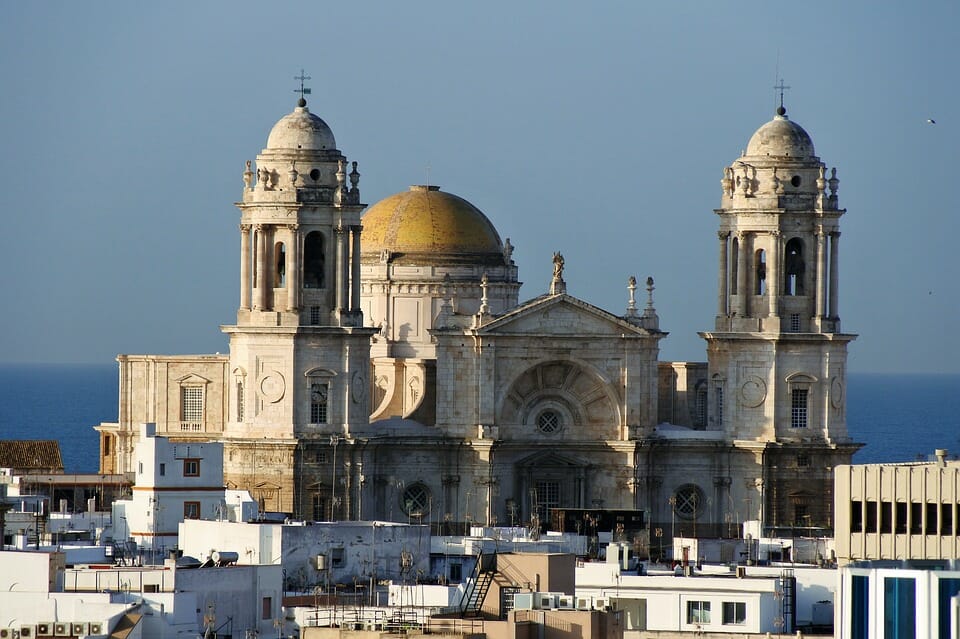
The yellow dome of Cádiz Cathedral overlooking the Atlantic
Cádiz Cathedral, with its yellow dome overlooking the seafront.

Cádiz Cathedral, also known as the New Cathedral, dominates the city’s seafront with its large yellow dome, visible from almost anywhere in the old town. Construction began in the 18th century to replace the previous cathedral, and the project lasted for over 116 years, with numerous interruptions, which explains why it features a blend of Baroque, Rococo and Neoclassical styles.

Inside is the crypt, where notable figures from Cádiz, such as the composer Manuel de Falla, are laid to rest. The climb up the Clock Tower offers one of the best panoramic views of the city and the Atlantic. It is advisable to check the visiting hours, which vary depending on the season and liturgical services.

3. Tavira Tower

The Tavira Tower is the tallest of the old watchtowers that merchants from Cádiz built to keep watch for incoming ships: it is around 33 metres high and its highest point stands 45 metres above sea level. Today it is famous for housing a camera obscura that projects moving images of the city in real time and live onto a concave surface.

From its terrace, you can enjoy a 360-degree view over the rooftops, domes and the sea, and it is one of the best places from which to understand the urban layout of the old town. The camera obscura sessions are organised in batches, so it is advisable to plan your visit in advance.

4. La Caleta Beach

La Caleta beach in Cádiz, with its Art Nouveau seaside resort
La Caleta beach, between the castles of Santa Catalina and San Sebastián.

La Caleta beach is Cádiz’s quintessential city beach, a small cove nestled between the castles of Santa Catalina and San Sebastián, right in the heart of the old town. Its compact size and its Art Nouveau lido, the Balneario de Nuestra Señora de la Palma y del Real, make it one of the city’s most photographed sights.

It is a place particularly worth visiting at sunset, when the sun sets over the Atlantic. As well as going for a swim, many visitors come here simply to stroll along the beach and enjoy the views of the two castles that flank it.

5. The Pópulo neighbourhood

The Pópulo neighbourhood is the medieval heart of Cádiz and the oldest part of the city. It still retains three of the old gates in the city walls — the Arcos de la Rosa, the Arcos del Pópulo and the Arcos de los Blancos — which provided access to the city. The Church of Santa Cruz, the city’s former cathedral, is also located here, which is why the current cathedral is known as the New Cathedral.

Its narrow streets lead to the Roman Theatre, one of the largest surviving examples in Spain, discovered in the 20th century. It is an ideal area for a leisurely stroll, with whitewashed houses, tapas bars and an atmosphere that blends history with everyday life. Its proximity to the Cathedral makes it easy to include in your itinerary.

6. Plaza de San Juan de Dios

Plaza de San Juan de Dios in Cádiz, with the Town Hall façade
Plaza de San Juan de Dios, next to the harbour, with the Town Hall in the background.

Plaza de San Juan de Dios is the former Plaza Mayor of Cádiz, also known as La Corredera, and remains one of the city’s most central and lively squares, situated next to the harbour and on the edge of the Barrio del Pópulo neighbourhood. It is dominated by the neoclassical façade of the Town Hall, the church of San Juan de Dios and the Casa de los Pazos Miranda, and features a monument to the Cádiz-born politician Segismundo Moret.

Its terraces, palm trees and proximity to the arrival area for boats, trains and buses make it a good starting point for exploring the old town. It is almost a must-see for anyone visiting the city.

7. Plaza de España

Plaza de España in Cádiz is a spacious esplanade opening out onto the bay, best known for the Monument to the Constitution of 1812, erected to commemorate the centenary of the enactment of «La Pepa» in the city. This large sculptural ensemble serves as a reminder of the central role Cádiz played in the history of Spanish constitutionalism.

Notable landmarks in the surrounding area include the Casa de las Cinco Torres and the former Palacio de la Aduana, now the headquarters of the Provincial Council. Just a short walk away is the Museum of Cádiz, which houses Phoenician and Roman archaeological finds and a remarkable collection of paintings; it’s well worth a visit if you have the time.

8. Genovés Park

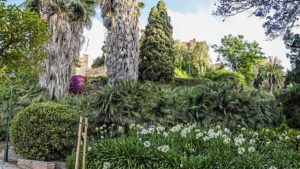
Parque Genovés is Cádiz’s main historic garden, situated by the sea and within the walled city. It is notable for its botanical collection, featuring species from various origins and trees and shrubs pruned into geometric shapes, as well as a small lake with a waterfall and several monuments dotted along its paths, including the well-known ‘Niños del Paraguas’ fountain.

It is a peaceful spot, perfect for relaxing in the shade whilst out and about or for a family stroll, and it hosts open-air concerts and theatre performances. Entry is free and it provides a lovely green contrast amidst all the stone and sea.

9. Promenade

The Cádiz seafront promenade stretches for over three kilometres along the Atlantic coast, running alongside La Victoria and Santa María del Mar beaches, in the city’s more modern area. It is a favourite spot for a stroll among the people of Cádiz, especially in the evening, with wide pavements, palm trees and unobstructed views of the ocean.

Several beach bars on La Victoria beach remain open for much of the year, and the Cádiz Football Club stadium is situated next to the main avenue. Although this area is a little further from the old town, it provides a good link between the historic quarter and the large urban beaches. A stroll here at sunset is one of the easiest ways to understand Cádiz’s relationship with the sea.

10. The castles of Cádiz (Santa Catalina and San Sebastián)

The two castles flanking La Caleta are key elements of Cádiz’s historic defensive system. Santa Catalina Castle, with its star-shaped layout, was built in the late 16th century following the Anglo-Dutch sacking of 1596, based on plans by the engineer Cristóbal de Rojas, and today serves as a cultural centre with exhibition halls, workshops and concerts held in its parade ground.

San Sebastián Castle stands on a small island connected to the mainland by an elevated walkway, with a lighthouse at one end. It houses a marine research laboratory run by the University of Cádiz and is used as an exhibition space and concert venue, as well as offering one of the most unique panoramic views of the city from the sea. Both can be visited according to the opening schedule, so it is advisable to check opening times and any closures before you go.

How to get to Cádiz and get around the city

Cádiz is well connected by road and rail. The medium-distance and commuter rail lines link the city with Jerez, El Puerto de Santa María and Seville, with trains arriving at the station next to the harbour and at Plaza de San Juan de Dios. By car, you can access the city via the 1812 Constitution Bridge, which connects the city to the bay; bear in mind that parking in the old town is difficult and it’s usually worth using paid car parks near the centre.

Once in the city, the old town is easy to explore on foot: the distances between the main sights are short and most are concentrated within the walled enclosure. To reach the seafront promenade and the large beaches in the modern part of the city, there are city bus routes, although it is also a manageable walk. The compact layout of Cádiz is, in fact, one of its great advantages for a one- or two-day visit.

What to see near Cádiz

There is much more to the province than just the capital. Very close by is Jerez de la Frontera, known for its flamenco and its sherry cellars, and to the south lie the beaches of Zahara de los Atunes y Tariff, at the southernmost tip of the peninsula. El Puerto de Santa María and Conil de la Frontera round off the options for extending your break.

Frequently asked questions about what to see in Cádiz

What are the must-see attractions in Cádiz?

The must-see sights in Cádiz city centre include the Cathedral, the Tavira Tower with its camera obscura, La Caleta beach – situated between the castles of Santa Catalina and San Sebastián – the Pópulo neighbourhood and the Gran Teatro Falla. These are the places that best encapsulate the walled old town and the city’s connection to the sea.

How many days do you need to see Cádiz?

A full day is enough to see the main sights of the old town, as the city is compact and can be explored on foot. If you want to take your time visiting the interior of the cathedral or the Tavira Tower and enjoy the city beaches, two days are more convenient.

What can you do in Cádiz in a day?

In a single day, you can climb the Tavira Tower, visit the Cathedral, stroll through the Pópulo district and the Praça de São João de Deus, and finish off at La Caleta and the seafront promenade at sunset. It’s a walking tour that combines monuments, squares and the sea.

If you liked... Share!

Make the most of it! only during the month of November and book our excursions.

UP TO 30% DISCOUNTS

Book now and enjoy the tour whenever you want!

BLACK MONTH offer valid from 1 November at 00:00h until 30 November at 23:59h.

We have a present for you!

Download the ebook "What to see in Malaga in 3 days - the perfect route" for free! and plan your perfect trip to discover Andalusia from Malaga.