EN
EN  ES
ES  FR
FR  DE
DE 
What do you know about this legendary town? Do you know what to see in Tarifa? Tarifa is a town located on the southern coast of Spain, in the province of Cadiz, and is known for its beaches and for being the southernmost point of Europe. As well as enjoying the coastline and water sports, Tarifa also has a rich history and culture worth exploring. From Visitanddo.com we leave you with 15 must-sees what to see in Tarifa.
The old town of Tarifa is a labyrinth of narrow cobbled streets lined with whitewashed houses with flowers on the balconies and craft shops. It is a perfect place to stroll around and enjoy the atmosphere.
The old town of Tarifa is a network of narrow, cobbled streets that reflect the city's rich history and Andalusian character. Largely surrounded by medieval walls, this historic quarter retains the essence of bygone eras, with its whitewashed houses and flower-decked courtyards, offering visitors an authentic and picturesque experience.
One of the most emblematic entrances to the old town is the Puerta de Jerezone of the ancient entrances to the city that has endured over the centuries. Passing through this gate is like travelling back in time, entering a labyrinth of narrow streets that do not follow a defined urban pattern, a common feature in many Andalusian villages.
Among the most prominent routes is the Calle Sancho IV el BravoThe main artery runs through the old town from east to west, connecting various points of interest and allowing visitors to immerse themselves in the daily life of Tarifa.
The old town is home to a number of interesting monuments, such as the Church of San MateoThe church, the city's main temple, whose construction began in the 16th century. This religious building is a remarkable example of the architecture of the period and a landmark in the heart of the historic centre.
In addition, the old town is known for its vibrant life in the squares, full of bars and restaurants offering delicious local gastronomy. It is a perfect place to enjoy Andalusian culture and cuisine in a historic and charming setting.
Strolling through the old town of Tarifa is an experience that allows visitors to connect with the history, culture and traditions of this ancient city, enjoying its architecture, its atmosphere and its people.
The Puerta de Jerez is one of Tarifa's most emblematic monuments and the only remaining access to the ancient walls that surrounded the town. Built in the 13th century, during the extension of the walled enclosure under Benimerín rule, it served as the main entrance from the north, connecting Tarifa with Jerez de la Frontera, hence its name.
Originally, Tarifa had three main gates: the Puerta del Retiro to the east, the Puerta del Mar to the west and the Puerta de Jerez to the north, the latter being the only one that has survived to the present day.
The structure of the Puerta de Jerez has two large crenellated towers on the outside, characteristic of medieval military architecture, which served as defensive elements. Above the entrance arch, an inscription can be seen commemorating the reconquest of Tarifa by Sancho IV el Bravo in 1292, with the legend: "VERY NOBLE, VERY LOYAL AND HEROIC CITY OF TARIFA WON FROM THE MOROS REIGNED BY SANCHO IV EL BRAVO, ON THE 21st OF SEPTEMBER 1292".
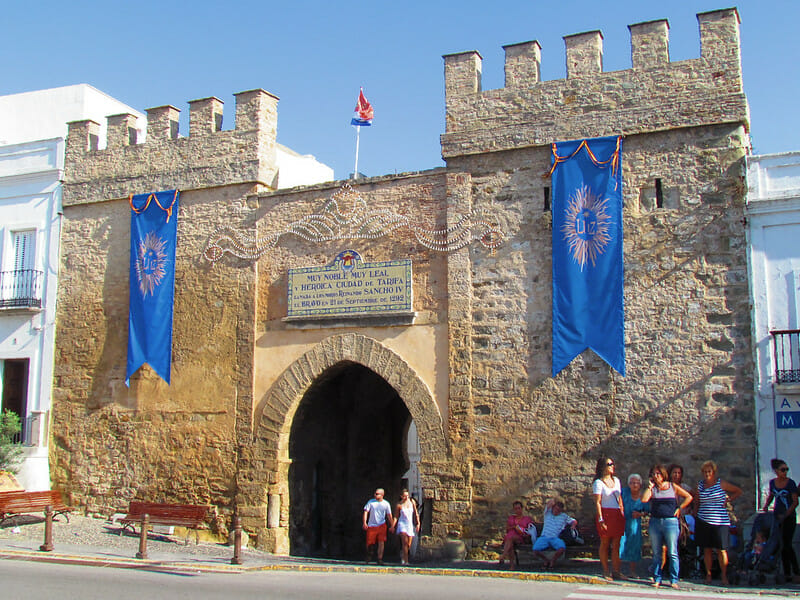
In the year 2000, the Puerta de Jerez was restored and a work by the artist Guillermo Pérez Villalta from Tarifa, called "El Cristo de los Vientos" (Christ of the Winds), was installed inside it, located in a niche decorated with an intense blue colour and a starry vault, adding a contemporary artistic value to the historical monument.
In addition to its historical and architectural value, the Puerta de Jerez is a reference point for visitors wishing to enter the old town of Tarifa, offering a transition between the modernity of the town and the charm of its cobbled streets and whitewashed houses. Its conservation and restoration make it a living testimony to Tarifa's rich history and an obligatory stop for those who wish to understand the past and present of this Andalusian town.
The Medieval Walls of Tarifa are a tangible testimony to the rich history and strategic importance of the town over the centuries. Originally, Tarifa had three walled enclosures: the Almedina Wallthe Aljaranda Wall and the Arrabal Wall. These defensive structures were essential to protect the city from invasions and attacks, especially during the Middle Ages.
The Almedina Wall is the oldest and surrounded the original core of the city, where the castle and the main buildings were located. The Aljaranda WallThe remains of which can be seen in the Prison Exhibition Hall, extended protection to new built-up areas. Finally, the Arrabal Wallthe most extensive one, included the emblematic Puerta de Jerezone of the main entrances to the old town.
In March 2015, major restoration work was carried out on the walls of the Aljaranda and Arrabal, recovering significant sections of the coastal path or parapet. This intervention enabled the creation of a route of approximately 500 metres, known as the "Caminha de Ronda".Fare in styleThe "City of the City", which offers visitors the opportunity to walk on the ancient defences of the city.
The itinerary starts at the Network Tower and extends to the Los Maderos Towerpassing through strategic points that offer panoramic views of the old town of Tarifa and the majestic Strait of Gibraltar. On clear days, it is possible to make out the African coast, highlighting the town's privileged geographical position as a bridge between two continents.
This walk not only allows us to appreciate the medieval military architecture, but also to understand the urban evolution of Tarifa and its adaptation to defensive needs throughout history. The restored towers and walls offer a detailed view of the construction techniques used and the importance of these structures in the protection of the town.
In addition, the route is conditioned to facilitate access to visitors, with security measures and information panels that enrich the experience, providing historical context and architectural details of interest. This project has revitalised an essential part of Tarifa's heritage, making it a tourist attraction that combines history, culture and breathtaking scenery.
For those who wish to delve deeper into the history of the walls and their relevance in historical events, such as the resistance against Napoleonic artillery during the siege of 1811-1812, there are studies and publications that analyse these aspects in detail.
In short, the Medieval Walls of Tarifa and the "Tarifa in style" tour offer a unique experience for visitors, combining the exploration of historic defensive structures with spectacular views, enriching the understanding of the town's past and its cultural heritage.
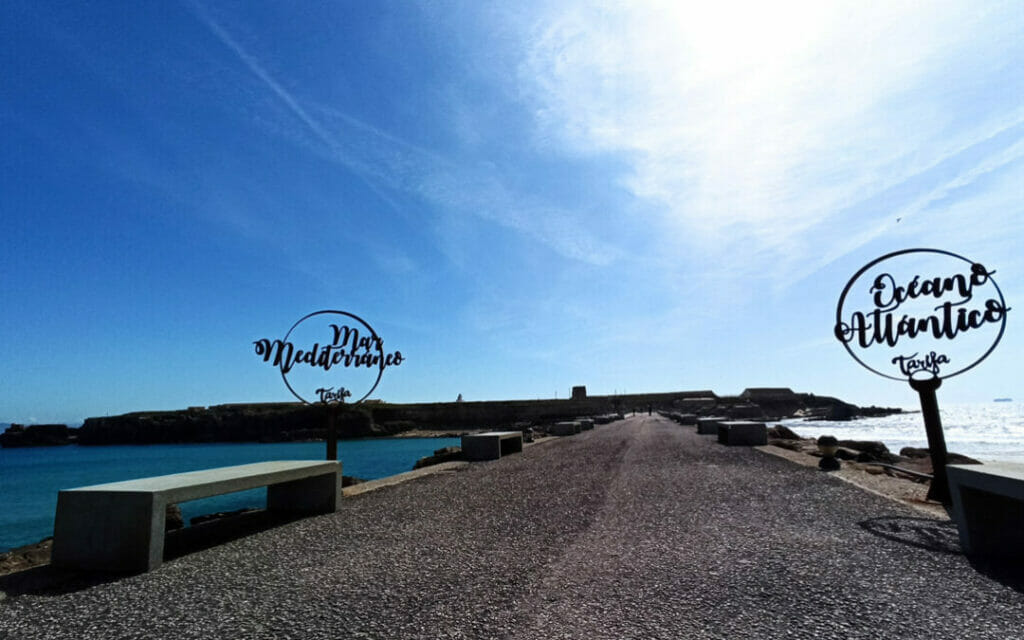
The Las Palomas Island is an emblematic point in Tarifa, Cadiz, which marks the southernmost point of continental Europe and separates the Mediterranean Sea from the Atlantic Ocean. This islet, of approximately 0.5 hectares, has witnessed several historical moments and possesses a significant natural and cultural wealth.
History and Origin
The island has been inhabited since ancient times. The Phoenician settlers used it as a strategic point for supplying supplies and establishing trade relations, taking advantage of its location to control the Strait of Gibraltar.
During Roman times, the island was home to limestone quarries, used in the construction of various infrastructures. Later, in the 20th century, the island became the property of the Ministry of Defence, which established military installations in the area.
Access and Visits
Access to Las Palomas Island is restricted due to its military use and the need to preserve its natural and cultural environment. However, it is possible to visit the Tarifa Island Interpretation Centrelocated in the building annexed to the Tarifa lighthouse, which offers detailed information on the history and biodiversity of the island. Visits to the centre are arranged through the municipal tourist office, and must be booked in advance.
Interpretation Centre
The interpretation centre, under the slogan "The Island of Tarifa. Witness to the History of the Strait", divides its themes into five blocks:
These exhibitions allow visitors to understand the strategic and cultural importance of the island over the centuries.
Natural Environment and Biodiversity
The Isla de Las Palomas is a place of great ecological interest. Its waters are home to a fossiliferous deposit between 5 and 10 million years old, although the surface has been altered by the extraction of limestone rock.
In addition, the island is a strategic point for the observation of sea birds, especially during migrations, which makes it a place of interest for ornithology lovers.
The Church of San Mateo is Tarifa's main religious temple, located in the heart of the old town. Its construction began in the early 16th century, in approximately 1506, on the remains of an old mosque, reflecting the town's transition from Muslim to Christian domination.
The original design of the church has a three-nave plan, characteristic of the late Gothic style, with ribbed vaults that are still preserved in the central nave and transept. Throughout the 17th century, several side chapels were added, enriching the architectural ensemble and providing spaces for private devotion for the influential families of the time.
One of the most outstanding elements of the church is its main façade, a masterpiece of Andalusian Baroque. Designed by the architect Torcuato Cayón de la Vega in 1774, the construction of the façade was completed in 1778 under the direction of the master builder Carlos Hermida. The façade is characterised by its elaborate ornamentation, with Solomonic columns and a central niche housing an image of the Virgin Mary. However, due to the use of poor quality materials in its original construction, such as biscorniz, the façade has required several restorations over the years to preserve its integrity.
The church's bell tower, with a sturdy square base, is crowned by a flanking dome, adding verticality to the ensemble and serving as a visual landmark in Tarifa's skyline.
Inside, the Sagrario Chapel is notable for its magnificent dome on pendentives, which extends to the ground to form three semi-circular chapels. This chapel was restored in 1899, reflecting the community's ongoing commitment to the conservation of the city's religious and artistic heritage.
The Church of San Mateo is not only a place of worship, but also a living testimony to Tarifa's rich history, reflecting in its architecture the various influences and transformations that the town has undergone over the centuries. Its central location makes it a point of reference for visitors and locals alike, offering a space for spiritual recollection and artistic admiration in the heart of Tarifa.
The Church of St. Francis of Assisi is a Catholic temple located in the historic centre of Tarifa, in the province of Cadiz, Spain. This building stands out for its baroque architecture and its rich history, being a place of interest for lovers of religious architecture.
History and Construction
The church has its origins in the 16th century, with fountains dating back to 1519. Over the centuries, it has undergone several modifications and restorations. After the Lisbon earthquake of 1755, the building was severely damaged and was practically demolished. Reconstruction was carried out between 1794 and 1797, following the Baroque and Neoclassical stylistic models of the period.
Architecture and Features
The church has a rectangular floor plan with three naves separated by quadrangular pillars resting on semicircular arches. The central nave is covered by a semicircular or barrel vault and culminates in a semicircular apse where the High Altar is located. The side naves have balconies that were once used to attend services. The interior houses valuable religious imagery, including the crucified Santo Cristo del Consuelo, a 16th century carving.
Location and Access
The Church of San Francisco de Asis is located in the Plaza del Angel, to the west of Tarifa's old town. Its location in the historic centre allows visitors to explore the narrow cobbled streets and flower-filled courtyards that characterise the town.
Cultural Importance
In addition to its architectural value, the church is an important centre of worship and a symbol of Tarifa's religious history. Its conservation allows visitors to appreciate the rich heritage of the town and to better understand its historical evolution.
In short, the Church of San Francisco de Asís is an emblematic monument that offers a deep insight into Tarifa's history and religious architecture, inviting visitors to explore and discover the cultural richness of this charming Andalusian town.
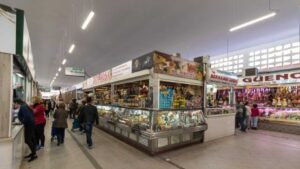
The Tarifa Food Market is a vibrant space where visitors can immerse themselves in the authentic local life of the town. Located in the heart of the old town, this market offers a wide variety of fresh and authentic produce, including fish and seafood caught in the waters of the Strait of Gibraltar, locally grown fruit and vegetables, as well as locally produced meats and sausages.
The market stalls are characterised by the quality and freshness of the products they sell. Here, visitors can find a large selection of fish and seafood, such as anchovies, bluefin tuna, octopus and prawns, which are the stars of the local gastronomy. In addition, there is a variety of seasonal fruit and vegetables, as well as baked goods. The shopkeepers are known for their friendliness and for sharing cooking tips and typical recipes with customers.
One of the great attractions of Tarifa's Mercado de Abastos are the food stalls offering typical dishes of the region. Visitors can enjoy tapas and portions of freshly prepared fresh produce, such as sardine skewers, Andalusian gazpacho, salmorejo, or the popular pescaito frito (fried fish). This is an excellent opportunity to experience authentic Andalusian cuisine, where local and high quality ingredients are used.
The market is not only a place to shop, but also a space where the people of Tarifa come together to socialise and share their daily lives. The atmosphere in the Mercado de Abastos is lively and vibrant, with loud conversations between traders and regular customers. The stalls are authentic and reflect the culinary traditions of the region, providing a glimpse into the local culture.
Tarifa's Mercado de Abastos is open for most of the day, from early morning until late afternoon, from Tuesday to Saturday. It is easily accessible on foot from any point in the historic centre of Tarifa, allowing visitors to enjoy a pleasant walk through the cobbled streets of the town before or after shopping. In addition, its proximity to other tourist attractions such as the Church of San Mateo and the medieval walls makes it a perfect complement to a complete visit to Tarifa.
The Los Lances Beachlocated in Tarifa, Cadiz, is one of the most emblematic of the region, renowned for its impressive extension and natural beauty. It stretches for approximately 7,250 metres, from the Punta de La Peña to the Punta de Tarifawith an average width of 120 metres.
This beach is commonly divided into two zones:
The beach is part of the Paraje Natural Playa de Los Lancesa protected area covering 226 hectares. This spot is a strategic point for the observation of migratory birds that cross the Strait of Gibraltar, making it a place of interest for ornithology lovers.
The rivers de la Jara and de la Vega, together with the Salado stream, flow into this beach, creating areas of marshland that enrich the biodiversity of the area. These natural conditions make Los Lances an exceptional habitat for various species, including the otter, which finds refuge in the reeds and rushes on the shores.
In addition to its ecological value, Playa de Los Lances is internationally recognised as a paradise for water sports, especially kitesurfing and the windsurf. The constant winds, both from the east and west, create optimal conditions for the practice of these disciplines, attracting sportsmen and women from all over the world.
It is important to note that, despite its popularity, the beach has faced challenges related to the conservation of its natural environment. The dune system, in particular, has suffered degradation due to the constant traffic of people and vehicles. Therefore, measures have been implemented to protect and restore these areas, promoting a responsible and sustainable use of the space.
For those who wish to enjoy a day at Los Lances, the beach offers panoramic views of the Strait of Gibraltar and, on clear days, it is possible to catch a glimpse of the African coast. The combination of its golden sand, crystal clear waters and protected natural environment make it an essential destination for visitors to Tarifa.
The Valdevaqueros Beachlocated some 9.7 kilometres northwest of Tarifa, is one of the natural jewels of the Costa de la Luz in the province of Cadiz. With an approximate length of 4,050 metres and an average width of 120 metres, this beach is characterised by its golden sand and crystal-clear waters, offering an ideal setting for relaxation and outdoor activities.
One of the most outstanding features of Valdevaqueros is its dune system, especially the large dune of Punta Paloma, formed to protect former military installations and which today constitutes a natural attraction of great interest. These dunes, shaped by the prevailing winds of the area, create a dynamic and constantly changing landscape, being a remarkable example of the sandy coastal formations of Andalusia.
The beach is internationally recognised as a paradise for beach lovers. kitesurfing and the windsurf. The constant winds, both from the east and west, generate optimal conditions for the practice of these water sports, attracting sportsmen and women from all over the world. In the area, there are various schools and specialised centres offering courses and equipment hire for beginners and experts.
In addition to water sports, Valdevaqueros has a varied gastronomic offer. Along the beach, it is possible to find beach bars and restaurants serving typical Andalusian cuisine, allowing visitors to sample fresh fish, seafood and other local delicacies while enjoying panoramic views of the sea.
Access to the beach is via signposted paths from the N-340 road, with parking areas available for visitors. It is important to mention that, during the summer months, the influx of tourists can be high, so it is advisable to arrive early to ensure a place on the beach and to facilitate parking.
The Valdevaqueros Beach not only stands out for its natural beauty and opportunities for water sports, but also for its relaxed atmosphere and the quality of its services, which makes it an essential destination for those who visit Tarifa and seek to enjoy nature at its best.
The Bolonia Beachlocated about 20 kilometres north of Tarifa, is one of the most outstanding destinations in the region. This beach not only offers breathtaking natural beauty, but also a fascinating historical background, making it a must for travellers in the area.
Bolonia Beach is known for its extensive dune, which is one of the largest and best preserved on the Iberian Peninsula. This dune, more than 30 metres high, provides spectacular panoramic views of the natural surroundings and is an ideal place to enjoy the sun and sea views. The beach of golden sand and crystal clear waters invites visitors to relax, swim and practice water sports such as windsurfing and kitesurfing.
One of the main attractions of Playa de Bolonia is the archaeological site of Baelo Claudialocated on the coast itself. This ancient Roman city was an important fishing port and commercial centre. Today, visitors can explore the ruins of thermal baths, houses, temples and the forum, which offer a unique insight into life in ancient Rome. The best preserved remains include a temple dedicated to the goddess Ceres, as well as the impressive theatre which is still used for performances in summer.
The setting of Playa de Bolonia is marked not only by its natural beauty, but also by its historical and cultural importance. The combination of the dune with the Roman ruins makes this place a meeting point between nature and history, allowing visitors to experience a journey back in time while enjoying the tranquillity of the beach.
To get to Bolonia Beach from Tarifa, you can follow the N-340 road until you reach the intersection with the A-2233 which leads directly to the beach. Despite its relatively remote location, the beach has some services such as beach bars offering local cuisine, public toilets and areas for renting umbrellas and sun loungers. It is also popular with surfers and water sports enthusiasts due to its open waters and constant winds.
In short, Playa de Bolonia is a natural and historical gem that not only allows you to enjoy the sun and sea, but also to immerse yourself in the region's rich Roman history. It is a place worth visiting for those looking to combine a day at the beach with an immersion into the past.
The Castle of Guzmán el Buenolocated in Tarifa, is a fortress of great historical and architectural importance. Built in the year 960 by order of the Caliph Abderramán III, its main purpose was to protect the city from possible invasions and to control the strategic crossing of the Strait of Gibraltar.
The layout of the castle is trapezoidal, adapting to the rocky terrain on which it stands. Its thick walls are reinforced by slightly protruding rectangular towers, characteristic of Caliphate military architecture with Byzantine influences.
One of the most prominent structures is the Tower of Guzmán el BuenoThe tower, an octagonal-shaped watchtower, is located at the western end of the castle. This tower, which formed part of the barbican, communicated with the castle through a coracha and has served as inspiration for other buildings, such as the keep of the castle of Santiago in Sanlúcar de Barrameda.
The main entrance to the castle is on the west side and is designed with a double-entrance system to improve the castle's defences. The first doorway, which curves around a bend, leads to a barrel-vaulted corridor with an upper opening called a buhera. After this corridor, one comes to the main gate, known as the Registration Gateway o of the Foundation Tombstoneflanked by two towers.
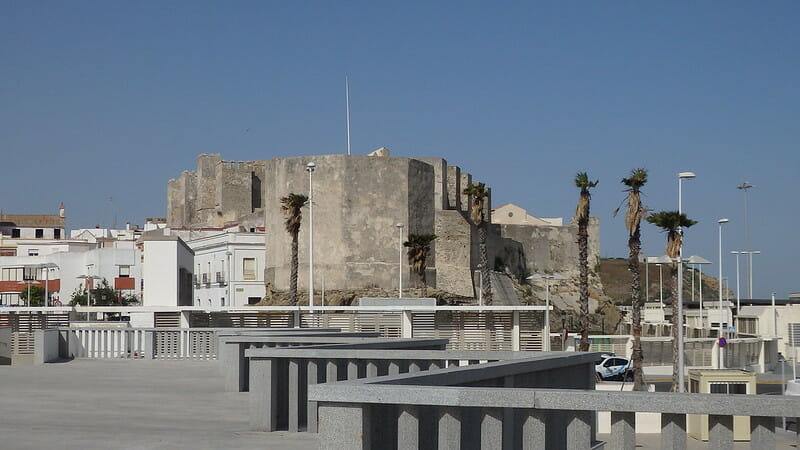
The castle owes its name to Alonso Pérez de Guzmán, known as Guzmán el Buenowho in 1294 defended the fortress during a Muslim siege. According to tradition, Guzmán preferred to sacrifice his own son rather than surrender the fortress, demonstrating a loyalty and bravery that made him a legendary figure.
In the 16th century, the castle underwent a transformation when it became a palatial residence during the Renaissance, incorporating architectural elements of the period. Later, in the 18th and 19th centuries, new structures were added and alterations were carried out to adapt it to the defensive needs of each period.
Today, the Castle of Guzmán el Bueno is open to the public and houses exhibitions that tell the rich history of Tarifa. From its towers, visitors can enjoy panoramic views of the Strait of Gibraltar and, on clear days, the African coast. Its location at the highest point of the old town makes it a privileged place to appreciate the natural beauty and strategic importance of Tarifa over the centuries.
This monument, declared an Asset of Cultural Interest, is a must-see for those who wish to delve into Tarifa's history and heritage, offering an experience that combines architectural exploration with the contemplation of breathtaking scenery.
The Santa Catalina Castle Tarifa Castle is an early 20th century building that stands out for its unique architecture and its strategic location on the Cerro de Santa Catalina, a hill near the town centre. Although it is not a medieval castle, its design and location give it a distinctive character that attracts visitors interested in the history and architecture of the region.
History and Construction
Construction of the castle began in 1929 and was completed in 1933. It was designed by the architect Julio Murúa, who was inspired by the Italian Renaissance style for its construction. The initial purpose was to house a traffic light for the port of Tarifa, and it was later used as a weather observation centre.
Architecture and Features
The castle has a star-shaped plan with two well-defined fronts: one formed by triangular bastions resting on the beach and the other open towards the city. The building rises 24 metres above sea level and is built with materials available in the 20th century, giving it a fortress-like appearance that harmonises aesthetically with the town and the hill on which it stands.
Views and Environment
From the Castle of Santa Catalina, visitors can enjoy panoramic views of the city of Tarifa, the Strait of Gibraltar and, on clear days, the African coast. Its elevated location allows one to appreciate the natural beauty of the surroundings and the proximity between the European and African continents.
Access and Visits
The castle is disused and is not open to the general public. However, its exterior and the surrounding environment can be visited, offering a unique experience for lovers of history and architecture.
In short, the Castle of Santa Catalina is a 20th century architectural jewel which, although not a medieval castle, offers an interesting insight into Tarifa's recent history and a privileged place to enjoy spectacular views of the town and its surroundings.
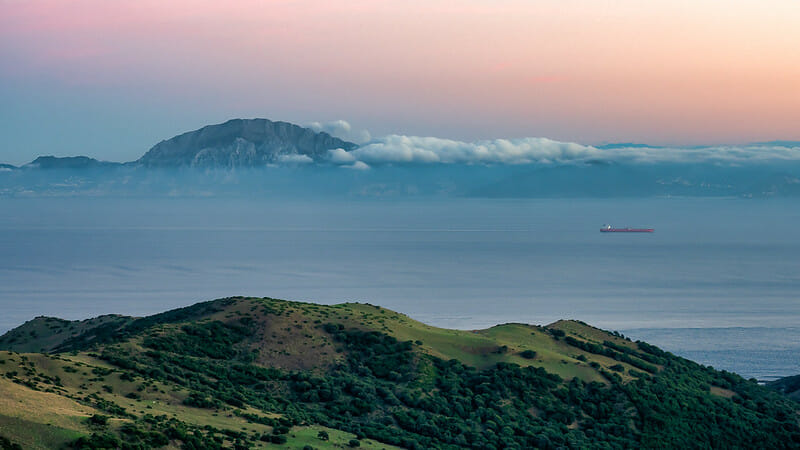
The Viewpoint of the Strait is a privileged observation point located approximately 6 kilometres northeast of Tarifa, in the province of Cadiz, Spain. Elevated some 300 metres above sea level, this viewpoint offers exceptional panoramic views of the Strait of Gibraltar, where the waters of the Mediterranean Sea meet those of the Atlantic Ocean.
Location and Access
The viewpoint is located on the N-340 road, one of the main roads connecting Tarifa with other towns on the Costa de la Luz. The strategic location of the viewpoint allows visitors to contemplate the proximity between the European and African continents, with a distance of just 14.4 kilometres between Punta de Oliveros in Spain and Punta Cires in Morocco.
Views and Attractions
From the Mirador del Estrecho, visitors can enjoy panoramic views that include:
Cultural and Natural Importance
The Mirador del Estrecho is not only a place of natural beauty, but also has great cultural and historical significance. The proximity between the European and African continents has been a meeting point for different cultures throughout history, making this viewpoint a symbol of the union of two worlds.
Recommendations for Visitors
Many people take advantage of their stay in Tarifa to visit the neighbouring country.
This natural park is one of the most important in Spain and is an ideal place to enjoy nature. Inside you can find animal and plant species that are unique in the world.. The Strait of Gibraltar is one of the most important places for bird migration in Europe, and the Strait's Natural Park is a perfect place to see this migration in action. The park is also home to a wide variety of wildlife, including dolphins, whales and sea turtles.
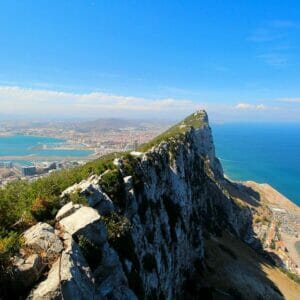
Many people take advantage of their stay in Tarifa to visit Gibraltar.
The ruins of Baelo Claudialocated a few kilometres from Tarifa, next to the beach of Bolonia, is one of the most important archaeological sites in Spain. This ancient Roman city, founded in the 2nd century BC, prospered during the Roman Empire thanks to its strategic location next to the Strait of Gibraltar, which allowed for fluid trade and the exploitation of the region's marine and agricultural resources.
Baelo Claudia was a nerve centre in antiquity, mainly because of its fishing activity and because it was a key point in the trade between Rome and the African regions. The remains of the city, most of which are well preserved, offer a unique insight into Roman life in the south of the Iberian Peninsula. Structures include the forum, the baths, an impressive theatre that could seat up to 3,000 people and a sanctuary dedicated to the goddess Tanit, indicating Punic influence and the integration of different cultures in the city.
Walking through the ruins of Baelo Claudia, visitors can admire the paved streets, dwellings, shops and workshops that show the urban organisation of the time. The baths, with their bathing areas and heating systems, show how comfort was managed in a Roman city. The forum, the nerve centre where political and commercial activities took place, gives an idea of the importance of Baelo Claudia as a centre of power in the region.
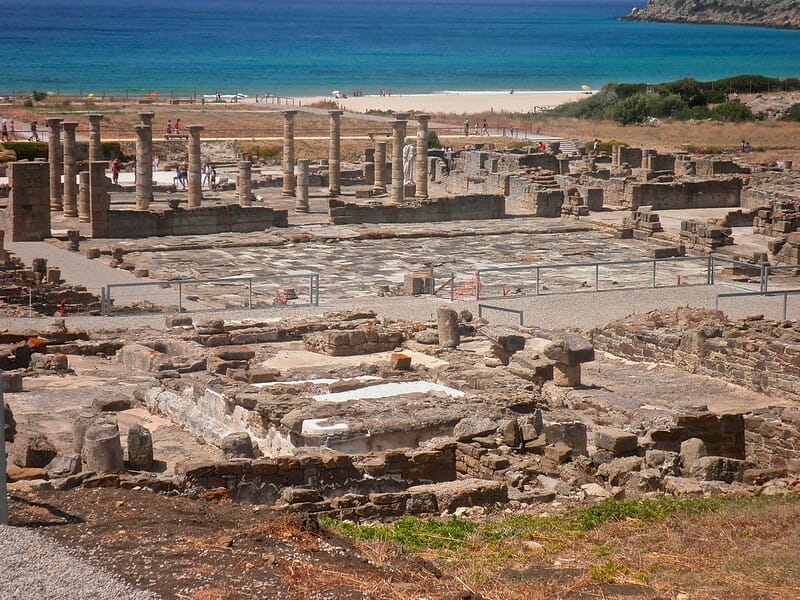
The site of Baelo Claudia has an interpretation centre that facilitates the understanding of the archaeological site through information panels and detailed exhibitions. This centre is essential for those who wish to delve deeper into the history of the city, explaining aspects such as daily life, construction techniques, the water supply system and the commercial activities that supported the population of ancient Baelo Claudia. In addition, the centre offers workshops and educational activities for families and school groups, enriched by 3D projections that recreate what the city was like in its heyday.
In short, Baelo Claudia is not only an important archaeological site in Spain, but also a place of learning and reflection on life in Roman times. The combination of the well-preserved ruins and the natural beauty of Bolonia beach makes this visit a must for those interested in ancient history and archaeology.
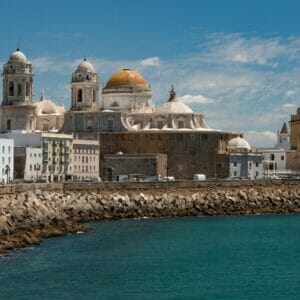
In addition to all of the above, Tarifa's location means that you can also enjoy discovering the province of Cadiz, as well as all that it has to offer in the surrounding area.
Here are some of them the best excursions to do from Tarifa and should be added to your list:
Tarifa is a town of great cultural and natural wealth, with a wide variety of places to visit and activities to enjoy. Whether you are interested in history, culture or nature, or simply want to enjoy the sun and sea, Tarifa is a place not to be missed.
Here is also a link to how to get to tarifa