Before entering the Mosque-Cathedral of Córdoba, it is worth knowing what to expect, as it is not a single, unified building but a complex of areas built at different times. The main parts to look out for are the forest of columns with their two-tone arches, the mihrab and the maqsura, the Patio de los Naranjos, the Renaissance cathedral standing in the centre, the Chapel of the Tabernacle and the bell tower. Familiarising yourself with them beforehand helps you understand the tour better and ensures you don’t miss the features that give the monument its meaning.
The Mosque-Cathedral of Córdoba is a World Heritage Site and embodies several centuries of construction: it began as a mosque in the 8th century, grew through successive extensions and, following the Christian conquest, a cathedral was built within it. It is this layering of history that makes a visit here so unique. If you’d prefer to explore it without having to worry about transport or tickets, you can do so with a organised day trip to Córdoba from Málaga including admission and a guide. Below, we’ll take a look, area by area, at what there is to see inside.
The original mosque was built from 785 onwards, under the emirate of Abd al-Rahman I, on a site previously occupied by a Visigothic basilica. Over the following centuries, the various rulers of Córdoba extended it in several phases until it reached the dimensions we see today, which explains why the interior changes in rhythm and proportions depending on the area you are in.
Following the Christian conquest of the city in 1236, the building was consecrated as a cathedral and remained in use, largely unchanged, for almost three centuries. In the 16th century, it was decided to construct a Renaissance transept and choir right at the heart of the old oratory, a project that transformed the monument’s appearance. Understanding this sequence of stages is what enables us to interpret each part of the building for what it is: layers of history coexisting within the same space. If you’d like to delve deeper into the architectural styles and construction techniques, you can find out more in our guide to the architecture of the Mosque of Córdoba.
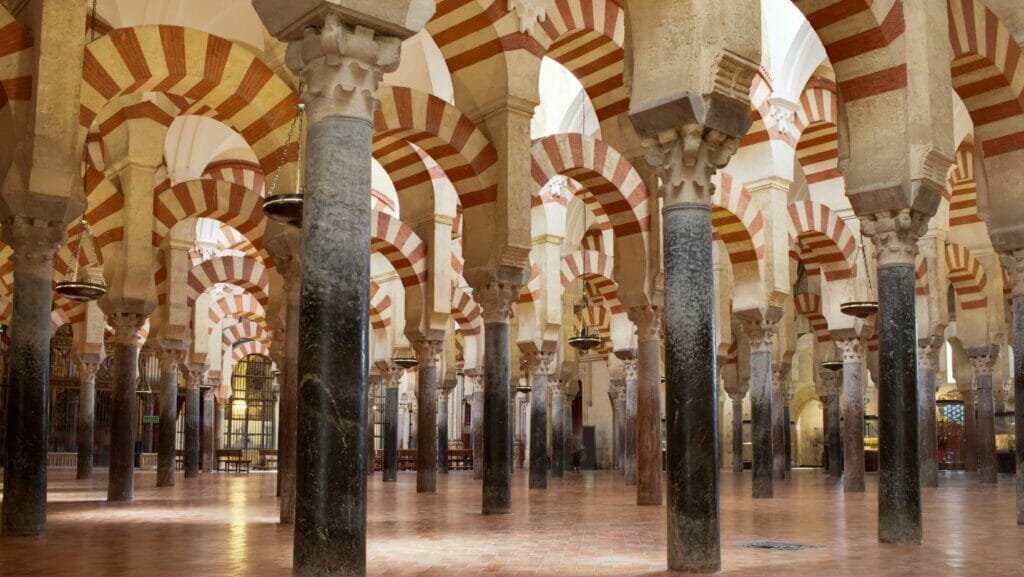
The prayer hall is the most recognisable part of the Mosque-Cathedral and the first thing you see as you enter from the courtyard. It consists of hundreds of columns lined up in rows, creating the effect known as the ‘forest of columns’: a grid that extends in all directions, giving a sense of continuous depth. Many of these columns and their capitals are reused elements from earlier Roman and Visigothic buildings.
Resting upon the columns are the two-coloured arches, the building’s most distinctive feature. These are arches with alternating voussoirs of light-coloured stone and reddish brick, arranged in two superimposed levels to gain height without compromising stability. It is this interplay of colours and the repetition of the arches that makes the hall the most photographed space in the complex. The Chapel of Villaviciosa is also incorporated here; it was one of the first areas within the old oratory to be adapted for Christian worship.
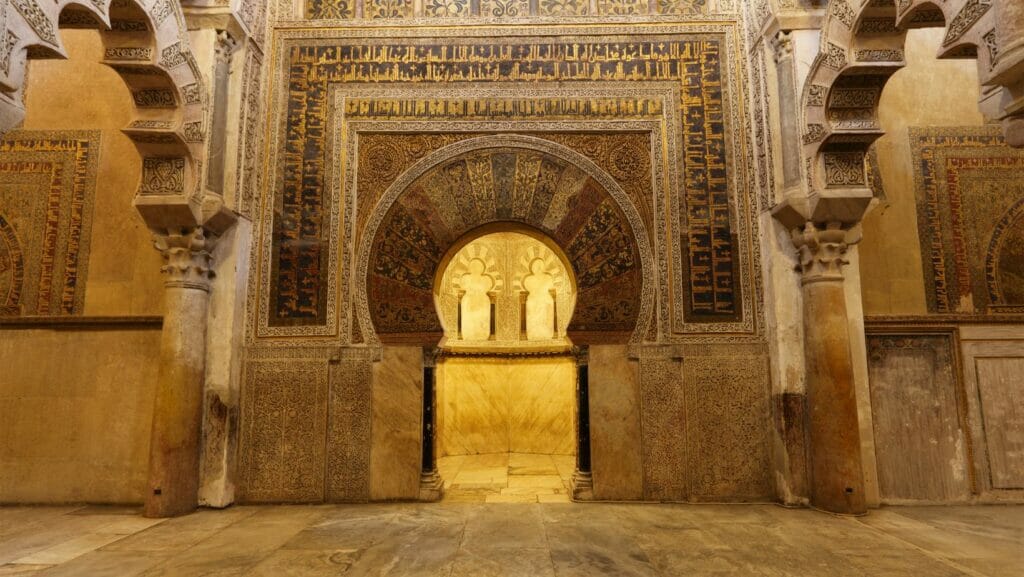
The mihrab is the point that indicated the direction of prayer and, within the mosque, the most elaborately decorated area. It is an open niche in the wall, framed by an arch covered with golden mosaics made of glass tesserae and inscriptions, crafted by specialist artisans. Unlike other mihrabs, this one was designed as a small space into which one could step, giving it a distinctive presence at the far end of the hall.
In front of the mihrab lies the maqsura, the reserved area that separated this section from the rest of the prayer hall. The maqsura is covered by domes featuring intersecting ribs and interlaced arches, which showcase the most elaborate ornamentation in the entire building. To understand these finishes in detail, you can consult our guide on the decorative features of the Mosque.
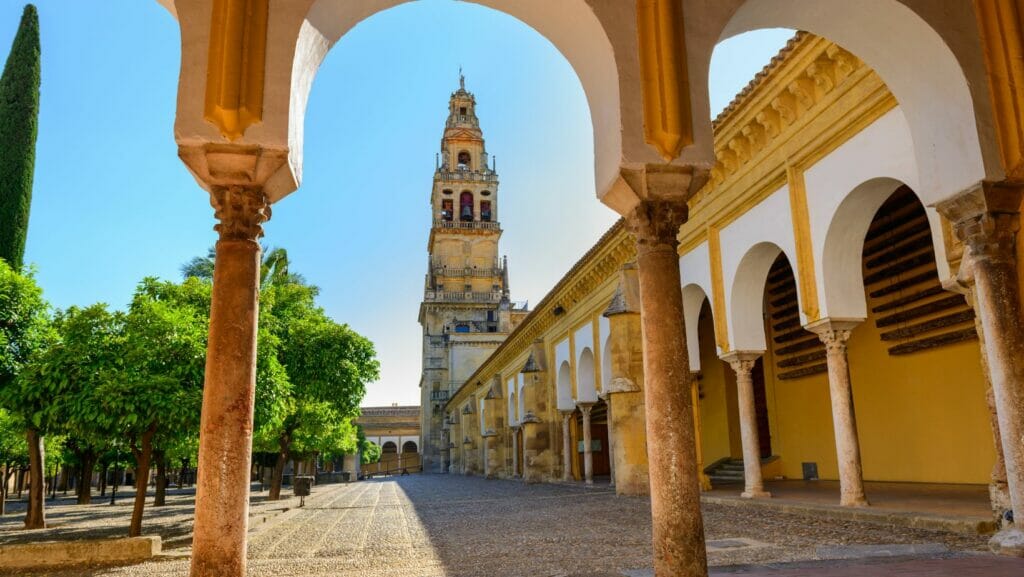
The Patio de los Naranjos is the open space through which one enters the monument and the part that many visitors explore first, sometimes without realising that it is already part of the Mosque-Cathedral. It was the place where worshippers would purify themselves before entering to pray, and it still retains the fountains and irrigation channels that distribute water amongst the rows of orange trees.
What is interesting about this courtyard is that its rows of trees visually extend the colonnaded aisles inside, so that the forest outside blends into the forest inside. It’s a good spot to get a sense of the complex’s scale and to locate the bell tower, which stands right on one of its sides. As it’s an open-air area, it’s also usually the quietest place to start or finish your visit.
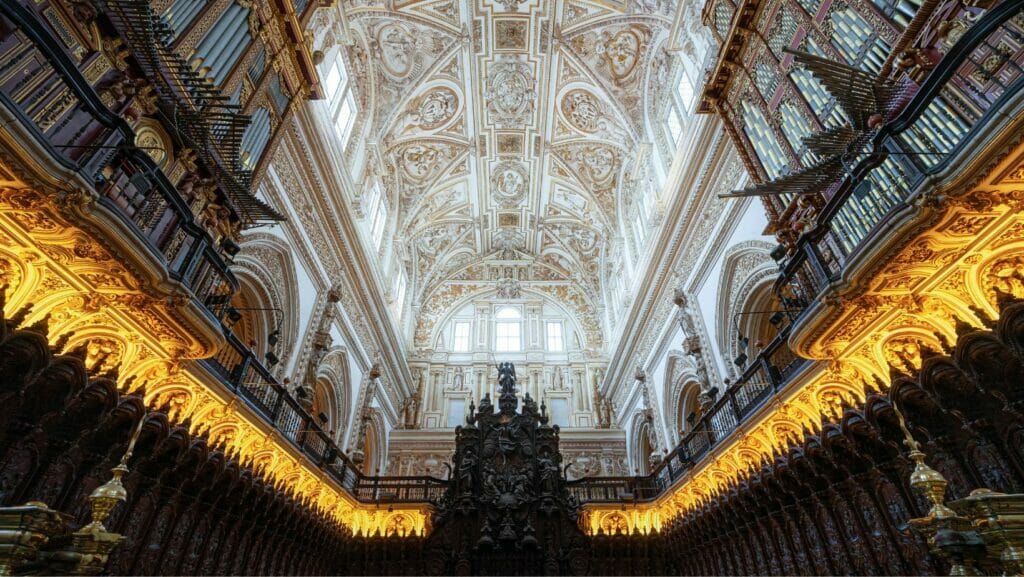
Right in the centre of the former prayer hall stands the Christian cathedral, built from the 16th century onwards. It features a soaring transept, with vaults and a carved choir, which breaks up the horizontal lines of the forest of columns and draws the eye upwards. The contrast between the enveloping half-light of the Muslim naves and the vertical light of the transept is one of the most striking moments of the tour.
This section includes the high altar, the choir stalls and several chapels situated around the perimeter of the building. It is worth taking your time to explore it, as from the inside you can see how the Renaissance church was fitted in amongst the pre-existing columns without dismantling the rest of the monument, resulting in the blend of styles that today defines the Mosque-Cathedral.
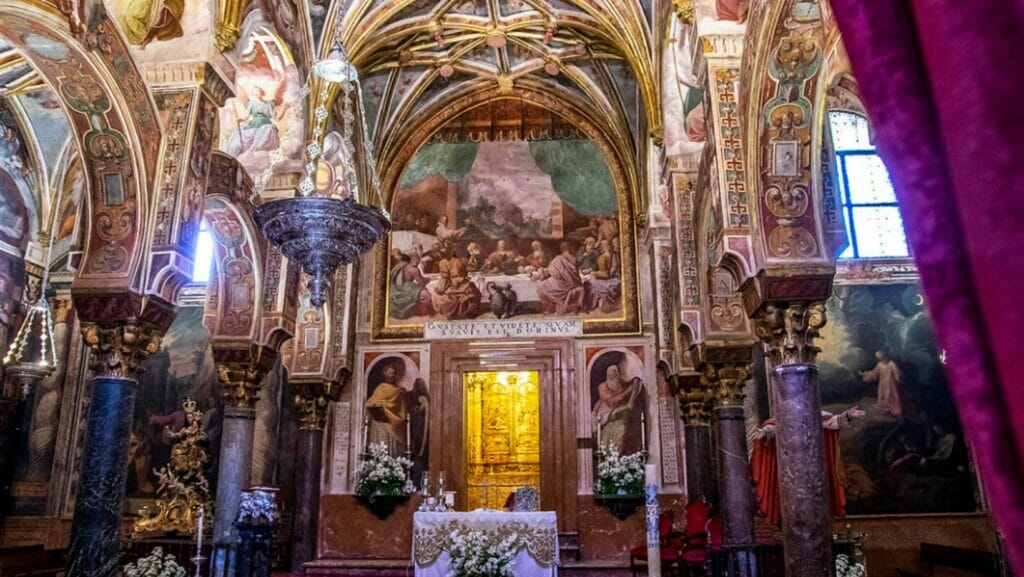
The Chapel of the Tabernacle is one of those places that is all too easily overlooked, yet it is well worth a visit. It is an enclosed space, situated on one side of the building, whose walls and vaulted ceiling are covered with murals depicting religious scenes in great detail.
In contrast to the austere stone and brick of the naves, colour dominates here, making it a fine counterpoint along the tour. It illustrates how the building gradually incorporated new uses and decorative features over the centuries, without any phase completely obliterating the previous one.
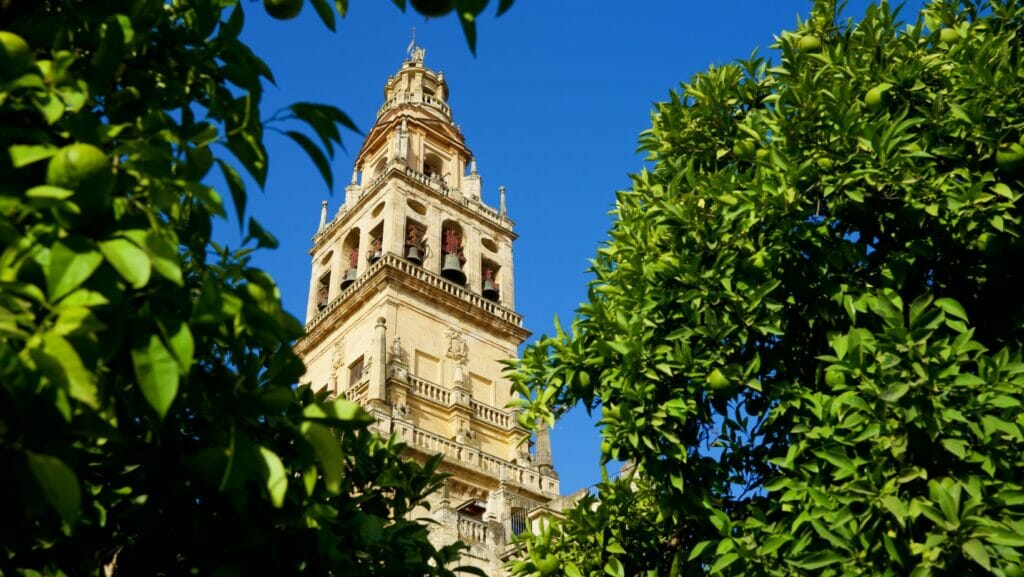
The tower that dominates the complex stands on the site of the mosque’s former minaret, from which the call to prayer was made. Following the Christian conquest, it was remodelled and a bell chamber was added, so that today it serves as the cathedral’s bell tower, just as is the case with other Andalusian monuments of Islamic origin.
From the top, you can enjoy views of the Patio de los Naranjos and Córdoba’s historic centre, although access to the climb may be subject to specific opening hours and capacity limits. If you’d like to find out more about its history and how to get to the top, we cover this in detail in the guide to the bell tower of the Mosque.
The usual route enters via the Patio de los Naranjos, continues through the forest of columns, approaches the mihrab and the maqsura, passes through the Renaissance cathedral in the centre and goes past the side chapels, including the Chapel of the Tabernacle. Taking your time to explore all these areas takes between one hour and an hour and a half, not including the climb up the tower, which is booked separately.
As opening times, admission prices and visiting times may vary depending on the season, it is best to check the latest information on the monument’s official website before you go and, during peak season, to buy your ticket in advance to avoid queues. If you’re travelling from the Costa del Sol and would rather not have to organise anything yourself, a guided tour takes care of transport, admission and commentary all in one go: book online with instant confirmation. To plan the rest of your day, you can also find out what else to see in the city in our guide to What to see in Córdoba.
The main features of the Mosque of Córdoba are the forest of columns with their two-tone arches, the mihrab and the maqsura, the Courtyard of the Orange Trees, the Renaissance cathedral at the centre, the Chapel of the Tabernacle and the bell tower. Each corresponds to a different stage of construction, so recognising them helps one to understand the monument as layers of history coexisting within the same space.
Inside the Mosque-Cathedral of Córdoba, you can see the forest of columns with their characteristic two-tone stone and brick arches, the mihrab covered in golden mosaics, the maqsura with its ribbed domes, the Renaissance cathedral erected in the centre, and the side chapels such as the Chapel of the Tabernacle, decorated with murals. The tour begins in the Patio de los Naranjos, which is now part of the complex.
Taking your time to explore the main parts of the Mosque-Cathedral of Córdoba takes between an hour and an hour and a half, not including the climb up the tower, which is organised separately and may have its own opening hours and capacity limits. During peak season, it is advisable to book your ticket in advance, as queues can extend the total duration of your visit.