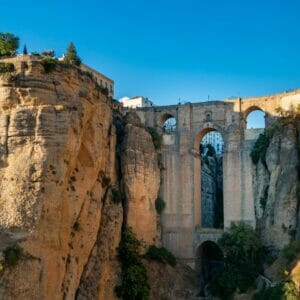
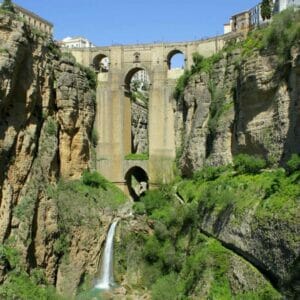
The Puente Nuevo bridge spans 98 metres of empty space over the Tagus, the gorge that splits Ronda in two.
And it has a story that hardly anyone tells properly, starting with the bridge that collapsed earlier.
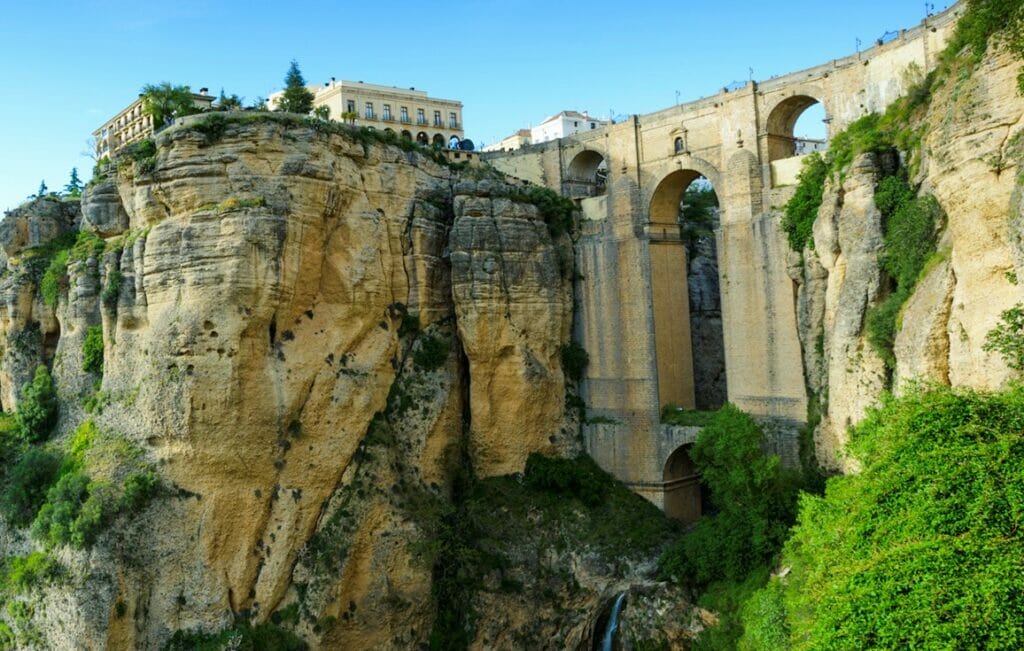
First of all, we need to clarify something that is constantly misunderstood: Ronda has three bridges on the Tagus, and all three are still standing.
The bridge that collapsed was none of those three. It was a room, built on the same site as the present one.
In 1735, the architects José García and Juan Camacho They built a bridge here a single 35-metre arch. They finished it in eight months, which was already a reckless move even back then.
It collapsed in 1741, six years later, and around fifty people died. The causes: lack of supports, poor arch closure and substandard workmanship.
And here’s the detail that brings it all full circle: The stone for the Puente Nuevo was quarried from the bottom of the gorge, from the rubble of that collapse. That is why the bridge blends in with the rock: it is the very same stone from the Tagus.
After the disaster, nobody wanted to try again for nearly twenty years. Work has resumed in 1759 and they didn’t finish until 1793: thirty-four years.
And it wasn’t the work of just one architect, although one is always mentioned:
How it was paid for: with 15,000 reales from the Real Maestranza and a tax on transactions at the May Fair. The city funded the bridge itself.
And how it was done: lowering the workers on ropes at the bottom of the gorge, with rockfalls and scaffolding hanging over the abyss.
This rumour is doing the rounds, so it’s worth setting the record straight: It is said that Aldehuela he threw himself into the Tagus when the bridge was completed, upon realising that he would never build anything bigger. Another version speaks of an accident that occurred during the inspection.
None of them is true. José Martín de Aldehuela he died of natural causes in Málaga in 1802, nine years after the bridge was completed, and he was buried in the convent of San Pedro de Alcántara.
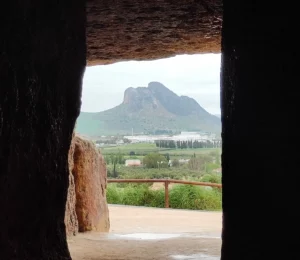
If you look at the central arch, you’ll see a small window. There’s a room inside, and it’s seen it all:
During the Civil War, according to contemporary accounts, Both sides used it as a place of execution, throwing the prisoners out of the windows into the depths of the Tagus. Hemingway incorporated it into his fiction, and from there it became part of the local collective imagination.
Today it is the Puente Nuevo Interpretation Centre, with access payment from the Plaza de España, through the old guardhouse. Inside, there is an explanation of the building’s construction and you can to look out of those very same windows.
It has its own opening hours, which is different from the bridge, so it’s best to check it beforehand.
You can cross the bridge for free: it’s just another street. But you can’t see it from above, and that’s the key to the visit.
For the photo: Early in the morning or at sunset, when the rock stands out against the shadow of the gorge.
The Tagus is a first-rate birdwatching spot, and the viewing points are at different heights along the cliff face, allowing you to see the birds flying below.
What you see: peregrine falcons y chaffinches, which nest in the walls. There are viewing points with telescope to observe the nests.
If you’re interested, go early: that’s when things are at their busiest.
The bridge is in the historic centre, so everything is within walking distance. Heading towards the old quarter: the Church of Santa María la Mayor, the Mondragón Palace and the Casa del Rey Moro. On the other side: the Real Maestranza bullring and the Alameda del Tajo.
The entire throat, in the Tagus Gorge. And the whole route, in What to see in Ronda y What to see near Ronda.
We are a local tour operator based in Málaga with over 50 years’ experience organising trips around Andalusia. Ronda is an hour and a half away, and the tour avoids the car park in the historic centre:
The first adds Setenil from Bodegas, with their houses nestled beneath the rock. The villages in the mountains, in The White Villages Route from Ronda y What to see in Setenil.
Ninety-eight metres from the base of the lower arch to the road surface, above the bed of the River Guadalevín. At this point, the Tajo Gorge is between one hundred and one hundred and twenty metres deep.
Work began in 1759 and was completed in 1793, a period of thirty-four years. Domingo Lois de Monteagudo supervised the work until 1778 and built the lower third; José Martín de Aldehuela then took over and completed it. The master builder was Juan Antonio Díaz Machuca.
Yes. In 1735, the architects José García and Juan Camacho built a single-arch bridge 35 metres long on the very same site, completing it in just eight months. It collapsed in 1741, killing around fifty people due to a lack of supports, poor archwork and shoddy construction. The stone used for the Puente Nuevo was subsequently quarried from the bottom of the gorge, from that rubble.
Three, and all are still standing: the Roman Bridge, which, despite its name, dates from the Muslim period; the Old Bridge, rebuilt in 1616 on its original foundations; and the New Bridge, the highest and most recent. The bridge that collapsed in 1741 was a fourth structure, distinct from the previous three.
No. It is said that José Martín de Aldehuela threw himself into the Tagus upon completion of the work, realising that he would never build anything greater, and there is also talk of an accident during an inspection. Neither version is true: he died of natural causes in Málaga in 1802, nine years after the bridge was completed.
Yes. The chamber situated above the central arch houses the Puente Nuevo Interpretation Centre, which can be accessed for a fee from the Plaza de España via the former guardhouse. That room was used as a storeroom, an inn and a prison, and during the Civil War, according to contemporary accounts, as a place of execution. It has its own opening hours, separate from those of the bridge.