If you’re looking for interesting facts about the Patio de los Leones, here are 10 facts that explain why this is the most recognisable part of the Alhambra. We’ve put together information on the origin of its name, details of its fountain, the legends surrounding it and other aspects that might go unnoticed during a quick visit.
The Patio de los Leones is the heart of the Nasrid Palaces and formed part of the sultan’s private quarters. To see it in person on a day trip from Málaga, without having to worry about transport or tickets, you can book a Day trip to Granada including tickets to the Alhambra. Please note that entry is only permitted with a ticket that includes the Nasrid Palaces. Here are the 10 interesting facts.
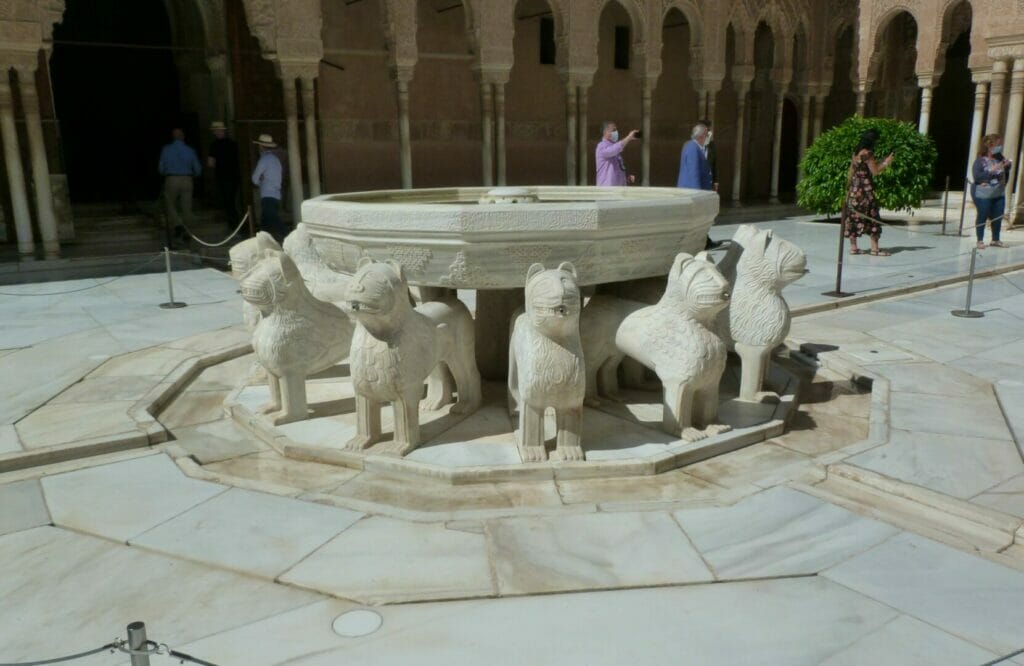
The courtyard takes its name from the fountain at its centre, supported by twelve marble lions spouting water from their mouths. It was not always called this: it was commissioned by Muhammad V in the second half of the 14th century and, during the Nasrid period, formed part of the Palace of the Lions, whose original name has been lost. It was later tradition that established the popular name based on the feature that most catches the eye.
The twelve lions and the large dodecagonal basin were carved from blocks of white Macael marble, sourced from the Sierra de los Filabres (Almería). According to restoration data from the Alhambra Trust, the basin has a diameter of 2.52 metres, was carved from a single block of stone and rests on a limestone plinth which houses the water pipes inside. It appears to be supported solely by the lions: in reality, the weight is borne by the shaft.
Although at first glance they appear identical, the twelve lions are not all the same. The restoration made it possible to identify three different types, each consisting of a group of four lions in pairs, distinguished by their noses, the fur of their manes, their jaws, and the position and contour of their tails. They all share the same alert posture, with their ears pricked up.
This lack of uniformity is one of the most surprising facts about the lions of the Alhambra when viewed up close: rather than twelve copies, there are twelve carvings that are related but distinct.
The courtyard has given rise to numerous legends over the centuries. One of the most widely told links the lions to a supposed water clock that marked the hours by causing a jet of water to spout from a different lion each time – a story for which there is no documentary evidence. Other interpretations see the twelve lions as the signs of the zodiac, the twelve tribes of Israel linked to the sons of Jacob, or a symbol of paradise associated with the four rivers of the Islamic Garden of Eden. It has also been suggested that the basin might have been inspired by the «Bronze Sea» described in the Bible.
The most widely held view was that the lions came from the house of the Jewish vizier Samuel ibn Nagrella, which predated the Alhambra. The restoration disproved this: the lions and the bowl date from the 14th century, are made of the same material and were produced at the same time. To put these stories into context, you can read The story of the Alhambra, explained for children.
Engraved on the rim of the cup is a poem by the vizier and poet Ibn Zamrak, which describes the fountain itself and praises the sultan who commissioned its construction. The verses play on the idea that the water and the lions come to life, comparing the water to molten silver and the cup to a sculpture of pearls, and form part of the epigraphic programme that runs throughout the palace.
In the early 17th century, a second basin was added to the fountain; it is no longer in the courtyard but is now kept in the Jardín de los Adarves, together with the spout that once topped it. If you’re interested in this feature, take a look the phrases and the inscription that is repeated throughout the Alhambra.
The Patio de los Leones and the Patio de los Arrayanes are both situated close to one another and date from the same period, but serve different purposes. Whilst the Patio de los Arrayanes was the official and ceremonial space, with its large pool, the Patio de los Leones belonged to the sultan’s private and domestic sphere.
There is also a striking formal difference: the Patio de los Leones is surrounded by a gallery in the style of a Christian cloister, a design that differs from the typical Andalusian Muslim courtyard and which experts cite as the finest example of the westernisation of Nasrid architecture. Comparing the two helps us to understand how life was organised in the Nasrid Palaces.
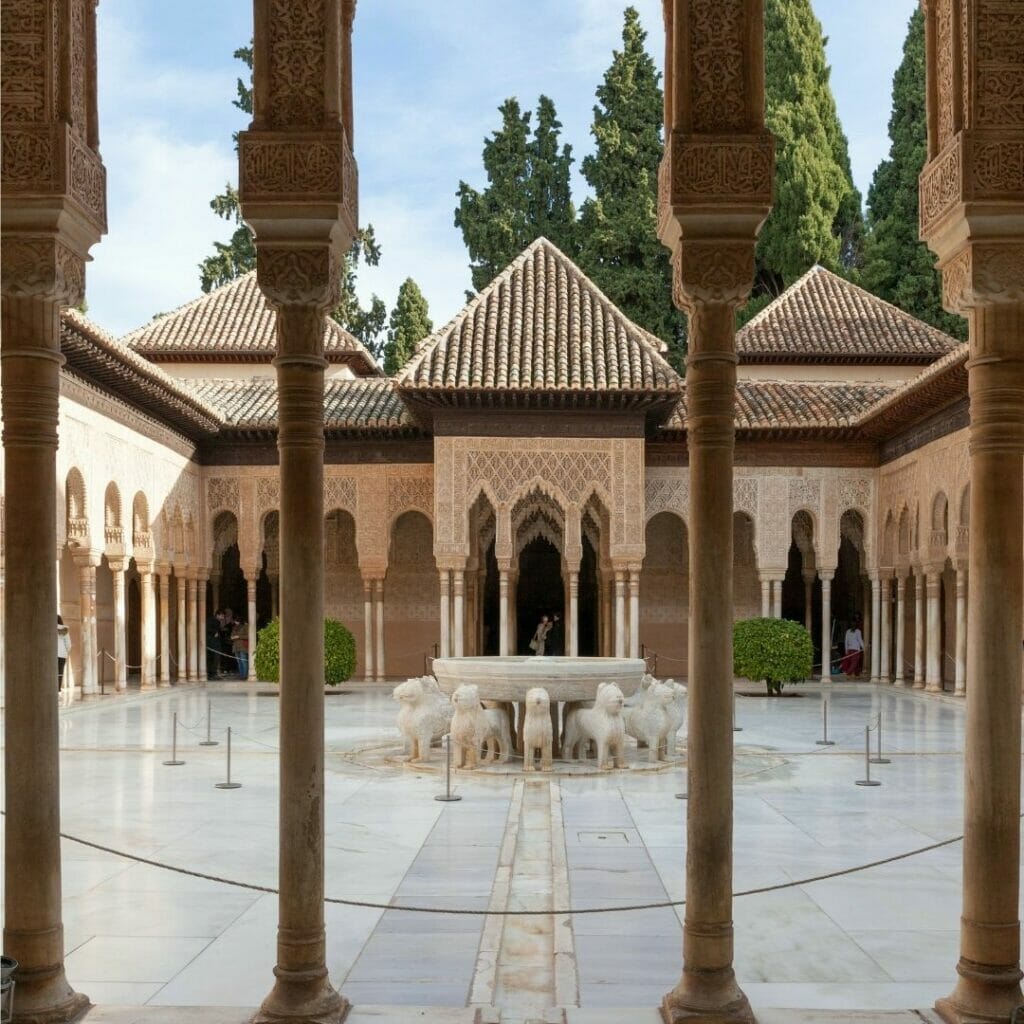
The courtyard is surrounded by a gallery supported by 124 white marble columns with slender shafts, arranged irregularly to create a visual rhythm that avoids monotony. The shafts feature numerous rings towards the top and support cubic capitals with large abaci decorated with inscriptions and arabesques.
Beneath the carved wooden frieze run cambered plaster arches, except in the pavilions and at the ends of the longer sides, which feature archivolts with muqarnas and spandrels with arabesque patterns. Each element was designed so that light and shadow would alter the appearance of the whole structure throughout the day: the white marble reflects light upwards, whilst the columns cast striped shadows across the floor.
The two central arches on the longer sides of the courtyard are larger than the rest and feature muqarnas archivolts. They lead to two of the palace’s most famous rooms: the Abencerrajes Room and the Dos Hermanas Room, as well as providing access to the route leading to the Hall of the Kings.
Above these arches, the sultan’s wives’ quarters can be seen on the upper floor. The arrangement of the arches is not merely aesthetic: it organises the flow of movement and establishes the hierarchy of each room within the palace’s private quarters.
The paved floor we see today was not always like this. Research suggests that the courtyard once housed a sunken garden, with flowerbeds set below the level of the paths so that the plants were at eye level, and the Flemish traveller Antoine de Lalaing recorded that orange trees were once planted there.
Between 2010 and 2012, an archaeological excavation was carried out in the courtyard and, once completed, it was paved with Macael marble to restore the original flooring and ensure its historical authenticity. The decision not to restore the garden was also based on practical grounds: to avoid the damp problems it had caused in the past.
The centrepiece of the fountain that crowns the basin is a replica. The original was removed in 1981 for study and is no longer at the fountain. The replica retains the eight holes distributed around the circumference, which correspond to the eight larger drains located underneath.
The complex has undergone several alterations over the centuries, not all of which have been preserved: in the 16th century, a balustrade was added, which was later removed to restore the fountain to its original state. In 2009, a project was also drawn up to renovate the hydraulic system and enable the courtyard fountains to be preserved in situ.
In 1964, the Patio de los Leones was transformed into a 64-metre catwalk for a fashion show organised with the aim of promoting tourism in Spain. This was an unusual use for a space that had once been the private heart of the Nasrid court.
Those occasional uses would now coexist with much stricter protection of the monument, which restricts access to ensure its conservation. The restoration of the fountain, in fact, took place in full view of the public: as the basin could not be moved to the workshop due to its size, a temporary structure was erected around it and the work was carried out in the courtyard itself. If you’d like to include the Alhambra as part of a wider itinerary, take a look at our guide to What to see in Granada and the a hub for excursions and experiences in Granada.
The courtyard takes its name from the fountain at its centre, supported by twelve marble lions spouting water from their mouths. During the Nasrid period, it formed part of a palace complex with a different name – now lost – and it was later tradition that established the popular name based on the space’s most striking feature.
The fountain is supported by twelve white marble lions from Macael. Although they appear identical, the restoration work identified three distinct types, arranged in groups of four with pairs that resemble one another, differentiated by their noses, manes, jaws and tails.
The best-known legend links the lions to a supposed water clock that marked the hours by causing a jet of water to spout from a different lion each time – a story for which there is no documentary evidence. Other interpretations see the twelve lions as representing the signs of the zodiac, the twelve tribes of Israel or the four rivers of Paradise.
Engraved on the rim of the cup is a poem by the vizier and poet Ibn Zamrak, which describes the fountain itself and praises the sultan who commissioned its construction. The verses compare the water to molten silver and the basin to a sculpture made of pearls, and form part of the epigraphic programme that runs throughout the palace.