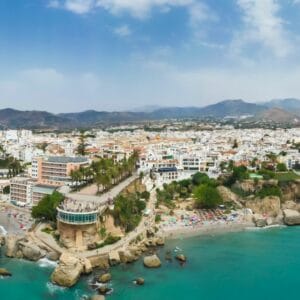
Nerja boasts one of the most diverse coastlines in the province of Málaga within just a few kilometres of coastline: wide beaches with all the amenities, secluded coves at the foot of the cliffs and waters sheltered within a nature reserve. It is this combination that sets it apart from the rest of the eastern Costa del Sol.
To make it easier for you to choose, we have organised the eleven beaches and coves, organised by area: those in the centre, which you can reach on foot from the Balcón de Europa; those to the west, which are more spacious and peaceful; and those to the east, which are already within the Maro area. If you’d like to explore the village and its coastline in a day without having to worry about transport, you can book a Day trip to Nerja and Frigiliana from Málaga.
| Beach | Area | Ideal for |
|---|---|---|
| Burriana | The one in the centre | A full day with services and families |
| Calahonda | Centre | A quick shower and the classic photo |
| The Hall | Centre | The Environment and the Fiesta Blanca in August |
| El Chorrillo | Centre | Snorkelling amongst the rocks, with no facilities |
| Carabeo | Central-East | Peace and quiet near the village |
| Carabeíllo | Central-East | Intimacy amongst the rocks |
| La Torrecilla | West | An urban beach with a promenade |
| El Chucho | West | Snorkelling by the watchtower |
| El Playazo | West | Space and long walks |
| Maro | This one, in the area known as | Crystal-clear water and kayaking |
| Coves in the area | This one, in the area known as | Nature and snorkelling |
These can be reached on foot from the Balcón de Europa in just a few minutes, via some steps. They’re convenient if you’re staying in the village, but they’re small: in the height of August, they fill up quickly.
A cove of dark sand just below the Balcón de Europa, nestled amongst rock formations and old fishermen’s cottages. It is Nerja’s most recognisable sight and the easiest to fit in with a visit to the town centre. It is accessed via a a flight of stairs with about twenty-five steps which winds down from the viewpoint itself, crossing the Boquete de Calahonda, the arch carved out of the rock.
Its small size means it fills up quickly in summer, but it’s unbeatable for a quick dip without having to go anywhere.

Right in the centre, with the Balcón de Europa to its right, El Salón has a few 200 metres long and is around 20 wide, depending on the tides. It has dark, medium-grained sand, with clean, calm waters, and is very popular with domestic tourists.
It has two distinctive features that you won’t find on other beaches in the municipality. The first is the White Party, which is held here every 14 August: guests turn up dressed in white, torches are lit and there’s chill-out music, live performances and cocktail bars. The second is its beach library, where you can borrow a book by leaving a form of identification as security – with titles available in English, German, French and Italian – and donate your own books at the end of the holidays. The service is also available in Burriana.

A secluded cove at the foot of the Almijara mountain range, framed by large boulders that provide shade and privacy. In fact, they are three adjoining coves to Calahonda, known as the Chorrillos, with around 60 metres with a total length that varies with the tide.
You get there by walking across Calahonda beach from the Balcón de Europa. It doesn’t have no services —no beach bar, no showers, no sun loungers—so it’s best to come prepared. On the other hand, the waters here are excellent for snorkel among the rocks.

Located between Calahonda and Carabeíllo, this cove with dark sand has an unusual entrance: you descend a flight of steps situated beneath the Carabeo Streetnext to the Mirador del Bendito. You can also walk there from Burriana.
Although it is just a few minutes’ walk from the Balcón de Europa, it is usually less busy than its more famous neighbours. And it’s the perfect way to end the day: climb up to the Mirador del Bendito and watch the sunset from one of its benches.

A secluded cove at the western end of Burriana, of which it is, in fact, a natural extension. The large rocks at one end and the surrounding vegetation give it its own distinctive character, which is why it has its own name.
There are about 70 metres A sandy beach with a gentle slope, calm waters and views of the Costa Tropical and the Maro area in the distance. Its nooks and crannies offer a refuge from the crowds. It has direct access to the town centre via a flight of steps on its eastern side leading up to Calle Carabeo.
They are wider, with dark sand and pebbles, and less crowded than those in the centre. They are situated near the mouth of the River Chillar.

It is the town’s western beach and one of the most popular in the municipality, just a few minutes’ walk from the Balcón de Europa. It is around 300 metres, consists of dark sand and pebbles, and the blue flag for its quality and services. It takes its name from the watchtower the remains of which are preserved at one end.
It has the most comprehensive facilities after Burriana: sun lounger and parasol hire, showers, changing rooms and access suitable for people with reduced mobility. It is lined with an avenue featuring bars, restaurants and beach bars, and in summer there is windsurfing, kayaking and live music at sunset.

A strip of dark sand stretching from the ruins of the watchtower to the mouth of the River Chillar, linking La Torrecilla with El Playazo. It is about 280 metres long by 30 metres wide and it is the last beach on the west side of the seafront promenade, with very easy access.
Two notices to mariners. There are quite a few stones on the shore, so it’s a good idea to wear water shoes. And in return, the rocky area surrounding the watchtower is one of the best in the municipality for go snorkelling: you can see small octopuses and fish in their natural habitat.

It is the longest beach in Nerja, stretching for around 1.7 kilometres with dark sand and pebbles, to the west of the town centre. As it is somewhat set apart from the centre, it retains a more natural and unspoilt feel, with few buildings behind it and far fewer people than in Burriana.
It is the choice of anyone looking for space to long walks by the sea without straying far from the village. Although amenities are more limited, there are a few beach bars where you can eat fish and seafood, and in high season it hosts beach volleyball tournaments and other activities.
Here the landscape changes: the coastline becomes rugged and the beaches give way to coves nestled between cliffs, now within a protected area.
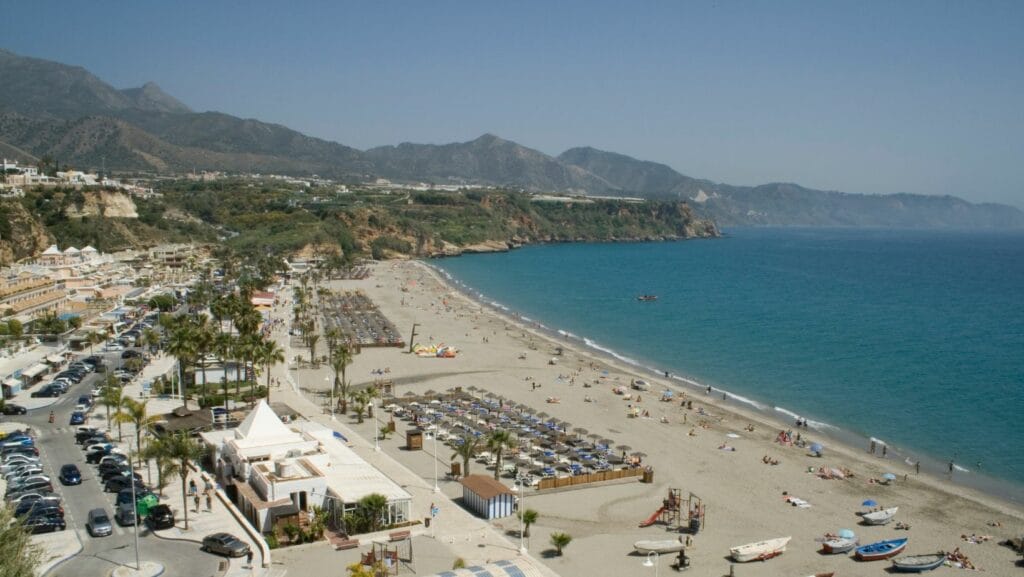
It is the town’s main beach and the best place to spend the whole day. It is about 800 metres with golden sand — the finest in Nerja —, moderate waves and clear waters, and it is about A 15-minute walk from the Balcón de Europa, looking east.
Its main attraction is its amenities: the seafront promenade, numerous beach bars with fresh fish and seafood, sun lounger and parasol hire, showers and changing rooms. And a wide range of WATER SPORTS: kayaking, stand-up paddleboarding, parasailing and boat trips. In summer, the action continues into the evening with music and events.
It’s the best option if you’re travelling with children or want to eat by the sea. In high season, it’s best to arrive early to find a parking space nearby.
Kayak trips setting out from Burriana beach take you to explore the coves of Maro and the waterfall
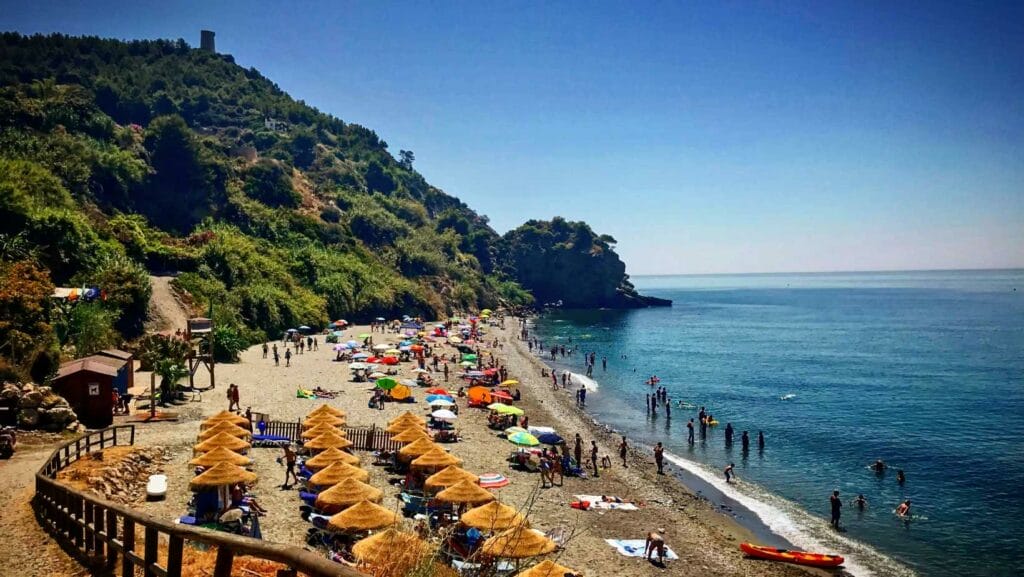
About 4 kilometres to the east of the village, next to the hamlet of Maro, lies this cove about 500 metres It features a mix of pebbles and golden sand set amongst steep cliffs covered in Mediterranean vegetation. Its crystal-clear, turquoise waters have made it the most photographed beach in the municipality after Calahonda.
Be part of the Maro-Cerro Gordo Cliffs Nature Reserve, which limits development and keeps the area well-maintained. In the surrounding area there are small freshwater waterfalls which drop straight down to the sea – a contrast well worth seeking out – and footpaths offering panoramic views.
Be careful with services: are very limited, with a small beach bar open in season, so it’s a good idea to bring water and food. You can get there by car via the N-340 to the Maro turn-off, and then walk down from the car park. It’s also the best starting point for the snorkelling and kayaking around the neighbouring coves.
Beyond Maro, the stretch of coastline leading up to the border with Granada is home to almost unspoilt coves within the protected area: the del Cañuelo, the one from the Paper Mill or the Caleta de Maro, amongst others. They are rocky, with very clear water, and are amongst the best in the province for snorkelling.
Many can only be reached on foot, via a footpath or by kayak. And here’s an important point to bear in mind when planning: In summer, access by car to El Cañuelo is usually restricted and there’s a shuttle bus running from the main road, so it’s worth checking before you go.
It depends on what you’re looking for, so it’s best to be clear about that before you go:
And a useful tip: apart from Burriana, Most of the beaches in Nerja are made up of dark, coarse sand or pebbles, because they’re framed by the cliffs. It’s worth taking baby booties if you’re going for a swim outside Burriana.
Nerja is about 50 kilometres to the east of Málaga city, along the motorway A-7. Once in the village:
If you don’t have your own car, there are intercity buses from Málaga and other parts of the Costa del Sol to Nerja station. To plan your entire visit, see the Nerja guide, and if you’re looking for somewhere to stop for a bite to eat, where to eat in Nerja.
Discover all the romantic getaways to enjoy in Andalusia
If you’re only in the province for a short time, this day trip combines Nerja with Frigiliana, the neighbouring white village:
The tour includes:
For a day out with a full range of facilities, Burriana is the most well-rounded option: around 800 metres of golden sand – the finest in the municipality – with a seafront promenade, beach bars, sun loungers and water sports. If you prefer natural surroundings and clear water, Maro and the coves towards El Cañuelo stand out within the protected area, although they offer fewer facilities and are more difficult to access.
Burriana has the finest, golden sand and is the most comfortable place to lie down. The rest of the beaches and coves in the municipality are mostly made up of dark, medium-grained sand, pebbles or shingle, as they are flanked by cliffs. It’s a good idea to take water shoes with you if you’re going for a swim anywhere other than Burriana, particularly at El Chucho.
In the centre, very close to the Balcón de Europa, lie Calahonda, El Salón, El Chorrillo, Carabeo and Carabeíllo. To the east, the Maro-Cerro Gordo Cliffs Nature Reserve is home to almost unspoilt coves such as Maro, El Cañuelo, El Molino de Papel and La Caleta de Maro, all of which boast crystal-clear waters that are excellent for snorkelling.
The best spots are El Chorrillo, amongst its large rocks, and the rocky stretch surrounding the watchtower on El Chucho beach, where you can spot small octopuses and fish. Outside the town centre, the coves in the Maro area have the clearest waters in the municipality.
It takes place every 14 August on El Salón beach, right in the town centre. Attendees turn up dressed in white and the beach is lit up by torches, with chill-out music, live performances and drinks bars. It is one of the town’s most popular summer events.
Nerja is about 50 kilometres from Málaga via the A-7 motorway. The beaches in the town centre can be reached on foot from the Balcón de Europa via a flight of steps; Burriana is a quarter of an hour’s walk to the east, whilst La Torrecilla, El Chucho and El Playazo are to the west along the seafront promenade. To get to Maro and the coves in the area, it’s more convenient to drive along the N-340, except in summer, when access to El Cañuelo is regulated by a shuttle bus.