Ronda is the ideal base for visiting the white villages, and for a geographical reason: It lies right on the cusp between the mountains of Málaga and the Sierra de Cádiz.
But there is something we should clarify before we begin, because hardly any guide mentions it.
The villages along this route are not all the same distance apart – far from it:
Casares and Gaucín do not fall on the same day as the others. They’re on their second outing, or on their way to the Costa del Sol.
The «White Villages Route» has an official route, and it is from the province of Cadiz,: nineteen municipalities —Arcos de la Frontera, Bornos, Espera, Villamartín, Algodonales, El Gastor, Olvera, Torre-Alháquime, Setenil de las Bodegas, Alcalá del Valle, Prado del Rey, El Bosque, Ubrique, Benaocaz, Villaluenga del Rosario, Grazalema, Benamahoma, Zahara de la Sierra and Algar—.
The white villages of Málaga, on the other hand, do not form a signposted route: they are a group of whitewashed villages scattered across the countryside.
That’s why Ronda works so well: From here, you join the Cadiz route y We reach out to the people of Málaga. We treat them in The route of the five white villages of Málaga, where they meet Ronda and Casares.
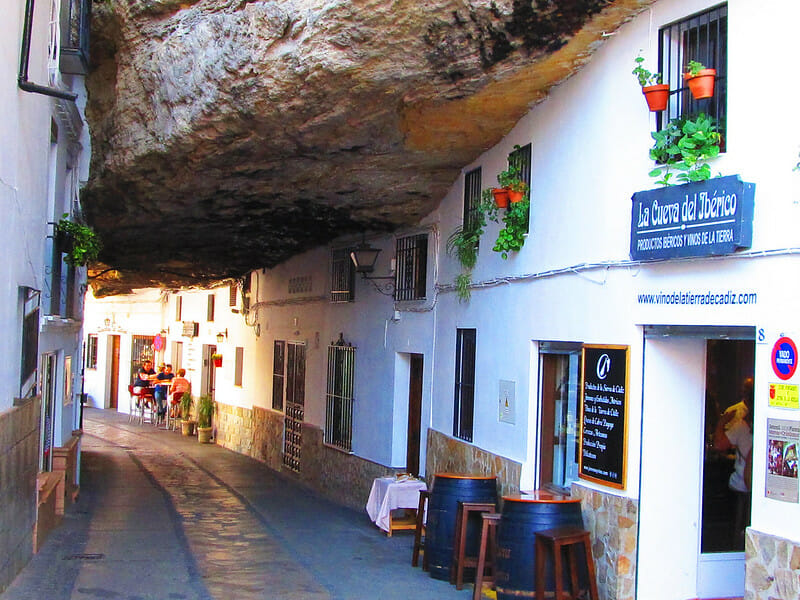
The most unusual of them all, and the closest: 20 minutes from Ronda.
Their houses are not on the rock: they are underneath it. They make use of the stone ledges in the riverbed of the Trejo River as a natural roof, and that is how its two famous streets came into being: Caves of the Sun y Cuevas de la Sombra Street.
And one detail that almost nobody notices: the local council retains a 16th-century Mudejar coffered ceiling.
Everything at What to see in Setenil de las Bodegas.
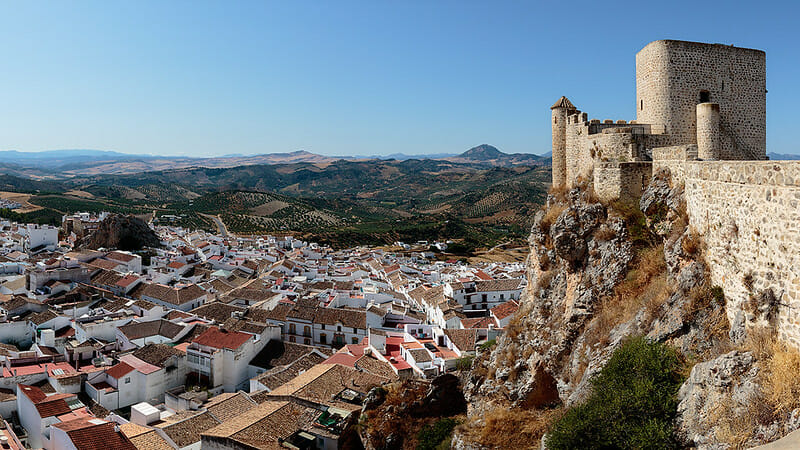
The most recognisable silhouette along the route: a church and a castle overlooking olive groves. In fact its name probably comes from «olive tree».
It has been a Historic-Artistic Site since 1983, and its castle it formed part of the Nasrid defensive line opposite Castile, just like the one at Zahara.
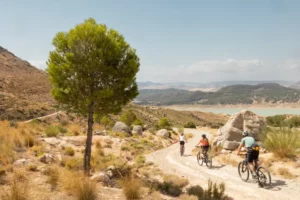
And here’s an additional plan: The event kicks off in Olvera Sierra Greenway, a former railway line with tunnels and viaducts, to do on foot or by bike.
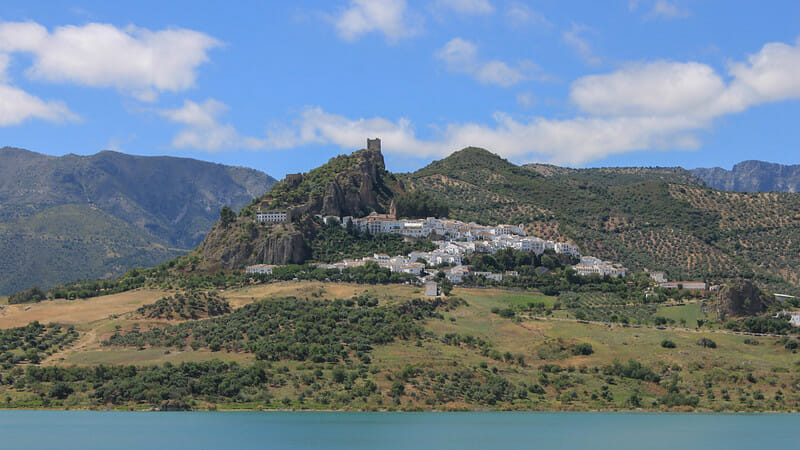
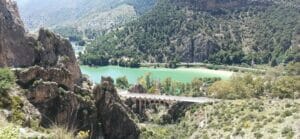
The classic postcard: the village huddled beneath a 13th-century Nasrid castle, and at its feet the Zahara-El Gastor reservoir, a turquoise colour that contrasts with the whitewash.
Zahara means «flower» in Arabic, and it was founded in the early 8th century.
Two notices: is the village with the steepest streets along the route, and the climb up to the castle is short but tough. In summer the reservoir serves as an inland beach.
It’s already within the Sierra de Grazalema Natural Park, between the rivers Guadalete and Bocaleones.
It gives its name to the nature reserve, and is well worth a visit in its own right. Mountain houses, wrought-iron balconies and the handcrafted blankets for which it is known.
A fact that explains the landscape: This mountain range is one of the rainiest places in Spain. Hence the greenery surrounding the white villages, which takes anyone expecting Andalusian scrubland by surprise.
It’s an ideal base for hiking, and its altitude keeps it cool in summer.
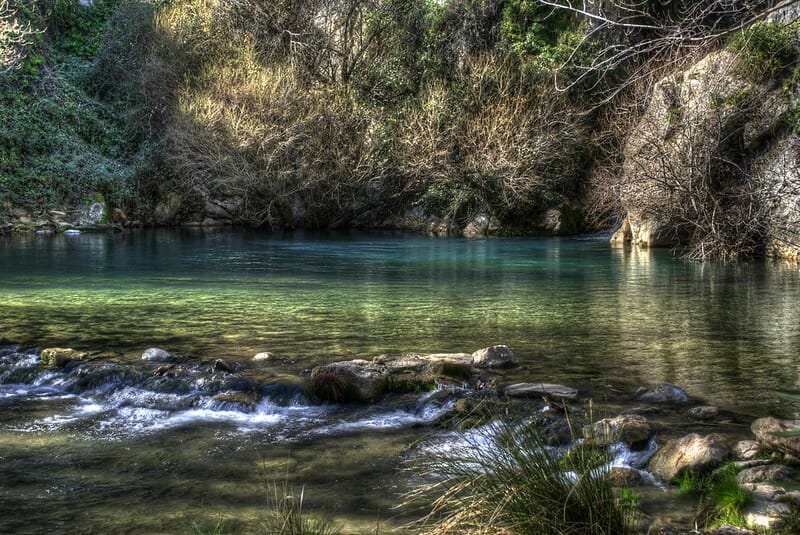
Fifteen minutes from Ronda, in the Guadiaro Valley. Small, peaceful and famous for its sausages.
But the real reason for coming is outside the village:
And a little-known plan: the station at Benaoján–Montejaque is in the Ronda–Algeciras line, one of the most spectacular in Spain. You can travel this stretch by train.
The «balcony of the Serranía», on the way to the coast. From the Eagle Castle, on clear days, You can see the Rock of Gibraltar and the African coast.
It’s less busy than the rest, so it’s ideal for anyone looking for some peace and quiet.
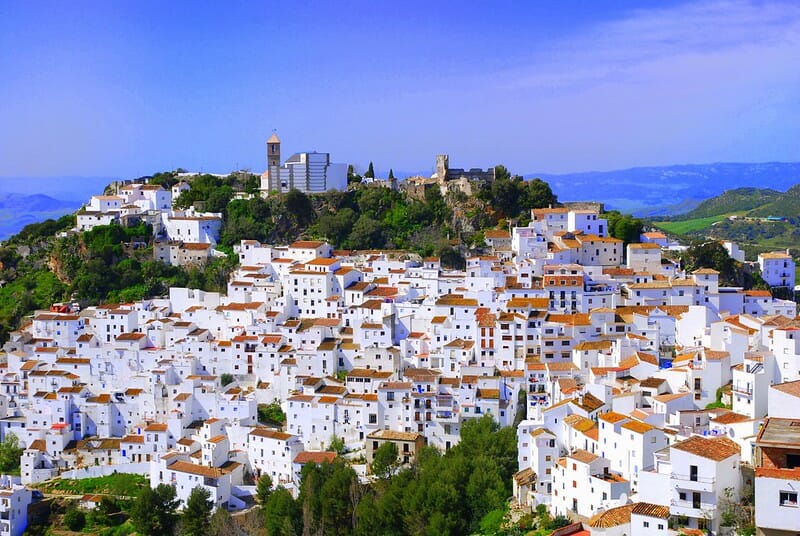
The furthest away — an hour and a quarter from Ronda — and the most photographed. They call it the «hanging village»: the houses climb up the hillside to a castle of Arab origin, a 435 metres altitude.
And there’s a fact that’s hardly ever mentioned: Blas Infante was born here, regarded as the father of the Andalusian nation. His birthplace is open to visitors.
You can see the Mediterranean from the castle, and on clear days, Africa.
If you’re only staying for a day, stick to the north arch:
These three bring together the very best: houses carved into the rock, two Nasrid castles and the reservoir. And you return to Ronda without backtracking.
For the second day: Grazalema and Benaoján, or the southern route via Gaucín and Casares towards the coast.
Road safety tips: They are narrow, winding roads, so it takes longer than the sat-nav says. Almost all the villages are pedestrianised: you park at the entrance and walk up. And bring some cash, as small bars don’t always have a card machine.
Whitewashing dates back to the Al-Andalus period, and it was not decorative:
Repeated house by house and year after year, this process shaped the landscape that today defines the region.
Spring and autumn, without a doubt. They are villages on a slope and In summer, the heat really takes its toll when climbing the castles.
And if you have a choice, October or November: is when the Genal Valley The chestnut trees are ablaze with colour, and it’s the best time of year in the mountains.
We are a local tour operator based in Málaga with over 50 years’ experience organising trips around Andalusia. If you don’t fancy the mountain road, the tour combining Ronda and Setenil, which is the best introduction to the route:
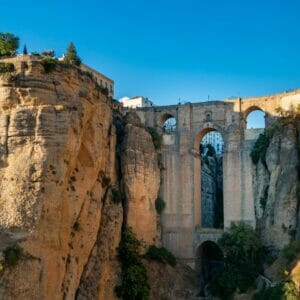
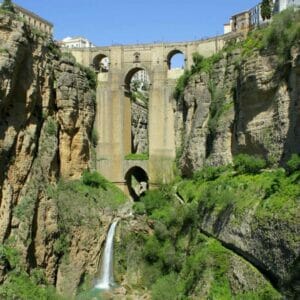
Before setting off for the villages, take some time to work on the basics: What to see in Ronda y the New Bridge.
And to put it all into context, the white villages of Andalusia y the most beautiful villages in Malaga.
Setenil de las Bodegas, Olvera and Zahara de la Sierra. These three towns make up the northern arc; they are close to one another and bring together the route’s most iconic features: the houses carved into the rock at Setenil, two Nasrid castles and the Zahara-El Gastor reservoir. They also allow you to return to Ronda without having to retrace your steps.
Nineteen, all in the province of Cádiz: Arcos de la Frontera, Bornos, Espera, Villamartín, Algodonales, El Gastor, Olvera, Torre-Alháquime, Setenil de las Bodegas, Alcalá del Valle, Prado del Rey, El Bosque, Ubrique, Benaocaz, Villaluenga del Rosario, Grazalema, Benamahoma, Zahara de la Sierra and Algar. The white villages of Málaga do not form a signposted route, but rather a collection of whitewashed villages in the interior of the province.
Not quite as far as people usually say: it’s about an hour and a quarter’s drive along the mountain road, heading towards the coast. Along with Gaucín, it’s best to save this for a second trip or for the journey to the Costa del Sol, as it doesn’t really fit in with a day trip that includes Setenil, Olvera and Zahara.
This was due to the whitewashing, a practice dating back to the Al-Andalus period which served no decorative purpose: the lime reflected light and kept homes cool in summer, acted as a disinfectant for the walls, and was cheap to obtain in the area. Repeated house by house over the centuries, it eventually came to define the landscape of the region.
Setenil de las Bodegas, about twenty minutes from Ronda. The houses here make use of the large stone ledges along the Trejo riverbed as a natural roof, giving rise to its two best-known streets: Cuevas del Sol and Cuevas de la Sombra.
Spring and autumn. These are villages set on slopes, and in summer the heat can be stifling, especially when climbing up to the castles. October and November have an added appeal, as this is when the chestnut trees in the Genal Valley change colour – the best time of year in the mountains.