The white villages of Málaga do not form a single signposted route, but a collection of villages with whitewashed houses across the inland province. These five —Ronda, Casares, Frigiliana, Mijas Pueblo and Júzcar— are the most representative.
For each one, we explain what to see, the actual distance from Málaga and, above all, how to group them, as they are in different districts and cannot all be fitted into one day.
Whitewashing dates from the Andalusi period and was not merely decorative: lime reflected the light and kept houses cool in summer; it also acted as a disinfectant for the walls and was inexpensive to obtain locally. Repeated house by house, it created the landscape that defines these villages today.
In Málaga, they are spread across the Serranía de Ronda, the Genal Valley, the Axarquia and the mountains along the western coast. For the wider Andalusian area, see our white villages guide; this guide focuses on those within the province.

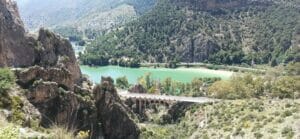
The largest and best known, standing above the Tagus, a gorge more than a hundred metres deep that divides the town. Its landmark is the “Puente Nuevo”, built between 1751 and 1793.
What to see: the bridge and its viewpoints, the La Real Maestranza Bullring — dating from 1785, one of Spain’s oldest — the Arabic baths the best preserved on the peninsula, the Palacio del Rey Moro and the La Ciudad quarter.
Distance: around 100 km from Málaga, between an hour and a half and an hour and forty-five minutes via the A-397. It is the only one with a railway station, making it a gateway to the Serranía.
How long: at least half a day, though you could spend a full day here. Find details in What to see in Ronda.
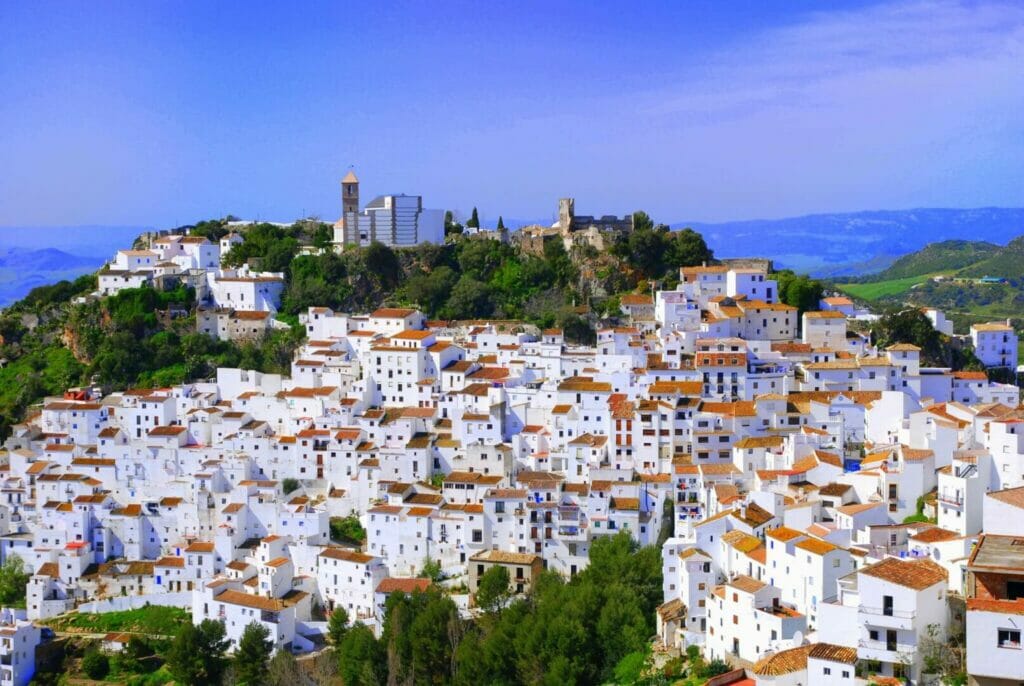
They call it the «hanging village» because of the way its houses climb the hillside beneath the Moorish castle. It is one of the province’s most familiar postcard views, all visible at once from the viewpoint on the approach road.
And here is its most important fact, which few people mention: Casares is the birthplace of Blas Infante, regarded as the father of the Andalusian nation. His birthplace is open to visitors.
What to see: the castle grounds, the Church of the Incarnation, the San Sebastián Chapel and the cemetery, set high up, with one of the best panoramic views of the village. Nearby are the Baños de la Hedionda, sulphurous baths traditionally associated with Julius Caesar’s troops, and the Roman ruins of Lacipo.
Distance: around 110 km from Málaga, about an hour and a half via the AP-7 and the climb inland from the coast. It is near Estepona, so pairs well with the western coast.

The best-preserved white village in the eastern province, in the Axarquía, close to Nerja. Its old quarter, the Barribarto or Moorish quarter, is a network of steep cobbled lanes with ceramic panels telling the story of the village.
What makes it unique: its sugar mill is the only cane syrup factory left in Europe, and it is still operating. It occupies the former palace of the Counts of Frigiliana.
What to see: the whole of Barribarto, the botanical garden of Santa Fiora and the climb to the remains of Lízar castle, with the sea on one side and the Almijara mountains on the other.
Distance: around 50 km from Málaga, between 45 and 50 minutes. It is the most accessible, and naturally combines with Nerja and some time on the beach. Read more in Things to see and do in Frigiliana.
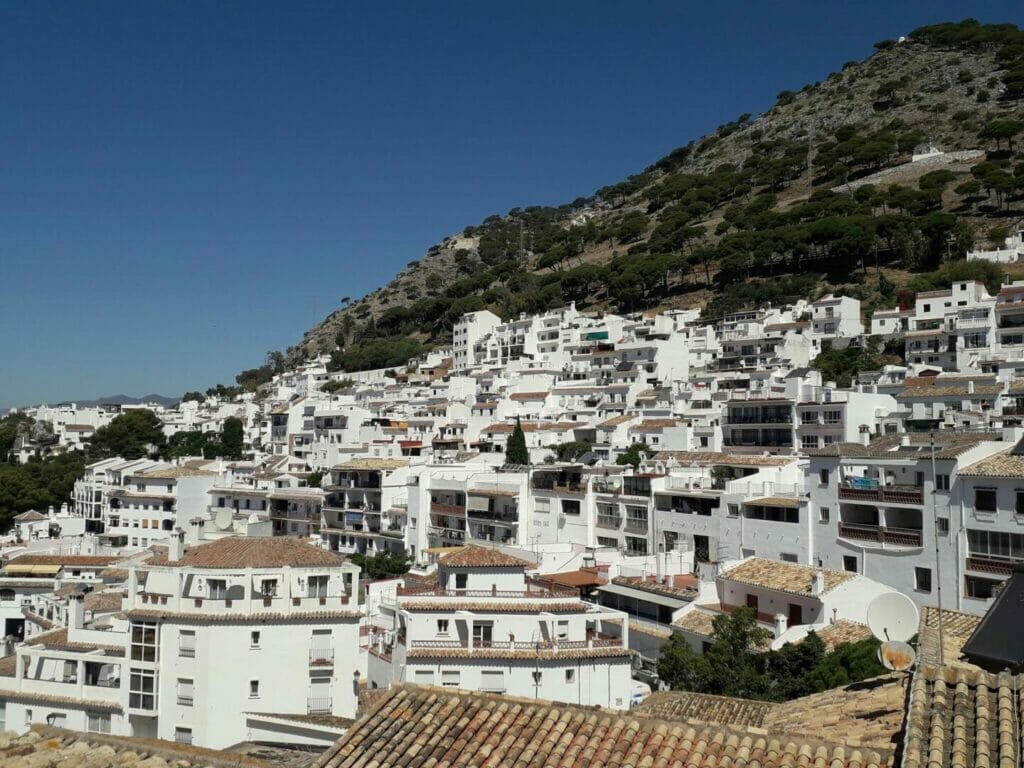
The closest to the coast, on the slopes of the Mijas mountains at around 400 metres above sea level. On clear days, you can see the sea and, with luck, the African coast.
What to see: the the chapel of the Virgin of La Peña, carved out of the rock; the gardens by the town walls and their viewpoints; Plaza de la Constitución; and the oval bullring, shaped that way because there was not enough room to make it round.
Distance: around 35 km from Málaga, about 40 minutes. It is the easiest to fit in if you are staying on the coast. More in what to see in Mijas.

The exception on the list: a white village in the Genal Valley which, in 2011 was painted entirely blue — including the church — for the premiere of a Smurfs film. The agreement provided for it to be painted white again afterwards.
But the residents voted. In that year’s referendum, 141 votes to 33 decided to keep it blue. And it still is.
Take note of the name, because it has changed: the Smurfs brand licence expired and the council could not meet the renewal conditions. In a new vote, residents decided to officially end the association with the brand, remove the character figures and stop promoting it as the ‘Smurf village’. Today it is promoted as ‘La Aldea Azul’ (the Blue Village). The colour remains, however: the council pays for the paint, and residents apply it themselves every few years.
What to see beyond the blue: the Royal Tinplate Factory, which was the first in Spain; the WATER MILLS; and the mushroom museum, as this is one of Andalusia’s best areas for mushrooms.
And the surroundings: it is in the Upper Genal Valley, surrounded by chestnut woods which take on extraordinary colours in autumn. It is one of the province’s best November getaways.
Distance: around 113 km from Málaga, about an hour and three-quarters. It is 22 km from Ronda along a mountain road, so it makes sense to visit both on the same day.
Do not attempt all five in one day. They are in different districts, and travelling between east and west is not straightforward.
| Village | Region | From Malaga | By car |
|---|---|---|---|
| Mijas Village | Sierra de Mijas (west) | ~35 km | ~40 min |
| Frigiliana | Axarquía (east) | ~50 km | ~45-50 min |
| Ronda | Serranía de Ronda | ~100 km | ~1 h 40 min |
| Casares | Western coast | ~110 km | ~1 h 30 min |
| Júzcar | Genal Valley | ~113 km | ~1 h 45 min |
Three combinations that work:
How long in each: two or three hours are enough for Casares, Frigiliana, Mijas and Júzcar. Allow a good half-day for Ronda.
When to go: spring and autumn. These villages have steep streets and the summer heat is tiring; by contrast, the Genal Valley in October and November, with its chestnut trees, is at its best for the year.
Parking is the recurring difficulty: most old centres are pedestrianised, so leave your car at the village entrance and walk uphill.
To link several villages starting from the Serranía, see the white villages route from Ronda. And for the Marbella area, the villages near Marbella.
We are a local Málaga tour operator with over 50 years’ experience organising trips around Andalusia. If you would rather avoid driving on mountain roads or struggling to park, these excursions cover the villages on the route:
The five most representative are Ronda, Casares, Frigiliana, Mijas Pueblo and Júzcar. Each has its own appeal: Ronda has the Tajo gorge and Puente Nuevo bridge, Casares its stepped silhouette below the castle, Frigiliana its Moorish quarter, Mijas its coastal viewpoints and Júzcar its blue façades.
Because of whitewashing, a practice inherited from the Andalusi period for practical reasons: lime reflected light and kept homes cool in summer, disinfected the walls and was inexpensive to obtain locally. Applied throughout a settlement, it created the landscape that characterises these villages.
It is still blue, but is no longer promoted under that name. The Smurfs brand licence expired and the council could not meet the renewal conditions, so residents voted to end the association and remove the character figures. The village is now officially promoted as ‘La Aldea Azul’ (the Blue Village). Its colour has remained since the 2011 referendum, won by 141 votes to 33.
Not realistically: they lie in different parts of the province. It is practical to group them into three trips: Ronda and Júzcar on the same day, as they are only 22 kilometres apart; Mijas and Casares if you are staying on the western coast; and Frigiliana as a separate trip east, combined with Nerja.
Mijas Pueblo, around 35 kilometres or 40 minutes away by car, followed by Frigiliana at around 50 kilometres. Ronda, Casares and Júzcar are between 100 and 113 kilometres away, with journeys taking over an hour and a half because the final stretches are mountain roads.
Spring and autumn, because of the temperatures: these villages have steep streets and summer heat can be tiring. If you have a choice, October and November in the Genal Valley are exceptional, when the chestnut woods around Júzcar change colour and create some of the province’s finest scenery.