The levante does not ruin your day in Tarifa: it changes the plan. And there is a place in town that exists for exactly that reason.
What to do when it blows, where to find shelter and why summer is the worst season if you wanted a peaceful beach.
The levante blows MORE in summer, not less. The opposite of what many guides say.
The months with the most levante are June to September. In spring and autumn it alternates with the gentler, more humid poniente.
So if you come in August to lie on your towel, expect a fair chance of sand in your face. And if you come to sail, August is your month.
It is a funnel effect. Air comes from the Mediterranean, meets the bottleneck formed by the Spanish and Moroccan coasts, compresses and accelerates. It reaches Tarifa much stronger than it would over the open sea.
It is dry and warm, leaves clear skies and can last several days in a row without a break.
This is missing from almost every guide, yet it is the best answer to the question.
Playa Chica is a small beach formed when the breakwater was built that connects Tarifa to Isla de las Palomas. Its position means it is sheltered from the levante.
This is where the locals go on windy days, when lying on Los Lances and Valdevaqueros is out of the question.
And there is more: this is where diving schools hold introductory dives, because the rocky seabed here is among the best in the Strait for snorkelling. Bring a wetsuit: the water is cold even in summer.
It is a short walk from the centre. A real alternative if you planned a beach day and the levante ruined it.
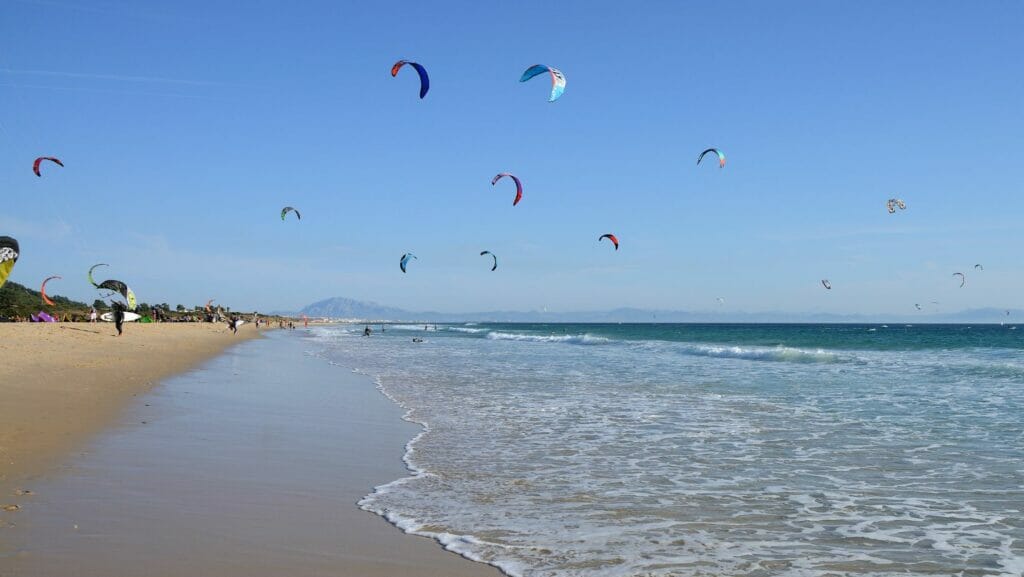
Tarifa is Europe’s kitesurfing capital, and days of sustained levante are the most eagerly awaited of the season.
| Sport | Where | In strong levante winds |
|---|---|---|
| Kitesurfing | Valdevaqueros, Los Lances | Small kite and instructor |
| Windsurfing | Los Lances | Experience required |
| Surfing | Los Lances (beginning), Punta Paloma | Depends on the day |
| Wingfoiling | Valdevaqueros | Works well in gusty winds |
Valdevaqueros is about a ten-minute drive from the centre and is home to most schools.
If you have never tried it: in strong levante winds, the difference between a good session and a bad experience comes down to a smaller kite and an instructor beside you. This is not the day to learn alone.
And wingfoiling —a handheld wing and a hydrofoil board— copes best with gusty days, which explains its growth here.
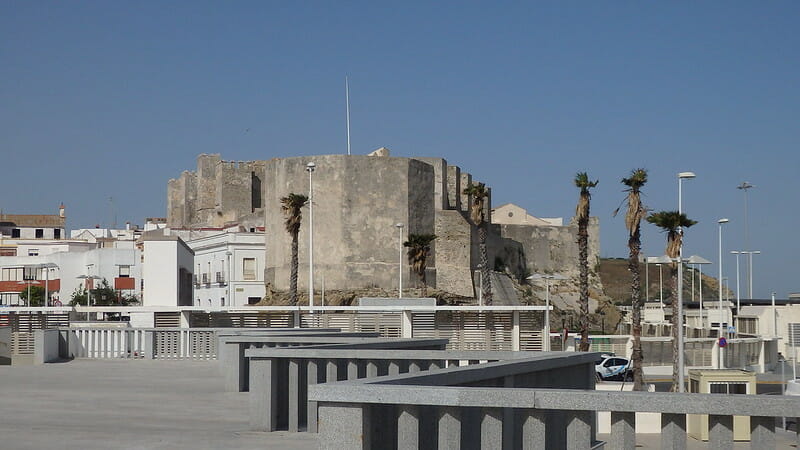
Guzmán el Bueno Castle dates from the 10th century, and its walls do exactly what you need: block the levante along much of the route.
The towers overlook the Strait and the African coast. Its name comes from the story of Alonso Pérez de Guzmán, who defended the town at the cost of his son’s life.
It is the best midday option when the wind keeps you out of the water: outdoors, yet sheltered.
This needs clarifying because incorrect information circulates.
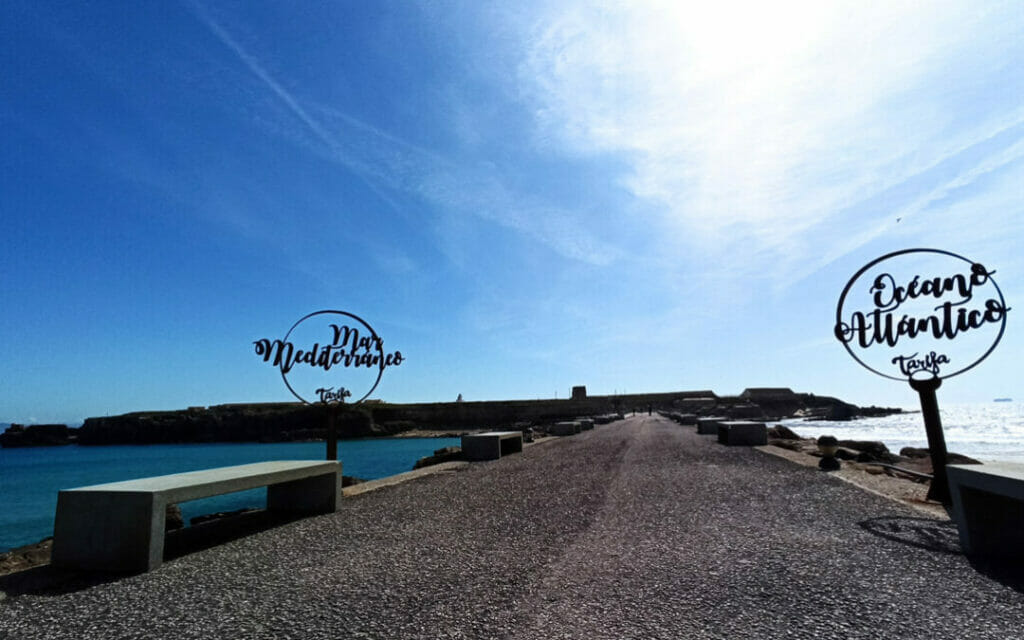
It is unique in the world. You walk with the Mediterranean on one side and the Atlantic on the other, at the southernmost point of the Iberian Peninsula.
In strong levante winds it becomes spectacular: the waves leap over the breakwater from one sea to the other. You get a free shower, and it is one of the most impressive sights here.
At the end stands Tarifa Lighthouse, dating from the second half of the 18th century and the first built in the Strait. It is still operating. The tower is 33 metres high.
The Strait is one of the world’s best places to see cetaceans: dolphins, pilot whales, fin whales and orcas, depending on the season.
Trips usually operate in moderate levante winds, but confirm before going to the port: strong levante winds cause cancellations. Full details at whale and dolphin watching in Tarifa.
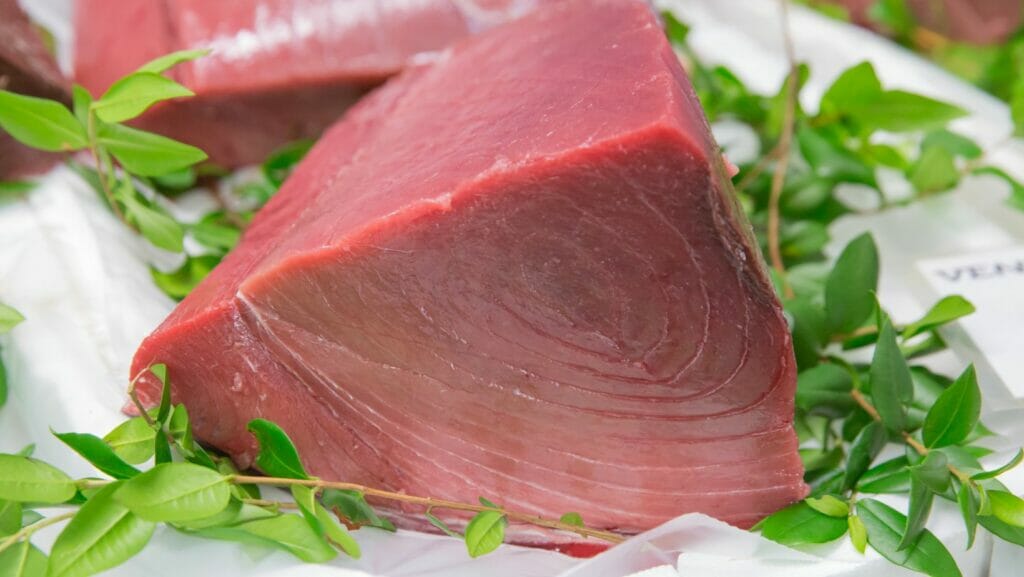
The local speciality is almadraba bluefin tuna, caught using a traditional fishing method in the Strait itself. It is prepared in countless ways and deserves a thoughtful choice.
And the rest: fresh fish, fried seafood and seafood rice dishes. The central taverns are a natural refuge during the windiest hours.
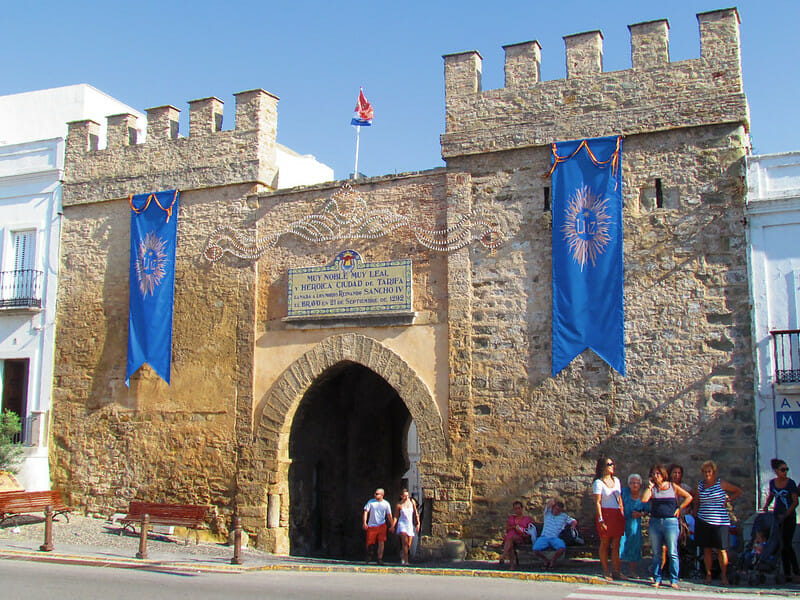
It is no coincidence that the streets are narrow and winding: the medieval layout was designed to block the wind and sun. Walking here when the levante blows is pleasant.
What to look for: the Puerta de Jerez, the entrance to the old medina; San Mateo church; and Plaza de Santa María.
Batalla del Salado street, by contrast, is more open and you feel the wind there. It is lined with shops and bars and is the liveliest street at night.
Full details at What to see in Tarifa.
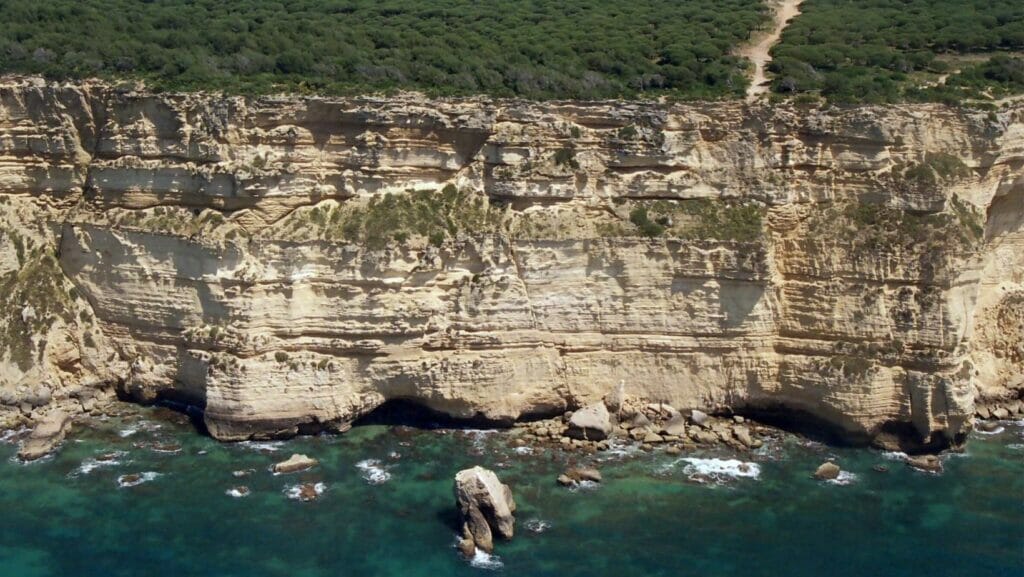
With the levante, the rule is simple: inland yes, cliffs no.
You are between Estrecho and Los Alcornocales Natural Parks, so there are plenty of options through woodland, where the wind is much gentler.
Avoid exposed coastal sections and cliff routes: strong levante winds make them uncomfortable and approaching the edges unwise.
The levante usually eases as evening falls, when the centre fills up. Bars, music and terraces around Batalla del Salado.
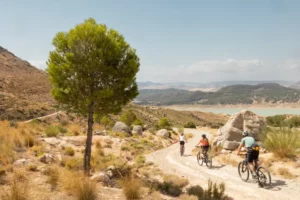
Other options during windy hours: the yoga schools move classes indoors when it gets strong, and cycling works well on inland routes.
We are a local operator with over 50 years of experience organising trips around Andalusia. When the levante settles in for several days, the most practical option is a change of scene:
Trips to Tangier depart from Tarifa’s own port, making it the shortest getaway: cross the Strait and reach another continent in an hour.
And Gibraltar is a short drive away, with the option of combining your visit with dolphin watching.
More ideas: Zahara de los Atunes and What you need to enter Gibraltar.
Then the levante works against you, quite simply: it lifts sand, churns up the water and makes things less comfortable.
Two options: the Playa Chica mentioned earlier, the town’s sheltered beach, or look for more protected coves. We explain more in Tarifa’s best beaches without wind.
From June to September, in the height of summer. Contrary to what you often read, summer is the windiest season, not the calmest. In spring and autumn, the levante alternates with the gentler, more humid poniente, so calm days are more likely.
Playa Chica, the small beach formed beside the Isla de las Palomas breakwater, is sheltered from the wind. Locals go there on levante days, when lying on Los Lances and Valdevaqueros is uncomfortable. Diving schools also hold introductory dives here because of the quality of the rocky seabed.
Only on a guided tour booked in advance through Tarifa’s tourist office, costing around four euros, as the interior is military land and belongs to the Ministry of the Interior. You do not go by boat: an artificial breakwater built in 1808 links it to the mainland, so you walk there. The isthmus is freely accessible, but has no parking.
Visit Guzmán el Bueno Castle, whose walls shelter much of the route; explore the old town’s medieval streets, designed to provide shelter; walk along the Isla de las Palomas isthmus, spectacular in strong levante winds; eat almadraba bluefin tuna in the central taverns; and hike inland, avoiding cliff sections.
Because of a funnel effect. Air from the Mediterranean meets the bottleneck formed by the Spanish and Moroccan coasts, compresses and accelerates, reaching Tarifa much stronger than it would over the open sea. It can continue for several days without a break.
Trips usually operate in moderate levante winds, but strong winds cause cancellations because of sea conditions. Confirm your departure on the day before travelling to the port, rather than assuming it will run.