The Dark Gate Gardens They are landscaped terraces that wind their way up the the southern slope of Mount Gibralfaro, behind Málaga Town Hall and right next to the Alcazaba ramparts.
They are free of charge, they’re right in the centre, yet hardly anyone goes there: people just walk straight past on their way to the Alcazaba.
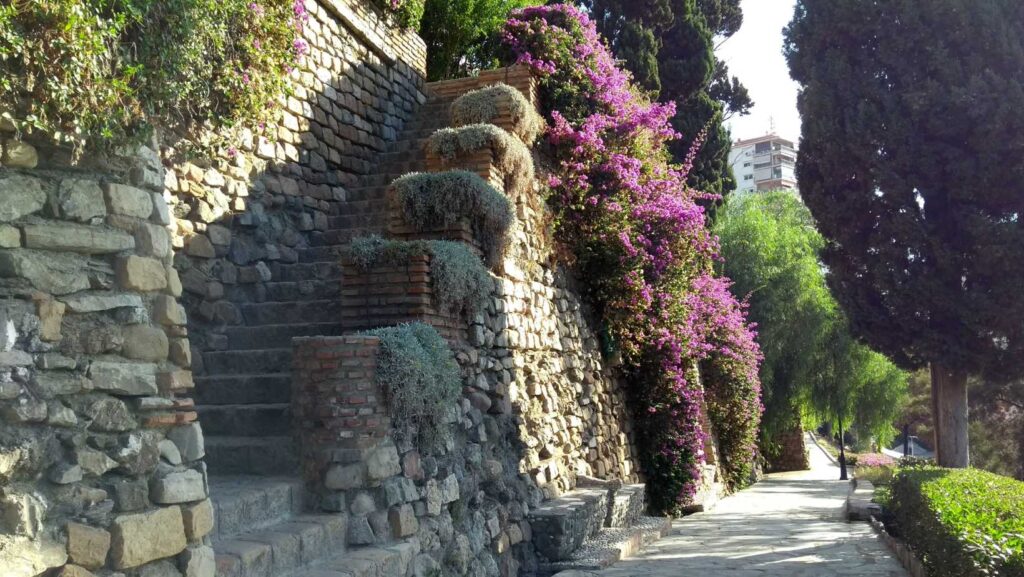
Incorrect dates are often read out. They are not «from the early 20th century»: they were designed by the architect from Málaga Fernando Guerrero-Strachan Rosado and were carried out between 1937 and 1939, that is to say, in the midst of the Civil War.
And they had a specific aim: It wasn’t about building a park, but rather to frame the walls of the Alcazaba. The garden is designed to serve as a setting for the monument, which explains its terraced layout: it was necessary to to make a steep slope passable without blocking the wall.
Where does the name come from?: There used to be a gate in the Muslim city wall here called Dark Door, and the garden retained the place name.
2,000 years ago, the sea reached right up to here. At the foot of Gibralfaro there used to be a beach, and what is now the Park and the Alameda are all land reclaimed from the sea.
In fact, during the demolition of the walls, it was discovered that a Latin inscription dedicated to the goddess Luna, and in later works a granite column about eight metres tall, brought from the Sierra de los Pedroches in Córdoba, which points to the existence of a Roman temple on this hillside.
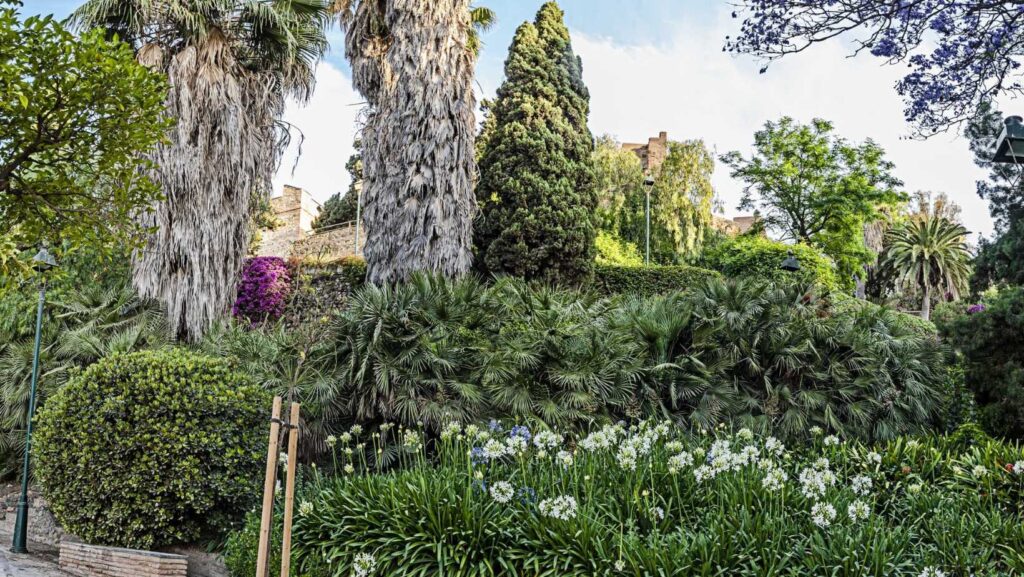
Terraces, promenades and small roundabouts linked by staircases, with fountains on various levels.
Vegetation It is Mediterranean in origin and of a tall stature: cypress trees, Canary Island palms, Aleppo pines, bougainvilleas and jacarandas. The bougainvilleas colour the walls in spring and the jacaranda trees turn purple in May, which is the best time of year to see them.
And what really makes it worth the climb: From the upper terraces, you have the Alcazaba wall, just an arm’s length away, with the harbour and the bay behind it. It’s a view of the monument you wouldn’t get even if you paid the entrance fee.
Just a heads-up, as this is causing some confusion: One sometimes reads that in these gardens there is the viewing point next to the statue of Larios. That’s not the case. The monument to the Marquis of Larios is in the Alameda Principal, at the junction with Calle Larios, about a ten-minute walk from here.
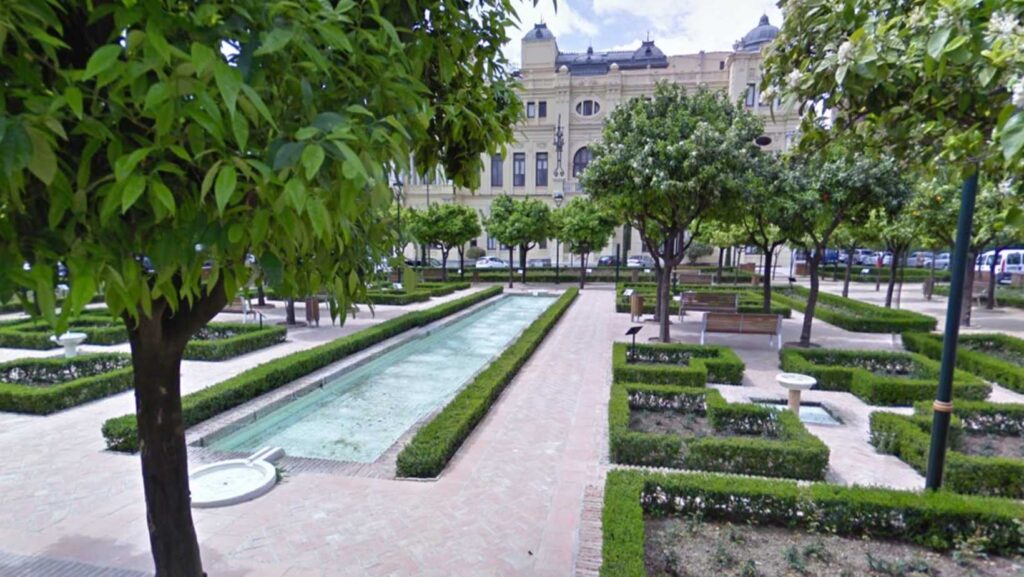
And in May, without a moment’s hesitation, because of the jacaranda trees.
It’s right at the point where everything comes together:
A comparison of them all, at the best viewpoints in Málaga, and if you’re into the hills, Mount Victoria.
All this without paying a penny: more plans at free things to do in Málaga, and the historic centre in The 8 must-haves.
We are a local tour operator based in Málaga with over 50 years’ experience organising trips around Andalusia. If you like historic gardens, Andalusia has the best:
You’ve got the city in What to see in Málaga in three days and destiny in The Malaga Guide.
They were built between 1937 and 1939, at the height of the Civil War, based on a design by the Málaga-born architect Fernando Guerrero-Strachan Rosado. They are often thought to date from the early 20th century, but this is a mistake by about three decades. Their purpose was not to create a park, but to frame the walls of the Alcazaba.
This is because on this side of the Muslim wall there used to be a gate known as the Puerta Oscura, which provided access to the city. When the gardens were designed on the hillside, this historic place name was retained, so that the name serves as a reminder of an entrance that no longer exists.
Yes, entry is free of charge. They are located behind Málaga City Hall, next to the Pedro Luis Alonso Gardens, between the Paseo del Parque and the Alcazaba. As it is a terraced area with steps and continuous slopes, it is advisable to wear closed-toe shoes.
Cypress, Canary Island palm, Aleppo pine, bougainvillea and jacaranda are the most common trees and shrubs. The bougainvilleas add colour to the walls in spring, and the jacarandas bloom in shades of violet during May, which is probably the best time of year to visit.
No. You sometimes read that the viewing point in these gardens is next to the statue of Larios, but the monument to the Marquis of Larios is on the Alameda Principal, at its junction with Calle Larios, about a ten-minute walk from the gardens.
From the upper terraces, the Alcazaba’s ramparts are practically within reach, with the port and the bay of Málaga in the background. It is a view of the monument that cannot be seen from inside the complex, which is why it is worth the climb, even though the garden is small.