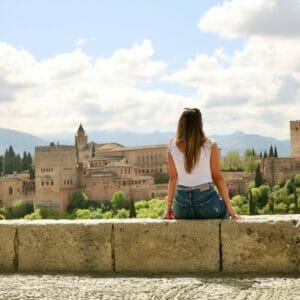
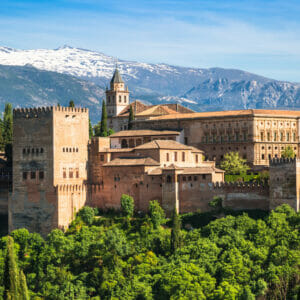
The Alhambra is both a palace and a castle, built more than 700 years on top of a hill in Granada.
Here we explain it in simple terms, so you can tell the children about it. And finally, what parents need to know about the tickets – there’s a bit of a trick to it.
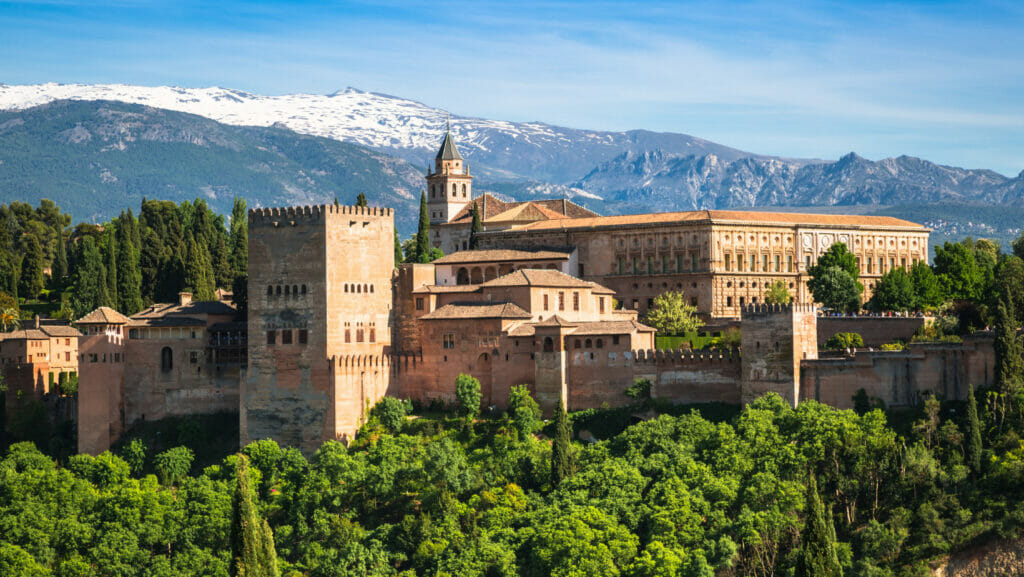
Imagine a tiny town surrounded by walls. Inside lived the king, his family and all the people who worked for him: cooks, soldiers, gardeners and craftsmen.
That is the Alhambra: palaces to live in, towers to keep watch from, walls to defend against attack, and gardens full of water.
And it consists of four main parts:
The Nasrid kings, who were the last Muslim kings of Spain. They began it in the 13th century.
It wasn’t done by just one person: each king added new rooms and gardens, so it took many, many years for it to become as we see it today. The two who carried out the most building work were:
That year The Catholic Monarchs, Isabella and Ferdinand, conquered Granada, and with that, they were almost finished 800 years of Muslim kingdoms on the Iberian Peninsula.
But here’s the interesting bit: They did not destroy the Alhambra. They thought it was so beautiful that they kept it and they stayed there to live. Years later, the emperor Charles V He had his own palace built inside, which is why two very different architectural styles now coexist within the same complex.
Because it means «the red one» in Arabic: al-Hamra.
And there are two explanations, both of which are lovely:
Just one thing I’d like to mention: Many people believe it is made of red stone, and that’s not the case. It is clay from the hill itself, pressed and mixed with lime.
Children find it much easier if they’re looking for specific things. These three are easy and there’s a prize to be won:
And for the journey, The Legends of the Alhambra y Eight interesting facts.
This section is for adults, and it is advisable to read it in full.
⚠️ And here’s the error that causes the most frustration: Children need a ticket, even if it’s free. You still have to take it out, and at the same time as the others. It’s not enough for parents to bring it in: everyone must bring their own.
Tickets sell out months in advance. It’s no exaggeration: during peak season, it’s common for there to be no places left for the following weeks.
The official channel is the Alhambra and Generalife Trust. It’s a good idea to check the daily rates there, as they are updated regularly.
If you see adverts for tickets with eye-catching discounts or «2 for 1» offers, be wary. The Board does not run that sort of promotion outside its own channels, and there are websites circulating that sell tickets which are then invalid for entry.
We are a local tour operator based in Málaga with over 50 years’ experience organising trips around Andalusia. The excursion includes admission tickets, which is the hardest thing to find, and avoids driving and parking:
The first option includes admission and a guided tour; the second is exploring the city at your own pace. Before you go, How to visit the Alhambra, and for the rest of the day, What to see in Granada.
It is like a tiny city surrounded by walls, built over 700 years ago on top of a hill in Granada. Inside lived the king, his family and all the people who worked for him. It consists of four parts: the Alcazaba, which was the soldiers’ quarter; the Nasrid Palaces, where the king lived; the Generalife, with its orchards and gardens; and the Palace of Charles V, built much later.
The Nasrid kings, the last Muslim kings of Spain, from the 13th century onwards. It was not built by a single person: each king added rooms and gardens over the course of many years. Those who undertook the most construction were Yusuf I, who built the Tower of Comares, and his son Muhammad V, who built the Courtyard of the Lions.
Because in Arabic, al-Hamra means «the red one». There are two explanations: the reddish colour of its walls, made from earth and lime compacted from the hill itself, which appear orange at sunset; and the nickname of the king who founded it, Muhammad ibn al-Ahmar, known as «the Red» because of the colour of his beard. It is worth clarifying that it is not built of red stone, as is often claimed.
Children under 12 get in free, those aged 12 to 15 pay a reduced rate, and from the age of 16 onwards, the adult rate applies. It is important to note that children need their own ticket, even if it is free, and that this must be obtained at the same time as the others: it is not enough for parents to simply bring their own.
Months in advance. Tickets often sell out, and during peak season it is common for there to be no places left for the following weeks. The official channel is the Alhambra and Generalife Tourist Board’s website, where you should also check the current prices, as these are updated regularly. Be wary of websites advertising large discounts or ‘two-for-one’ offers.
Each visitor must present their original national identity card or passport, as this is compulsory. It is also advisable to wear comfortable shoes, as the tour lasts several hours and involves slopes and steps, and to bring water during the hot months. Admission to the Nasrid Palaces is time-slotted and punctuality is essential: once the allocated time has passed, entry is not permitted.