El Torcal is the largest karst landscape in Europe, admission is free and the three signposted routes can be followed at your own pace.
But there’s one thing that determines the whole day: the time you arrive at the car park.
Parking at Torcal Alto is free, but there are only a limited number of spaces. And there’s nowhere else nearby:
This is the most common mistake here: to arrive at midday on a Sunday, find it full and not be able to park the car anywhere.
On weekdays and outside the peak season, this isn’t a problem.
| Concept | Fact |
|---|---|
| Entrance to the site | Free |
| The three signposted routes | Free and self-guided |
| Car park | Free, limited places |
| Visitor Centre | Open every day. Extended opening hours in summer |
| Guided tours | Pay-as-you-go and by booking |
Next to the car park is the Torcal Alto Visitor Centre, with a visitor centre, a shop, a restaurant with views and an astronomical observatory.
Opening hours vary depending on the season, so it’s a good idea to check the day before: in winter it closes quite a bit earlier than in summer.
Note regarding the reviews: almost all the display panels in the visitor centre are in Spanish only.

All three start from the same place: the Torcal Alto car park, next to the visitor centre. They are marked with wooden signposts in the colour of each route.
| Route | Distance | Weather | Who is it for? |
|---|---|---|---|
| Green | 1.5 km | 45 mins | First time, short stay, with children |
| Yellow | 3 km | 2 hours | The one I recommend |
| Red | Guided | Several hours | Subject to booking and payment |
And a note that appears in all the reviews: The distances seem short, but they aren’t. The ground is uneven rock, you move much more slowly than usual and have to watch your step constantly.
A circular route, with a vertical ascent of just 40 metres, and it is the one that presents the least difficulty.
The advantage is that it doesn’t compromise on quality: It passes through the area where the karst formations are at their most spectacular, including Dark Alley and Tobacco Alley, two passageways created by the collapse of fissures in the ground.
Here are the Sphinx, the Indian and the Watchman, three of the figures mentioned by name.
If you’re coming on a day trip from Málaga and want to see the rest of Antequera, this is the one for you.
3 kilometres and about 2 hours, moderate difficulty. It is an extension of the green area that incorporates the upper section.
And that’s the one I recommend for one specific reason: it’s the one that crosses the most shapes. They appear here The Finger, the Camel, the Robot, the Little Hat, the Chalice and the Die, plus whatever else you might want to add.
It is very well signposted and you don’t need a guide to follow it.
You can’t just do this on your own. It is a guided tour that requires advance booking, lasts several hours and includes informative stops.
It is not recommended for people with injuries or for young children. The difficulty is medium to low, but it’s a long one.
There is also a The Ammonites’ Route, a guided, shorter tour focusing on the fossils. Both can be booked by telephone or email with the centre.

It is the most famous rock formation in El Torcal and has its own protected status: it has been declared Natural Monument, not just protected as part of the landscape.
It is a block of limestone with layers stacked in a spiral pattern, like a stone screw several metres long. You can get there from the upper car park for a short stretch, without having to complete the whole route.

This is what’s most surprising: there are marine fossils lying on the ground.
Ammonites were molluscs with spiral shells which lived in these seas hundreds of millions of years ago, and whose shells were embedded in the rock. They’re visible to the naked eye in several areas, particularly on the climb up to Torcal Alto.
Obviously, you don’t pick them up. But finding them is the best bit of the walk for anyone travelling with children.

It is just a few metres from the car park and is open to the public at all times.
And it has the highest rating in the whole of Antequera: 4.8. From there, you can see the entire karst landscape and, on clear days, the coast.
If you don’t fancy a hike, this viewpoint alone is worth the climb. Sunset is the best time.

This was the seabed. Specifically, from the Tethys Sea, some 200 million years ago.
The three-step process:
That’s karst, and El Torcal is its finest example in Europe. The formations — screws, mushrooms, alleys — are the result of this dissolution.


El Torcal is over 1,200 metres high, and that changes everything when it comes to the valley:
The best times of year: spring and autumn. The temperature is just right for a walk, and in spring there are orchids too.
In the summer, first thing in the morning. As well as the heat, there’s the issue of parking.
Next to the visitor centre there is an astronomical observatory, and capitalises on something that is indeed true here: This is one of the clearest skies in Andalusia, because of the altitude and the distance from the lights on the coast.
Guided night-time tours are organised which combine walking amongst the rock formations with stargazing. Booking is required.
It’s a different sort of scheme, and not many people know it exists.
It is 16 kilometres from Antequera along the access road to Torcal Alto, which leads up to the car park.
From Málaga, about 60 kilometres: Take the A-45 towards Córdoba as far as Antequera, and from there take the turn-off to the site. About an hour in total.
And here’s the important bit: there’s no public transport to El Torcal. You’ll need a car, a taxi from Antequera or an organised tour. The shuttle bus only runs between the lower car park and the upper car park when the upper car park is full.
The access road is narrow and winding, but it is tarmacked and in good condition.
El Torcal only takes half a day, and the rest is 16 kilometres away:
The system that works: Dolmens first thing in the morning, the town centre mid-morning and Torcal in the afternoon. Full details at What to see in Antequera.
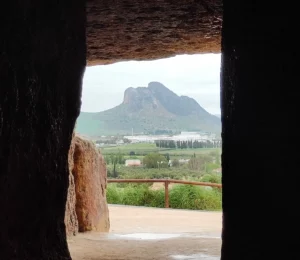
And one connection that explains the site as a whole: El Torcal forms part of the World Heritage Site alongside the dolmens and the Peña de los Enamorados, because the Menga dolmen faces the Peña and the site is understood as a single entity.
We are a local tour operator based in Málaga with over 50 years’ experience organising trips around Andalusia.
El Torcal has a real logistical problem if you don’t have a car: There is no public transport, the access road does not allow parking, and the car park fills up. An organised trip solves all three problems.
Meanwhile: the Caminito del Rey It’s half an hour’s drive from El Torcal and can easily be combined with a visit there over two days, and the most beautiful villages in Malaga to continue through the province.
Nothing: entry to the site is free, as are the car park and the three signposted trails, which you can follow at your own pace. The only charges apply to guided tours, such as the red trail or the ammonite trail, which also require advance booking.
At weekends and on public holidays, before 9.30 am, as the Torcal Alto car park is free but has limited capacity. You cannot park on the access road, so if the car park is full, you’ll need to drive down to the lower car park and take the shuttle bus up. On weekdays and outside the high season, there’s usually no problem.
The yellow route, three kilometres long and taking about two hours, is the one that passes the most named rock formations: El Dedo, El Camello, El Robot, El Sombrerillo and El Cáliz. The green route is the alternative if you’re short on time or travelling with children: just one and a half kilometres long, with a forty-minute climb, it also takes in the most spectacular rock formations.
Around forty-five minutes, covering a circular route of one and a half kilometres with a 40-metre elevation gain. It’s worth noting that the terrain consists of uneven rock and you’ll make slower progress than the distance might suggest, so if you stop to take photos, the walk could take considerably longer.
Yes, there are ammonites visible to the naked eye in various areas, particularly on the climb up to Torcal Alto. They were marine molluscs with spiral shells, the remains of which were preserved within the limestone when this whole area was the seabed of the Tethys Sea. There is also a guided tour dedicated specifically to them.
The best-known feature of the area: a block of limestone whose layers are stacked in a spiral, like a stone screw. It has been designated a Natural Monument, with its own protected status in addition to that of the area as a whole, and can be reached from the upper car park via a short walk, without the need to complete a full route.
It’s about sixty kilometres and takes around an hour: take the A-45 towards Córdoba as far as Antequera, and from there take the turn-off onto the access road to Torcal Alto, which is a further sixteen kilometres. There is no public transport to the site, so you’ll need a car, a taxi from Antequera or an organised excursion.
Yes, and this is the most common surprise: the area is over 1,200 metres above sea level, it’s windy at higher altitudes, and there’s often fog, even in summer. It’s a good idea to take a jacket with you, even if it’s hot in Antequera. It snows in winter, in which case it’s best to check the condition of the access road beforehand.
Yes, take the green trail, which is short and has very little elevation gain, and look for ammonites along the way – that usually works very well. Closed-toe shoes with a sturdy sole are essential, as the ground is uneven rock. Long guided walks, on the other hand, are not recommended for young children.