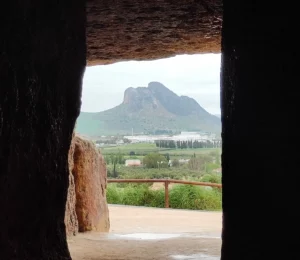
At the Alhambra Water isn’t just decoration: it’s the thread that holds everything together. It flows from the River Darro via the Acequia Real, winds its way around Cerro del Sol and spreads out across the whole site by the force of gravity alone.
Here are the five fountains that are well worth a stop, and what to look out for at each one.
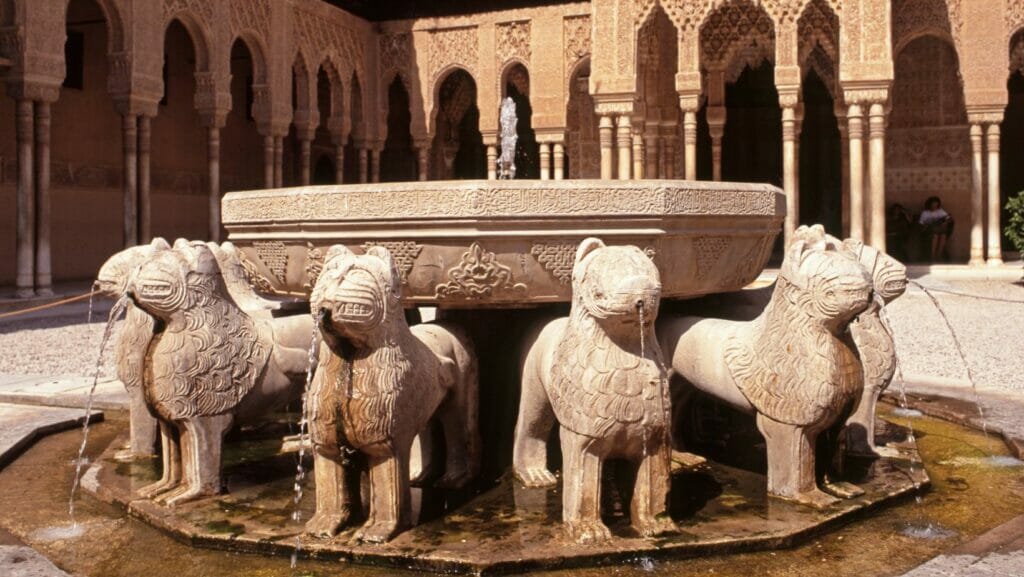
The most famous part of the monument, in the centre of the Palacio de los Leones, which Muhammad V commissioned to be built around 1380.
Data that doesn’t usually work out well:
On the rim of the cup are twelve verses by Ibn Zamrak, a poet and vizier at the court of Muhammad V, in honour of the sultan.
And there’s a catch: those twelve lines were part of a casida of 146 which begins in the Sala de Dos Hermanas. The poem winds its way through the palace and ends at the fountain.
One of the verses plays on the themes of water and marble: it describes water spilling out and disappearing down the drains as «a lover whose eyelids are brimming with tears».
The fountain you can see isn’t exactly the medieval one. During For three and a half centuries, it had a different cup, with balusters and a Romantic-style fountain added around 1837.
The first documented restoration took place in 1624, coinciding with a visit by Philip IV. The last one, which was far more ambitious, lasted from 2002 to 2012 and restored the building to its present appearance.
Find out more about the courtyard at Interesting facts about the Patio de los Leones.
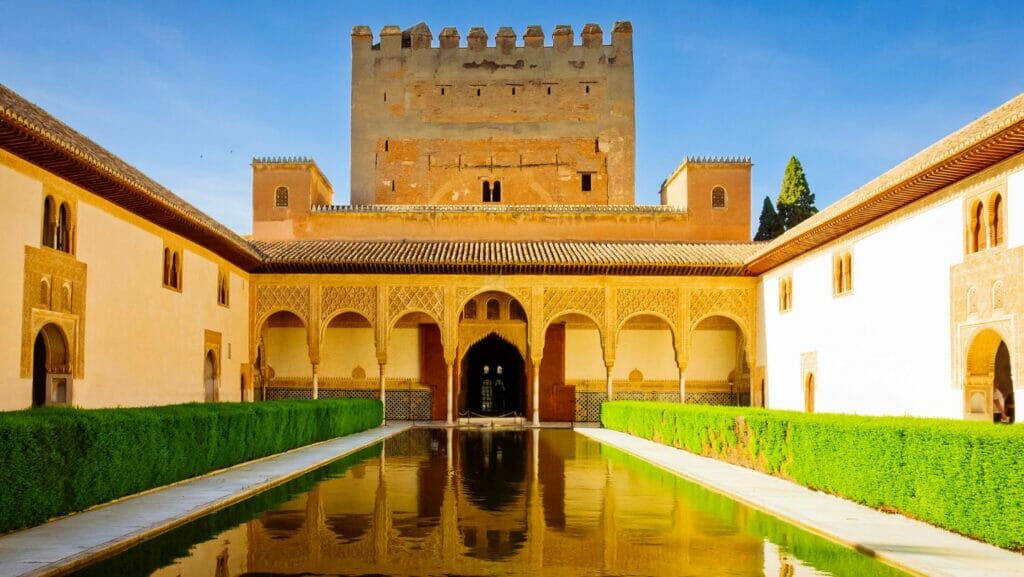
Here, the water behaves in the opposite way to that at Los Leones: it stays still.
In the Myrtle Courtyard, also known as ‘de la Alberca’, there is a large rectangular pond flanked by myrtle hedges. At either end, two very low jets which barely make a ripple on the surface.
And that’s no coincidence. Water acts as mirror: it mirrors the façade of the Comares Tower and replicates its architecture, extending the courtyard.
The detail that explains it all: This courtyard was the antechamber to the Ambassadors’ Hall, the throne room. Anyone who came to see the sultan I crossed this stretch of water first. The staging was carefully planned.
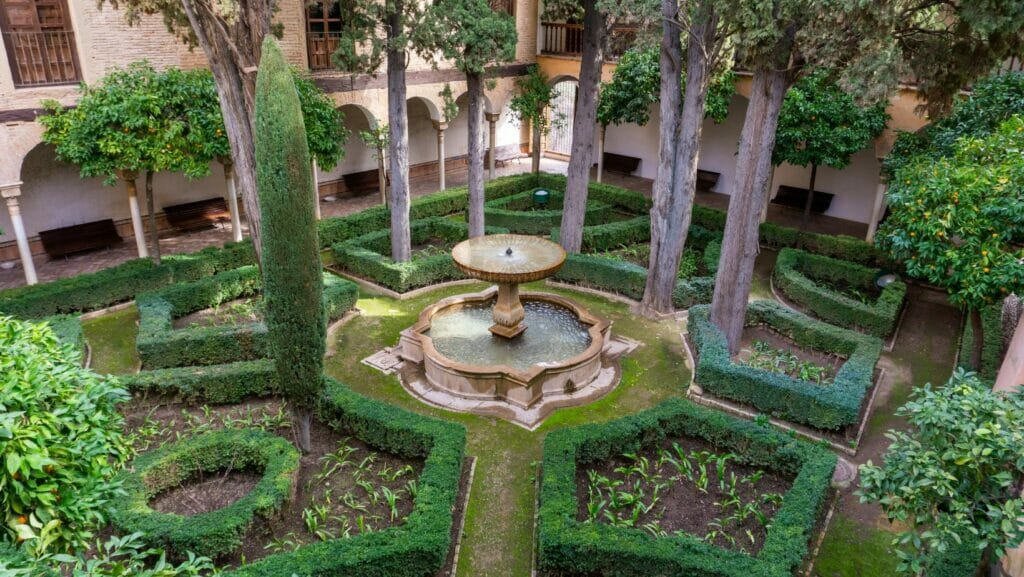
This one has an interesting story behind it: the cup is from the Nasrid period, but it wasn’t always here.
It was carved in the 14th century, in white marble, and He took up residence in the Lindaraja garden in 1626, when that corner was transformed into a Renaissance garden. It is next to the The Queen’s Hairdresser, surrounded by the rooms commissioned by Charles V.
It also includes a poem by Ibn Zamrak, in relief along the edge: twenty lines in this case, self-descriptive, which refer to the fountain itself and praise the Nasrid dynasty.
A little something for the curious: to the text three lines are missing in the central section. They were lost, and with them part of the eulogy to the sultan.
⚠️ Before you start looking for it: you can’t always see it. The Visits to Baños de Comares are restricted and they are not usually open to the public. It is worth checking whether they are open on the day of your visit.
And it’s worth asking, because it is the only medieval Islamic hammam to have survived almost intact to the present day. Hence the restriction.
They were the Sultan’s and his family’s private bathrooms, with fountains both in the halls and in the courtyards. Here, the water was not merely decorative: regulated the temperature and humidity, and observed a social ritual inherited from the Roman tradition.
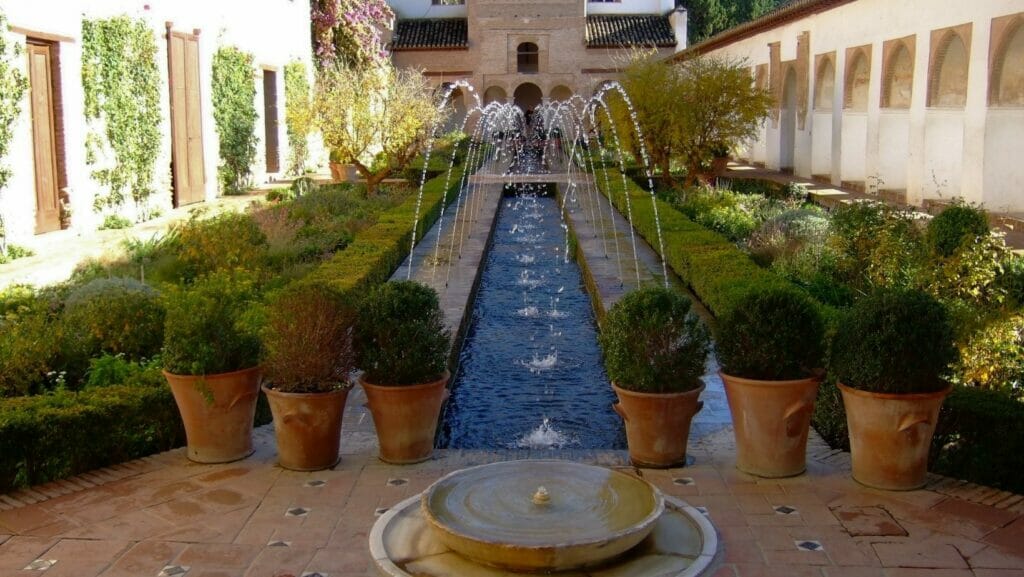
The most photographed view of the Generalife, and with good reason: a canal runs through the courtyard from one end to the other and two rows of jets cross paths above forming an arc of water.
But it’s worth bearing in mind that: those criss-crossing jets they are not Nasrids, but a later addition. The original design was much more understated.
What is original, however, is the irrigation channel, and that’s the important thing: it’s the Acequia Real, the same one that brings water from the River Darro and supplies the entire complex. The Generalife was the kings’ orchard and summer retreat, and is situated in the system header.
If you look closely, the Alhambra uses water in two contrasting ways:
And it all works without a single pump. It’s simply the elevation gain from the mountain range that’s what really impresses about the range.
We are a local tour operator based in Málaga with over 50 years’ experience organising trips around Andalusia. Tickets include admission to the Nasrid Palaces and the Generalife, which is where four of the five are:
Before you go, How to visit the Alhambra. More about the monument at Eight interesting facts, its legends, the phrases it inspired y his children’s story.
And for the rest of the journey, What to see in Granada.
The Fountain of the Lions, in the centre of the Palace of the Lions. Its dodecagonal basin rests on twelve white marble lions from Macael, each carved with distinctive features, probably by different artists. It dates from around 1380, during the reign of Muhammad V.
Twelve verses by Ibn Zamrak, poet and vizier at the court of Muhammad V, carved around the rim of the cup in honour of the sultan. They formed part of a much longer qasida, comprising 146 verses, which begins in the Hall of the Two Sisters, so that the poem winds its way through the palace and culminates at the fountain. The Lindaraja Fountain bears another poem by the same author, this one consisting of twenty verses.
Access is restricted and they are not usually open to the public, so it is advisable to check before visiting. The reason for this restriction is their exceptional value: they are the only medieval Islamic hammam to have survived virtually intact to the present day.
From the River Darro, via the Acequia Real, a watercourse that runs along the Cerro del Sol until it reaches the site. The system operates solely by gravity, making use of the gradient from the mountains, without the need for pumps or other driving mechanisms.
No. The two rows of fountains whose jets cross over the Patio de la Acequia channel are a later addition to the Nasrid design, which was considerably more austere. What is original, however, is the irrigation channel itself, which forms part of the Acequia Real that supplies the entire monumental complex.
Because it is designed to act as a mirror. Its fountains are deliberately low so as not to disturb the surface of the water, which reflects the façade of the Comares Tower and visually duplicates the architecture. The courtyard served as an antechamber to the Hall of Ambassadors, the throne room, so that anyone coming before the sultan would first pass through that reflection.